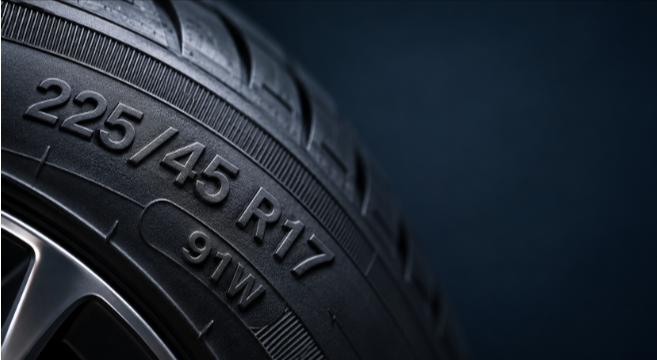
Look at the side of any tire and you'll see a string like P205/65R15 80H. It looks random, but every character tells you something about the tire's size, type and limits. Once you can read it, you can match tires to your wheels, replace them with confidence and avoid buying the wrong size.
Here is the example we'll use throughout: P205/65R15 80H.
At a Glance
Tire Type: P, LT or ST
The letters at the start show what the tire was designed for.
P means P-metric, a tire built for passenger vehicles such as cars, minivans and smaller SUVs.
LT means light truck. These tires are built for heavier loads, towing and hauling, and are common on pickups and larger SUVs. If you're setting up a truck, you can browse the HD Off-Road wheel collection.
ST means special trailer. These tires are made for trailers only and shouldn't go on a passenger vehicle. Trailer owners can look at HPD's Hercules trailer tires and standard radial trailer tires.
If there are no letters at the start, the tire is usually a Euro-metric size. It's read the same way, but its load rating is worked out slightly differently, so check the load index when you compare it with a P-metric tire.
Width: The First Three-Digit Number
The first three-digit number is the tire's width in millimetres, measured from one sidewall to the other. In P205/65R15, the tire is 205 mm wide. A bigger number means a wider tire and a larger contact patch on the road.
Tire width also needs to suit your wheel. Each tire is designed to work within a range of wheel widths, so a very wide tire on a narrow wheel, or the reverse, won't sit properly. To see how a wheel looks on your vehicle before you buy, try HPD's vehicle visualizer.
Aspect Ratio: The Number After the Slash
The two-digit number after the slash is the aspect ratio. It compares the height of the sidewall with the width of the tire. A 65 means the sidewall is 65% as tall as the tire is wide. For a 205 mm tire, that works out to about 133 mm.
A lower number means a shorter sidewall. Low-profile tires look sportier and respond sharply, while a taller sidewall gives more cushioning and more protection for the wheel on rough roads.
Construction: The Letter Before the Wheel Size
The letter between the aspect ratio and the wheel diameter describes how the tire is built. An R means radial, which is the standard construction for almost every tire sold today. You may occasionally see a D, which stands for diagonal (bias-ply), but this is uncommon on modern road vehicles.
Wheel Diameter: The Number That Matches Your Wheel
The number after the construction letter is the diameter of the wheel the tire is made to fit, in inches. In P205/65R15, that's a 15-inch wheel.
This is the number that connects your tires to your wheels. A tire marked R15 fits a 15-inch wheel and nothing else. If you're upgrading to larger wheels, you'll need tires with a matching new diameter, and often a different aspect ratio to keep the overall tire height close to the original. New wheels often call for the right lug hardware too, and HPD offers PerfectlyTight install hardware for that.
This is also a common point of confusion. The 15 is the wheel diameter, not the tire's width. The width is the 205.
Golf carts use much smaller wheels. HPD's HD Golf wheels come in 10, 12 and 14-inch diameters, and the same rule applies: the tire has to match the wheel diameter. HPD also lists DURO golf cart tires and RPG golf cart tires.
Load Index: How Much Weight the Tire Can Carry
The number after the wheel diameter, 80 in our example, is the load index. It's a code, not a weight, so you look it up on a chart. Here are a few reference points for the carrying capacity of a single tire:
Always choose a load index that is at least as high as your vehicle requires. This matters most on trucks, trailers and anything that tows or hauls. For trailers, the HD Trailer wheels and tires page is a good place to start.
Speed Rating: The Final Letter
The last letter is the speed rating, which is the highest speed the tire is rated to handle under test conditions. It is not a recommendation to drive that fast. Some common ratings:
Match or exceed the speed rating your vehicle manufacturer specifies. It also tends to go hand in hand with handling, since higher-rated tires are usually built to respond more precisely.
Putting It All Together
Reading P205/65R15 80H from left to right:
P is a passenger tire.
205 is 205 mm wide.
65 is a sidewall height of 65% of the width.
R is radial construction.
15 fits a 15-inch wheel.
80 can carry 992 lb per tire.
H is rated up to 130 mph.
One More Code: The Tire's Age
Look for a code that starts with DOT on the sidewall. The last four digits show when the tire was made: the first two are the week and the last two are the year. A code ending in 2425 means the tire was made in week 24 of 2025. Tires age even when they aren't used, so it's worth checking the date, especially if you're buying from stock that has been sitting for a while.
Where to Find the Right Size for Your Vehicle
You don't need to guess. The recommended tire size, and often the recommended pressure, is usually printed on a placard inside the driver's door jamb and in the owner's manual. Use that as your starting point, and compare it with the code on your current tires.
Still not sure? The HPD Wheels team in Plant City, Florida can help you match wheels and tires. Reach them through the HPD contact page, call 850-306-6179, or email [email protected]. HPD also offers a 3-year finish warranty and a lifetime limited structural warranty. The warranty and care page has the full terms.
FAQ
What do the numbers on a tire mean?
They show the tire's type, width in millimetres, aspect ratio, construction, wheel diameter in inches, load index and speed rating.
What does P205/65R15 mean?
It's a passenger tire that is 205 mm wide, with a sidewall 65% as tall as the width, built with radial construction, for a 15-inch wheel.
What is the difference between P and LT tires?
P tires are made for passenger vehicles. LT tires are made for light trucks and heavier loads, and often suit towing and hauling better.
What does the last letter on a tire mean?
It's the speed rating, which shows the maximum speed the tire is rated for under test conditions.
How do I know what tire size my vehicle needs?
Check the placard on the driver's door jamb or your owner's manual, and compare it with the size printed on your current tires.
How do I find out how old my tires are?
Look for the DOT code on the sidewall. The last four digits show the week and year of manufacture.
Can I put a different size tire on my wheel?
Only if the wheel diameter matches and the tire width suits the wheel. Changing the size can also affect clearance and speedometer accuracy, so ask the HPD team if you're unsure.