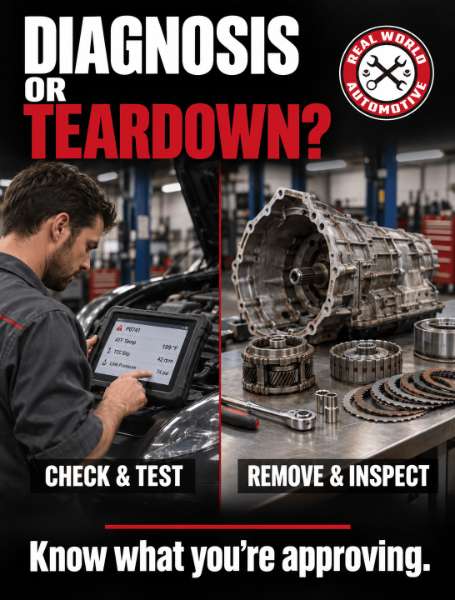
You book your car in because it hesitates before moving into Drive. Then the shop calls: further inspection may mean removing the transmission.
Before you agree, ask what that next step involves.
Transmission diagnosis and a teardown are related, but they involve different work. Understanding the difference helps you discuss the findings, costs, and repair options without guessing what you have authorized.
What does an initial transmission diagnosis involve?
Diagnosis is the process of finding the cause of a problem. The first checks can often happen with the transmission installed.
Depending on the vehicle and symptoms, a technician may:
Ask when the problem occurs and review previous repairs.
Check fault codes and relevant scan-tool data.
Inspect fluid level, fluid condition, and visible leaks.
Check wiring, connections, and external controls.
Road-test the vehicle, when safe.
Perform additional tests specified for that transmission.
These checks help establish whether the concern involves an electrical, hydraulic, or mechanical fault. They do not all apply to every vehicle.
For example, General Motors’ bulletin 21-NA-169 sets out preliminary checks for certain low-mileage automatic transmissions. It includes code retrieval, fluid inspection, pressure testing, and road testing. That bulletin has specific vehicle and mileage limits; it is not a universal testing procedure.
The useful question is: “What have the checks confirmed, and what remains uncertain?”
What is a transmission teardown?
A teardown involves disassembling the transmission to inspect its internal components. It may require removing the unit from the vehicle first. The Michigan Department of State’s consumer guide to automatic transmission service describes this distinction between initial inspection and teardown.
That gives the technician access to parts that cannot be fully assessed from outside. The inspection can help establish the extent of internal damage and what parts would be needed.
A teardown is investigative work. Ask whether the proposed authorization covers inspection only, or also includes repair.
Also clarify the scope. Removing a transmission pan for inspection is different from removing and fully disassembling the entire unit. “We need to open it up” is worth a follow-up question.
What findings could justify looking inside?
A slipping transmission does not, by itself, identify which part has failed.
Initial testing may reveal a fluid-level problem, an electrical fault, or evidence that warrants internal inspection. The next step should follow the findings.
In the GM bulletin mentioned above, large metal particles or gritty debris are reasons to investigate internal damage. The same document calls for checking electronic operation so an electrical condition is not misdiagnosed.
Those examples show why the explanation matters. Ask the technician to connect the recommendation to your vehicle’s results.
Useful questions include:
“What did you find that points to internal damage?”
“Can you explain the test results or show me the findings?”
“What will a teardown tell us that the earlier checks could not?”
You do not need to interpret pressure readings yourself. You need a clear explanation of why further work is recommended.
Ask about the cost of stopping after inspection
Before approving a transmission teardown inspection, discuss what happens if you decide against the repair.
Ask for written answers to these questions:
What is the charge for removal, disassembly, and inspection?
Would reassembly and reinstallation cost extra?
Could the transmission’s condition prevent reassembly?
Are diagnostic or teardown charges credited toward the repair?
What would I owe if I collect the vehicle without repairs?
Do not assume the answers. Shops’ fees and arrangements differ.
If another business might complete the repair, discuss transport before disassembly. Ask how the vehicle and removed components would be prepared for collection.
Keep the repair decision separate and clear
An inspection finding and a repair estimate answer different questions.
The finding explains what is wrong. The estimate explains the proposed work and its cost.
The Federal Trade Commission’s Auto Repair Basics guide recommends getting a written estimate identifying the problem, required parts, and anticipated labor. It also recommends agreeing on when the shop must contact you before exceeding an agreed amount.
If the estimate changes after inspection, ask what new damage was found. Then review the revised scope before approving additional work.
For a rebuild or replacement, confirm the installed total and written warranty terms. Review Real World Automotive’s warranty information and ask which terms apply to your proposed repair. Ask which charges remain conditional rather than treating an early estimate as a fixed final price.
Discuss your transmission concern with Real World Automotive
Real World Automotive provides auto repair and diagnostic services in Raleigh, including transmission rebuilds and replacements.
If your car is hesitating, shifting harshly, or slipping, contact the team. Describe the symptoms and ask what the initial diagnostic appointment includes.
If testing confirms internal damage, discuss the appropriate transmission rebuild or replacement options in Raleigh.
Call Real World Automotive at (919) 322-0170 to arrange an appointment. The shop is at 1031 Corporation Parkway, Raleigh, NC 27610.