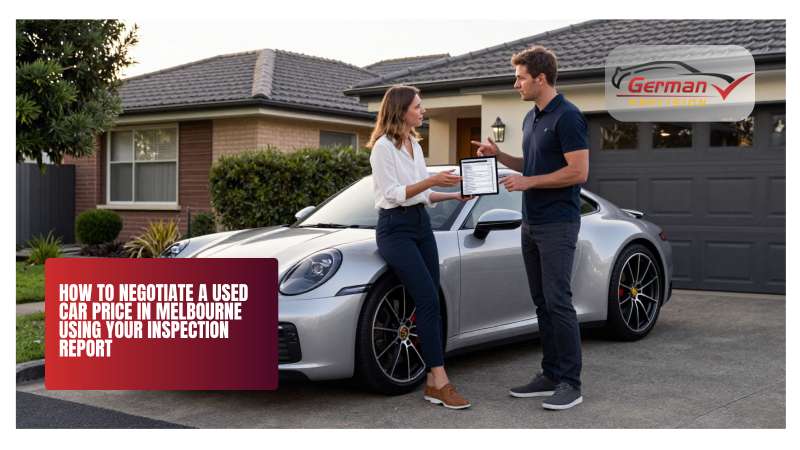
If you have ever tried to negotiate a used car price in Melbourne on nothing but a gut feeling, you know how it usually goes. The seller holds the confidence. You hold a hunch. Hunches do not move dealers or private sellers off their asking price.
A pre-purchase inspection report changes that balance. It replaces "I think this car is worth less" with "here is exactly why, on page 14, with a photo." That is the difference between asking for a discount and getting one.
Why the Report Carries Weight
Most buyers walk in with opinions: it feels a bit rough, the paint looks off, these ones have gearbox issues. None of that holds up, because none of it is proof.
A proper inspection report is different. It documents the car's condition, engine to exhaust, with photos and findings a seller cannot easily dismiss. A German Precision report often runs past 30 pages, covering everything from panel gaps to fluid leaks to prior accident repairs.
That detail matters for three reasons. It is specific: "the rear brake pads are at roughly 20 percent" is a line a seller has to answer. It is independent, written by a third party with no stake in the sale. And it gives you a number. Once an issue is documented, you can attach a repair cost to it, and that cost becomes your opening figure.
Step 1: List Every Finding and Its Cost
Before you say a word, go through the report properly. Group findings into two categories. Safety items affect whether the car is roadworthy now: worn brakes, a failing suspension component, tyres below legal tread. Monitor items are not urgent but will need attention later: a slow oil weep, early wheel arch rust, an ageing battery.
Attach a rough cost to each one. "New brake pads and rotors, front and rear, typically run $600 to $900 in Melbourne" is far stronger than "the brakes seem worn."
Which Items to Lead With
Lead with safety items and anything that will cost real money within six to twelve months. These are the ones a seller cannot dismiss, and the ones you can price exactly.
Save cosmetic or long-term items for later, and mention them lightly. Making a big deal of a $40 wiper blade signals you are hunting for faults, not negotiating in good faith, and that undermines the points that actually matter.
Step 2: Check Current Melbourne Rates
Your estimate needs to hold up when the seller pushes back. Labour costs vary by workshop type, and this matters most with European makes like BMW, Audi, and Mercedes-Benz, which need specific tools and parts. A quick call to a workshop that services that make and model gives you a stronger number than a generic online estimate.
Step 3: Stick to Facts, Not Opinions
Say "the independent report shows these findings, and Melbourne repair rates put the cost at roughly this much." Not "this car is a mess." One sentence starts a discussion. The other starts an argument.
Stay calm and factual throughout. Most sellers genuinely did not know about hidden issues an inspection uncovers. Bring the report on your phone or printed, and show the page when you raise a finding.
What to say to a dealer:
"I had this car independently inspected, and a few items came up. The brakes are at around 20 percent, which is roughly $700 to replace properly. There is also a slow coolant weep, and the report notes prior repair work on the front left guard that was not disclosed. I would like a price adjustment for the brake work, or to have it fixed before settlement."
What to say to a private seller:
"Overall the car presented well, but a couple of things came up. The rear tyres are close to the legal limit, which is $400 to $500 for a pair, and there is a minor oil leak worth watching. I am still keen to buy, but I would like to come in at [your figure] to account for the tyres."
Step 4: Set Your Walk-Away Number First
Take the asking price, subtract the safety and near-term repair total, and that is your fair adjusted price. Decide beforehand how far below that you will go before you walk. Knowing this number stops a seller from reading hesitation on your face.
Step 5: Proceed, Negotiate, or Walk Away
A clean report with only minor items means little to negotiate on condition. Genuine but defensible issues are what this process is built for. But undisclosed accident damage, odometer tampering, or a PPSR flag showing the car is still financed are trust issues, not negotiating points, and usually mean it is time to look at the next car.
Book the Inspection First
None of this works without a thorough inspection to start with. German Precision has inspected used cars across Melbourne for over 35 years, with particular depth in European and luxury makes. Every inspection is done personally, with photo reports typically running 30 pages or more, plus a follow-up call to walk you through the findings.
Book your pre-purchase inspection before you commit to a price. It is far cheaper than finding out what you missed after the sale.