Let’s start with Börek!
Börek's origins are, arguably, sketchy. Only a few records from before the mid-12th century have survived; the scattered remains that have passed down to us provide slight indications of where and when it initially formed. There are several ideas. One of the most common is descended from the Byzantine plakous - a flat cake developed from the Roman placenta. It consists of two sheets of dough packed with honey and cheese or chopped almonds.
Börek began to alter once it was no longer restricted to the steppe. Though yufka retained its specific component, fillings were modified to suit the preferences of new consumers and reflect product availability. Anchovies, for example, were famous in Trabzon on the Black Sea. In contrast, foxtail lily leaves were popular in Erzurum, high in the highlands.
Now you understand what Börekor boregi came from and how the snack managed to vary. It has journeyed worldwide to fulfil everyone's taste buds. But, what about Kol Boregi?
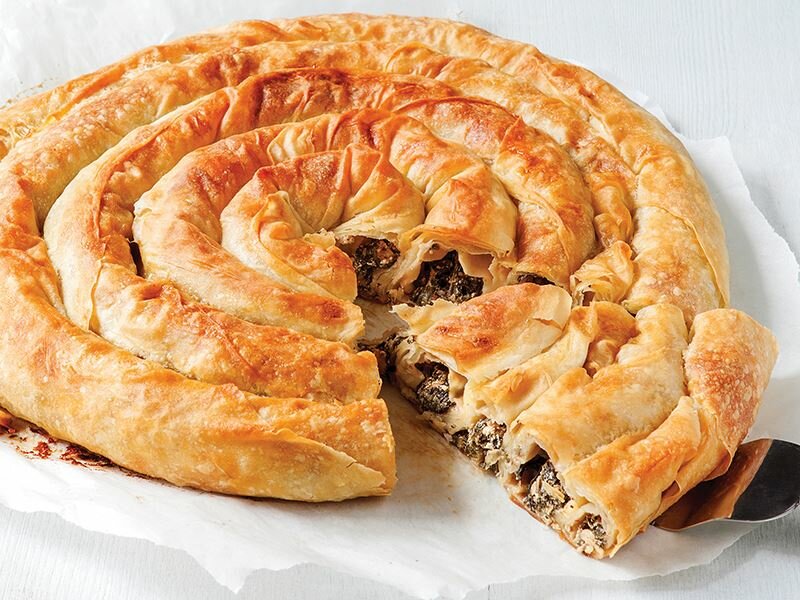
In common language, the Turkish word kol means 'arm,' and the Turkish name for this Börek or boregi is likely derived from the fact that each pastry roll is curved to resemble an arm to embrace you. It would be more accurate to refer to this as a spiral or a labyrinth since it appears when all of the arms are joined together. But wait, let me take you back to how kol and boregi can perform a relationship!
Now, onto Kol Börek or Boregi...
In common language, the Turkish word kol means 'arm,' and the Turkish name for this Börek or boregi is likely derived from the fact that each pastry roll is curved to resemble an arm to embrace you. It would be more accurate to refer to this as a spiral or a labyrinth since it appears when all of the arms are joined together. But wait, let me take you back to how kol and boregi can perform a relationship!
Once upon a time, the native sea bream 'çipura,' cooked to perfection and avidly consumed at a seaside restaurant overlooking the turquoise ocean. At the family-run Bella Moon restaurant in Bellapais, spicy chicken shish kebabs 'Tavuk iş' are grilled over leaping flames. Goat Kleftiko, a lengthy braised meal baked in a traditional island oven high up in the Kyrenia Mountain ranges at a modest restaurant.
Börek, painstakingly baked by hand, at one of the numerous local cafés scattered along the busy main seaside route.
Börek comes in a variety of shapes and sizes. Still, it is usually a stacking of filo or yufka bread with a filling of cheese, spinach, minced beef, or a mix of the three. It may be fried or baked, and it is always tasty. The massive platters of Kol Börek, also known as 'Arm Börek,' are our personal favourite, called from the lengthy 'arms' of pastry spiralling around the centre.