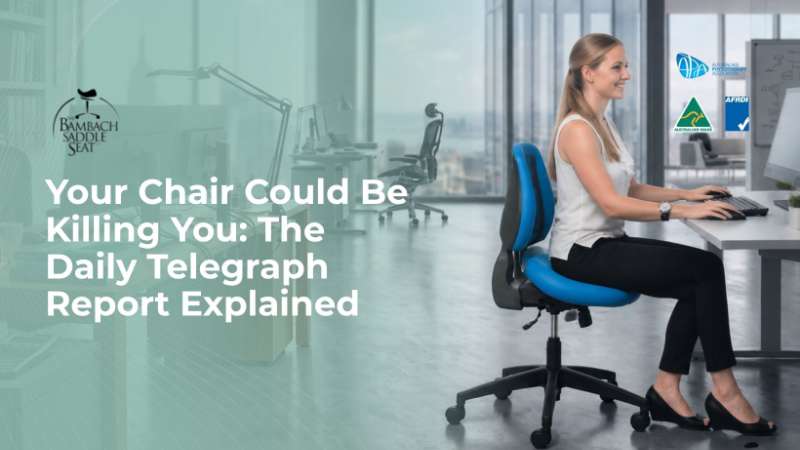
In a national health feature titled “Your chair could be killing you”, The Daily Telegraph highlighted a silent epidemic affecting millions of workers across Australia. The investigative report revealed that traditional office seating is not merely uncomfortable. Instead, prolonged sitting directly contributes to preventable chronic illness and long-term spinal degeneration.
At Bambach, we believe that understanding these clinical risks is the first step toward reclaiming your health. Here is what the research tells us and how dynamic seating provides a clear solution.
The Daily Telegraph Warning: A 24% Spike in Preventable Disease Risk
The investigative report from The Daily Telegraph cited alarming clinical findings regarding workplace sitting habits. Specifically, research links prolonged sitting to a 24 per cent increase in the likelihood of succumbing to preventable diseases, including heart disease and certain forms of cancer.
Furthermore, data from the Baker IDI Heart and Diabetes Institute revealed a concerning paradox in public health:
- High Concern, Low Action: Australians report being more worried about dying from preventable lifestyle diseases than from accidental injuries. However, very few take proactive steps to change their daily habits.
- Extreme Daily Sitting Hours: Australian adults sit for an average of up to nine hours every day.
- Lack of Prevention: Despite clear medical warnings, only one in five Australians prioritise reducing their daily chair time to protect their health.
Consequently, millions of office workers, healthcare professionals, and studio artists remain locked in static, unsupportive seating for most of their waking hours.
According to workplace health surveys conducted by the Baker Heart and Diabetes Institute and reported in The Daily Telegraph, prolonged sitting creates a 24% increase in the risk of preventable chronic diseases, with Australian adults averaging up to nine hours of chair time daily.
Why Conventional Chairs Accelerate Physical Breakdown
Standard office chairs force your hips into a closed 90-degree stance. As a result, your pelvis tilts backward, flattening the natural “S” curve of your lower back into a slumped “C” shape.
When you sit in a collapsed position for up to nine hours daily, several physiological breakdowns occur:
- Intra-Discal Spinal Pressure: Slumping on a flat seat increases pressure on your lumbar discs by up to 180%, accelerating disc wear and spinal degeneration.
- Metabolic Slowdown: Inactive leg and core muscles slow down enzyme production, impairing your body’s ability to regulate blood glucose and break down blood fats.
- Abdominal Compression: Slumping collapses your chest cavity, restricting deep diaphragmatic breathing and reducing blood oxygen levels during the workday.
Daily Telegraph Sitting Risk Breakdown
Sitting Health Metric | Daily Telegraph & Baker IDI Findings | Mechanical Impact on Body | Bambach Active Seating Solution |
Daily Chair Time | Up to 9 Hours Daily Average sitting time for Australian adults. | Creates static muscle fatigue and continuous lumbar pressure. | 135° Open Hip Stance Restores natural “S” spinal curve without static strain. |
Chronic Disease Risk | 24% Risk Increase Higher incidence of heart disease & cancer. | Inactive leg muscles impair metabolic fat and sugar processing. | Active Muscle Engagement Keeps core and leg stabilizers active throughout the workday. |
Public Action Gap | Only 1 in 5 Prioritise Change Most Australians ignore sitting hazards. | Unchecked spinal slumping causes chronic back and neck pain. | Evidence-Based Ergonomics OT-designed, AFRDI Level 6 certified pelvic support. |
How Bambach Converts Passive Sitting into Active Health
You cannot always eliminate desk work, but you can change how your chair supports your body. Engineered in Sydney by Occupational Therapist Mary Gale, the Bambach Saddle Seat eliminates the postural collapse inherent in standard office chairs.
135-Degree Open Pelvic Angle
By opening your hip stance to 135 degrees, the Bambach naturally tilts your pelvis forward. This restores your spine’s natural, upright “S” curve, taking structural pressure off your lumbar discs.
Open Torso & Unrestricted Respiration
An upright posture opens your chest and abdominal cavities. Consequently, your diaphragm moves freely, boosting blood oxygenation and keeping you alert without slumping.
Australian Made & AFRDI Level 6 Certified
Built to withstand severe commercial use, Bambach chairs are independently tested to Australia’s highest structural standard. Therefore, you receive reliable, long-term spinal support backed by Australian clinical expertise.
Reclaim Your Health and Spine Today
Do not let standard office seating compromise your physical health. Take control of your daily workplace posture with a scientifically proven seating intervention.
Explore our complete range of Ergonomic Saddle Chairs or read our Australian Clinical Case Studies to discover how dynamic seating transforms daily endurance.
Ready to eliminate sitting hazards in your workplace? Contact us today for a personalised trial or visit our Sydney showroom.
Frequently Asked Questions
What did The Daily Telegraph report reveal about sitting risks in Australia?
The report highlighted that prolonged sitting is linked to a 24% increase in preventable diseases like heart disease and cancer. It also revealed that Australian adults sit for up to nine hours daily, yet only 20% prioritise cutting down chair time.
How does prolonged sitting affect heart health and metabolism?
Sitting passively deactivates major leg and core muscles. This slows down metabolic enzyme activity, making it harder for your body to regulate blood sugar and process blood fats effectively.
Why do standard office chairs cause back pain during long workdays?
Standard chairs force your hips into a 90-degree angle, causing your pelvis to tilt backward. This slumps your spine into a weak "C" curve, multiplying pressure on your lower lumbar discs and tiring your back muscles.
How does an open 135-degree hip angle protect your spine?
An open 135-degree hip angle rotates your pelvis forward into a neutral position. This naturally restores your spine's upright "S" curve, taking structural load off lumbar discs without requiring a restrictive backrest.
What is the difference between passive and active sitting?
Passive sitting on flat chairs causes your core muscles to turn off, leading to slumping and fatigue. Active sitting on a Bambach saddle seat lightly engages your core and leg muscles, promoting healthy circulation and balanced spinal support.
How can I start reducing sitting hazards at work?
Switch to an open-hip saddle seat to maintain natural pelvic balance. Additionally, take brief one-to-two-minute movement breaks every 30 minutes to keep your metabolic enzymes active.