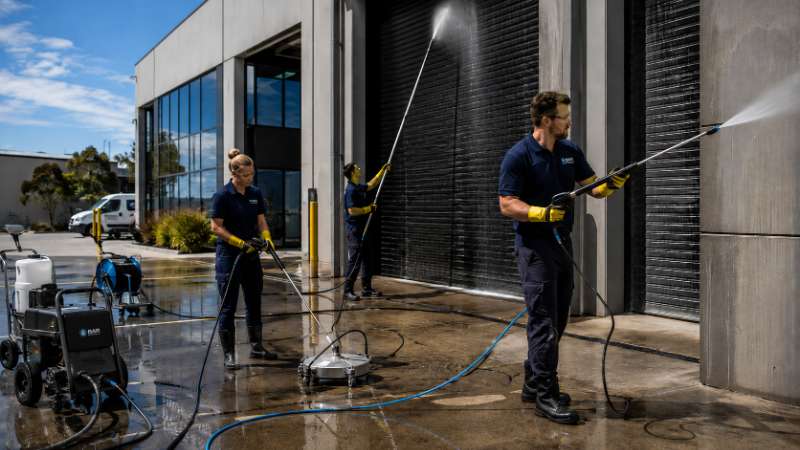
At its core, winter exterior cleaning for a Melbourne commercial property is about eliminating hazards before they cause real harm — it's not simply about appearances. Two risks stand out above the rest: gutters packed with autumn leaf litter that push water into walls and ceilings instead of away from them, and walkways covered in moss or algae that turn into genuine slip-and-fall dangers once they're wet. Handle both before June arrives, and a commercial property in South East Melbourne — whether it's in Dandenong South, Springvale, Noble Park, or further out near Berwick and Cranbourne — remains safe for staff, customers, and delivery drivers right through winter.
This guide sticks to exterior cleaning work — gutters, walkways, and windows. It's also limited to cleaning specifically: any structural repairs, roofing work, or drainage fixes belong with a roofer, plumber, or builder, not a cleaning provider.
TL;DR: For a Melbourne commercial property, winter exterior cleaning is first and foremost about safety — presentation comes second. The two biggest hazards facility managers deal with ahead of the June–August rain season are clogged gutters and slippery, moss-covered walkways: one leads to water damage, the other leads to slip-and-fall injuries. Sites across South East Melbourne, from Dandenong to Berwick, Cranbourne, and Frankston, need their gutters cleared and their walkways pressure washed before the rain arrives — not after an incident makes it unavoidable.
What does winter exterior cleaning involve for a commercial property in Melbourne?
Winter exterior cleaning targets the surfaces and drainage points that pose the greatest risk once wet weather arrives. For a commercial property in South East Melbourne, that typically means:
- Removing leaves and debris from gutters ahead of the rainy season
- Clearing leaf litter and debris from accessible downpipe and drainage entry points
- Pressure washing walkways, ramps, loading areas, and car parks to strip away moss and slime
- Cleaning windows so entrances and street-facing glass stay clear all winter
Sites in the leafier parts of the South East — think Berwick, Beaconsfield, and sections of Cranbourne — collect gutter debris more quickly because of nearby tree cover, so the hazard builds faster there as well. If a gutter, downpipe, or drainage point is actually damaged rather than just blocked, that calls for a roofer or plumber — a cleaning provider clears debris, it doesn't repair fixtures.
Why is gutter cleaning a safety issue before Melbourne's winter rains?
Gutter cleaning is a safety matter because a blocked gutter doesn't just spill over — it sends water somewhere it shouldn't go, causing damage or creating a fresh hazard. Leaf litter peaks in late autumn, and it has to be cleared before the heavier rain of June, July, and August rolls in.
Once a commercial building's gutter overflows, water streams down the facade and can pool directly at an entrance or walkway — turning a drainage issue into a slip hazard right where foot traffic is at its heaviest. Water can also push back into ceiling cavities near the roofline, which surfaces later as a leak, a damp patch, or, in a worst-case scenario, a compromised ceiling near light fittings.
Facility managers throughout South East Melbourne should treat gutter clearing as a pre-winter safety check rather than a purely cosmetic task, scheduling it in late autumn before the seasonal rain pattern kicks in. WorkSafe Victoria's guidance on slips, trips and falls specifically calls for work areas, car parks, and entrances to be kept clean, well-lit, and free of obstacles — a standard that a gutter overflowing onto an entry path directly undermines.
How does pressure washing prevent slip-and-fall incidents on commercial walkways?
Pressure washing cuts the risk of slip-and-fall incidents by stripping away the moss, algae, and grime that turn concrete and paved surfaces genuinely dangerous once they're wet. This build-up accumulates gradually through the colder, wetter months, and it's frequently not obvious just how slick a surface has become until someone actually loses their footing.
Walkways, ramps, loading bays, and car park surfaces see the heaviest foot and vehicle traffic, which puts them at the top of the risk list. A commercial property in Dandenong South, or a retail strip in Springvale or Noble Park, will see this build-up happen faster wherever the surface misses out on direct sun for much of the day — shaded entries and south-facing paths are usually the first to turn hazardous.
Pressure washing on a regular basis before winter, plus a second pass mid-season for shaded or high-traffic spots, keeps these surfaces safe for staff, customers, and delivery drivers. Australia assesses pedestrian surface friction against AS/NZS 4586, the national standard for slip resistance classification — a helpful reference for understanding that a mossy or algae-covered walkway isn't merely unattractive, it's genuinely falling short of the surface grip a safe pedestrian area needs.
What's a facility manager's exposure if winter exterior hazards go unaddressed?
A facility manager who allows gutters to stay blocked or walkways to go untreated is taking on two forms of risk: property damage caused by water intrusion, and injury risk from a slip-and-fall on a mossy or wet surface. Either can escalate into a liability issue once someone is hurt or a tenant's property is damaged as a result.
Two pieces of Victorian legislation are relevant here. Under the Occupational Health and Safety Act 2004 (Vic), employers and businesses carry a duty to provide and maintain a working environment free from health risks, so far as is reasonably practicable — and WorkSafe Victoria's own guidance names wet, slippery, or poorly maintained outdoor surfaces as a direct example of what falls under that duty. Separately, Section 14B of the Wrongs Act 1958 (Vic) establishes that an occupier of premises owes a duty of care to take reasonable steps ensuring people on the property aren't injured because of its condition — this is the provision behind most slip-and-fall claims brought against commercial premises in Victoria.
Slip-and-fall injuries are far from a minor category, either. WorkSafe Victoria's injury data shows knee injuries make up roughly a quarter of workplace slip, trip, and fall claims, with back and wrist injuries also common — exactly the kind of outcomes a cleared gutter and a pressure-washed walkway are designed to prevent.
None of this amounts to legal advice, and the precise details of duty of care and liability depend on the property, the lease, and the insurance arrangements in place — worth confirming directly with your insurer or a workplace safety advisor. That said, from a practical standpoint, a visibly slick entrance path or a gutter clearly overflowing onto a walkway is hard to frame as unforeseeable once it's sat there through a wet Melbourne winter.
How often should South East Melbourne properties get winter exterior cleaning to stay safe?
Most South East Melbourne commercial properties need one thorough gutter clear in late autumn, plus at least one pressure wash of their walkways before winter rain peaks. Sites with higher traffic or heavier shade — where hazards accumulate faster — often need a second pass partway through winter.
Here's a simple way to plan it:
Task | Recommended timing | Why |
Gutter clearing | Late April – May | Ahead of the June–August rain peak |
Downpipe and drainage clearing | May | Confirms gutters are clear before rain hits |
Walkway pressure washing | Late April – May | Ahead of moss and algae creating a slip hazard |
Second walkway wash (shaded/high traffic) | July | Counters mid-winter moss regrowth |
Window cleaning | May, then again mid-winter if needed | Addresses winter grime and rain spotting |
Sites closer to bushland or with heavier tree cover — parts of Berwick, Pakenham, and Cranbourne fit this description — generally need the earlier, more frequent schedule, since their gutters and shaded walkways build up hazards faster than sites with less tree cover nearby. If you're ready to lock in dates, you can book a winter exterior cleaning service directly.
What happens if a commercial property skips this seasonal exterior prep?
Skipping winter exterior cleaning tends to lead to one of two outcomes: water damage from blocked drainage, or a slip-and-fall incident on a walkway left untreated. Both come with real costs attached — repair bills in one case, potential injury and liability exposure in the other.
For a facility manager, a mossy, untreated entrance or a gutter overflowing onto a shopfront is more than an appearance problem. It's an active hazard visible to anyone walking past — something that matters for any commercial site across South East Melbourne trying to maintain both a safe and professional presentation through the colder months.
What most facility managers get wrong about winter exterior safety prep
Most facility managers rank winter exterior cleaning below interior upkeep — something to circle back to once the more visible, high-traffic interior spaces are sorted. Gutters and walkways often get left alone until there's an obvious problem: a leak, a complaint, or a near-miss on a slippery path.
The catch is that Melbourne's winter rain doesn't arrive all at once. It builds gradually across June, July, and August, meaning a blocked gutter or a slick walkway can sit as a hidden hazard for weeks before it causes any damage or an actual incident. By the time it becomes obvious, the property has usually already been carrying that risk for a while.
Building exterior hazard checks into a pre-winter priority list — rather than treating them as an afterthought — is the more dependable way to keep a South East Melbourne commercial property safe through the season.
How much does winter exterior cleaning cost for a commercial property in Melbourne?
Winter exterior cleaning costs in Melbourne shift depending on property size, gutter length, walkway area, and how overdue the work has become — there's no single flat rate that applies across South East Melbourne. A single-storey retail unit in Dandenong will cost less to service than a larger, multi-tenant site in Cranbourne or Berwick with more roofline and paved surface to cover.
Because pricing is specific to each site, the most reliable way to budget for winter exterior cleaning is a direct quote based on your property. Reach out to SM&MN Cleaning Services for a free, no-obligation quote — a quick look at your gutter run, walkway area, and access points is all it takes to get you a clear figure before winter sets in.
FAQ
Q: When should I book gutter cleaning before winter in Melbourne? A: Late April through May is the ideal window — after most autumn leaf-fall has wrapped up but before Melbourne's heavier June–August rain sets in, so gutters are clear and not overflowing onto walkways right when it matters most.
Q: Can moss on walkways actually cause injury? A: Yes. Moss and algae trap moisture and become genuinely slippery once wet, particularly on concrete or paved surfaces that don't get much direct sunlight. That makes walkways, ramps, and loading areas real slip-and-fall hazards through winter.
Q: Who's responsible if someone slips on a mossy walkway outside my building? A: That depends on your specific lease, insurance, and duty-of-care arrangements, so it's worth confirming with your insurer or a workplace safety advisor. In practical terms, though, a visibly hazardous walkway that hasn't been dealt with is worth treating as urgent regardless of where liability ultimately sits.
Q: Do I need to pressure wash walkways more than once during winter? A: Shaded or high-traffic spots often need a second wash partway through winter, since moss and algae can regrow while conditions stay wet. Sunnier, lower-traffic areas may only need the one pre-winter clean.
Q: What's the risk if gutters are left blocked over winter? A: Water backs up and can run down external walls, pool at entrances and walkways, or push into roof cavities near the gutter line. This often stays hidden until a leak shows up inside the building or someone slips on pooled water outside.
Q: Does SM&MN Cleaning Services fix gutters, roofing, or drainage if something's damaged? A: No — SM&MN Cleaning Services clears gutters, downpipe entry points, and walkways of debris, moss, and grime. If something's actually broken, sagging, or leaking, that repair work calls for a roofer, plumber, or builder. We'll flag it if we spot it, but we don't carry out the repair ourselves.
Q: Does SM&MN Cleaning Services cover commercial properties outside Dandenong? A: Yes. SM&MN Cleaning Services is based in Dandenong South and services commercial properties right across South East Melbourne, including Springvale, Noble Park, Keysborough, Berwick, Cranbourne, and the surrounding suburbs.
Winter exterior cleaning for a Melbourne commercial property ultimately comes down to addressing two hazards at the right time: clearing gutters before the June–August rain season arrives, and pressure washing walkways before moss and algae turn into a slip-and-fall risk. Properties across South East Melbourne — from Dandenong South through to Berwick, Cranbourne, and Frankston — that get both sorted ahead of winter avoid the water damage and safety incidents that tend to surface once the season is underway. Contact SM&MN Cleaning Services for a pre-winter exterior cleaning quote for your property.