Let’s be honest about something. If excessive sweating were just about being a little warm, people wouldn’t be researching treatment options. They’d grab a stronger deodorant and move on.
But hyperhidrosis, the clinical term for sweating that goes well Beyond Medical Aesthetics Medical Aesthetics, what your body actually needs, has a way of showing up in every part of your day. The outfit you didn’t wear because of what might happen. The handshake you hesitated over. The way summer stops feeling like something to look forward to.
At Beyond Medical Aesthetics, we see this a lot. And one of the most effective things we can offer is also the one people are most surprised by: Botox. Not for wrinkles. For sweat.
Here’s what that actually means, how it works, and whether it might be right for you.
Your sweat glands aren't broken. They're just getting the wrong signal.
Sweating is controlled by your sympathetic nervous system. When your body needs to cool down, it releases a chemical called acetylcholine, which tells your sweat glands to get to work. That’s normal and necessary.
In people with hyperhidrosis, that signal fires too often, too intensely, or both. The glands in the underarms, palms, scalp, or feet stay active even when there’s no real reason for it. You’re not hot. You’re not stressed.
And yet. That’s the part that makes it hard to manage with conventional antiperspirants. Those work at the surface, physically blocking the duct. But the problem isn’t at the duct. It’s upstream, at the nerve signal that’s telling the gland to activate in the first place.
So what does Botox actually do here?
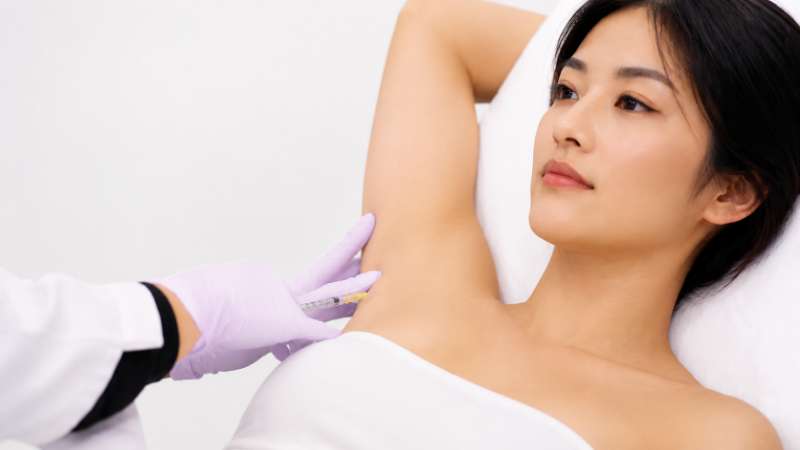
This is the part most people don’t expect. Botox, the same botulinum toxin type A used for cosmetic treatments, can be injected directly into the skin to interrupt that nerve-to-gland pathway.
When it’s placed intradermally, meaning just below the skin’s surface rather than into a muscle, it blocks the release of acetylcholine at those nerve endings. The signal never reaches the sweat glands. The glands don’t activate. The sweating stops.
TO PUT IT SIMPLY:
Botox treats hyperhidrosis by blocking the chemical signal (acetylcholine) that tells sweat glands to activate. At Beyond Medical Aesthetics Medical Aesthetics Medical Aesthetics, we inject small, precise amounts intradermally across the treatment area, targeting the glands responsible for excessive sweating. This is a different application and technique from cosmetic Botox, which works on muscle tissue.
The distinction matters because it affects how the treatment is done. The injection depth, the dosing, and the mapping of the area are different from a cosmetic appointment. It’s not a one-size approach, which is why we assess each patient’s pattern and severity before recommending anything.
What does treatment actually look like?
The appointment is straightforward. We can apply a numbing cream beforehand to keep things comfortable. Then we map the treatment area, which for underarms usually involves a simple starch-iodine test to identify exactly where the active glands are, and inject in a grid pattern using a very fine needle.
The whole thing takes about 20 to 30 minutes. There’s no downtime in the surgical sense. We ask patients to skip intense exercise and heat exposure for the first 24 hours, but most people head back to their day immediately after.
Underarms are the most commonly treated area and the most predictable. We also treat palms and the scalp, though those require adjusted dosing and a slightly different technique. If you’ve been dealing with palm sweating specifically, it’s worth noting that temporary, very mild muscle effects in the hand are possible with higher doses, and that’s something we’d talk through in your consultation before deciding on an approach.
When will you actually notice a difference?
Most patients start noticing a reduction within 5 to 7 days. Full results are usually established by day 14. It’s not immediate, but it also doesn’t take long.
ON HOW LONG RESULTS LAST:
Botox for hyperhidrosis typically lasts 4 to 6 months, depending on the treatment area and how your body responds. Underarms tend to hold results toward the longer end of that range. Palms and scalp may need retreatment closer to the 4-month mark. Some patients find results extend slightly over time as the glands become less reactive with consistent treatment.
For a lot of patients, the practical math works out to two or three appointments a year. Book once in May, and you’re covered through the summer. A follow-up in the fall gets you through the rest of the year.
Is this actually safe? What about my body's ability to cool down?
This question comes up often, and it’s worth addressing directly. Treating a localized area like the underarms does not impair your body’s ability to regulate temperature. You have millions of sweat glands distributed across your entire body surface. Reducing activity in one small zone doesn’t put a meaningful load on the rest of the system.
Side effects from the treatment itself are generally mild: some temporary redness or tenderness at injection sites, occasional minor bruising. Serious complications are rare when the treatment is done by someone with real experience in this specific application, which is why we’d always rather you come in for a consultation first than try to figure out dosing and placement from a general Botox protocol.
Who is this actually for?
If you’ve tried clinical-strength antiperspirants and they’ve helped somewhat but not enough, or if they’re causing irritation with repeated use, this is worth exploring. Botox works upstream from the duct, which is why it’s often more effective than topical options for moderate to severe hyperhidrosis.
It works best when the sweating is localized to specific areas rather than generalized across the whole body. It’s not appropriate during pregnancy or breastfeeding, or for patients with certain neuromuscular conditions. All of that is something we’d go through in your consultation.
If you’re not sure whether what you’re experiencing qualifies as hyperhidrosis or whether this is the right route, that’s an entirely reasonable place to start a conversation. You don’t need to come in with a diagnosis.
If summer sweating is something you've been managing around, it doesn't have to stay that way.
Hyperhidrosis is one of those concerns where people often wait longer than they need to because they assume there’s nothing that can actually help. There is, and the process is more straightforward than most people expect.
You can learn more about how we approach this on our Excessive Sweating page, or book a consultation at Beyond Medical Aesthetics in Toronto and Markham. We’ll talk through what you’re experiencing and whether Botox for hyperhidrosis makes sense for you.