Congratulations on deciding to take this step toward becoming a yoga teacher. If you are comparing schools here in Bali, it helps to know exactly what separates a genuinely high standard training from one that just looks good on a website. Here is what to look out for.
The teaching team and additional support
Start with the teachers. Confirm that every lead teacher holds an E-RYT 500 accreditation, which means real hours of teaching experience behind the certificate, not just a course completion. Ask whether the studio has a coordinator and support staff on hand day to day, since a training runs far more smoothly when someone is dedicated to keeping students organised and supported.
It is also worth checking that the teachers pictured on the website are the ones who will actually be in the room with you. Schools sometimes list well known names for marketing purposes, then bring in different staff once the course starts. For specialised subjects such as anatomy, Ayurveda, or subtle body teachings, ask who is delivering those sessions and what their background is. A knowledgeable specialist teaching their own subject makes a noticeable difference to how well the material lands.
Proper schedule with enough breaks
A proper 200 hour YTT should include at least 160 hours of direct contact time with teachers, on top of homework, reading, and personal practice. Cramming that into a short, rushed timetable rarely does anyone favours. Look for a schedule of roughly 8 to 10 hours a day with sensible breaks built in, and at least one full day off each week so your body and mind have time to absorb everything.
Four weeks is a reasonable minimum for a course that wants you to leave with real, usable knowledge rather than a stack of half finished notes. Also ask whether the training includes both a written and a practical assessment, along with supervised practice teaching. Sitting through lectures is one thing, teaching a live class with feedback is what actually builds confidence. Our own 200 hour YTT follows this structure closely, with weekdays running longer and Sundays kept free.
How many students do they take?
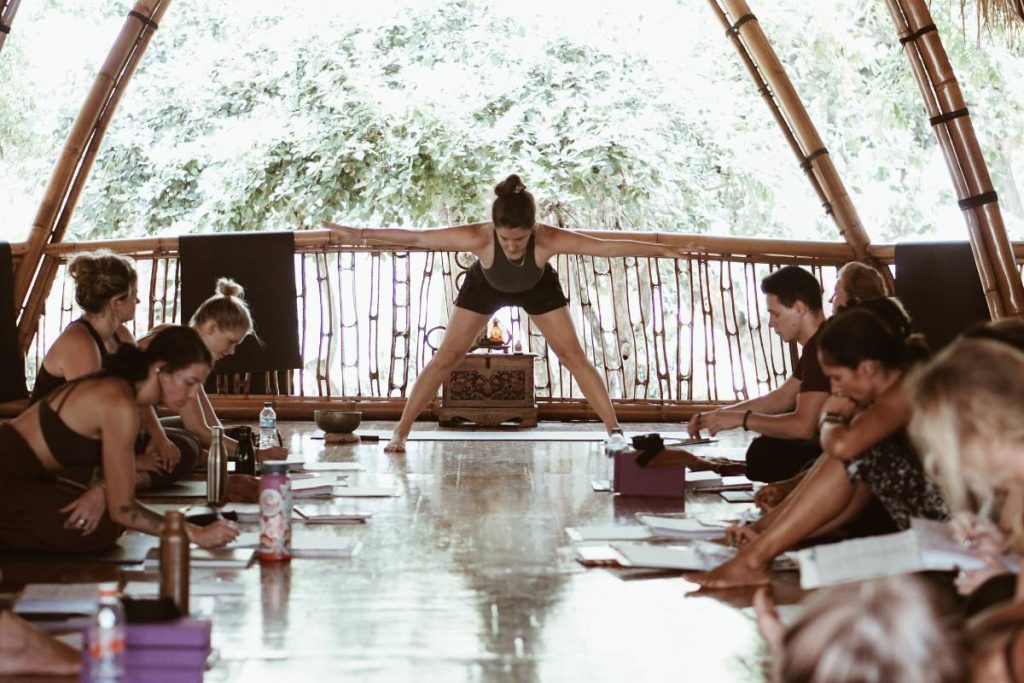
Personal attention matters more in a YTT than almost anywhere else in yoga. The school needs a dedicated space and enough equipment for the whole group, and that becomes harder to guarantee once class sizes grow. A training squeezed into a shared villa or a budget hotel alongside other guests, in a space that was never designed for teaching, tends to come with constant distractions.
A smaller group in a purpose built space allows teachers to actually see what each student is doing, correct alignment properly, and get to know how everyone learns. It also tends to make the whole experience feel calmer and more connected, which matters over four intensive weeks. Ask directly how many students are typically in a group, and whether that number ever changes once a course has already filled up.
Check essential details
Before you commit, look closely at what is actually included in the price. Compare the inclusions, any bonus extras, and whether a training-only option exists for those who already have accommodation sorted. As a general rule, an unusually low price usually means something has been left out somewhere, whether that is teaching hours, materials, or support after the course ends. Ask exactly what you are paying for rather than assuming, and get the full breakdown in writing before you send any deposit.
The credibility of the school
Reputation should be checked, not taken at face value. Look into how long the school has actually been running courses, whether it is a properly registered Yoga Alliance school under current standards, and whether it operates from a real studio rather than existing only online. Confirm that a code of conduct or ethics policy is in place, and that former students can vouch for how the programme actually ran.
Honesty matters here, which lines up with Satya, the second Yama in yoga philosophy: truthfulness in what a school claims about itself. It is also worth noting when a school gives back, through community work or karma yoga, since that kind of integrity tends to show up in how a training is run day to day too. Read genuine reviews, avoid booking through third party agents, and where possible speak directly with the school, its teachers, or graduates before you sign up.
We hope this gives you a clearer picture as you choose the right training for your journey toward becoming a certified yoga teacher in Bali.