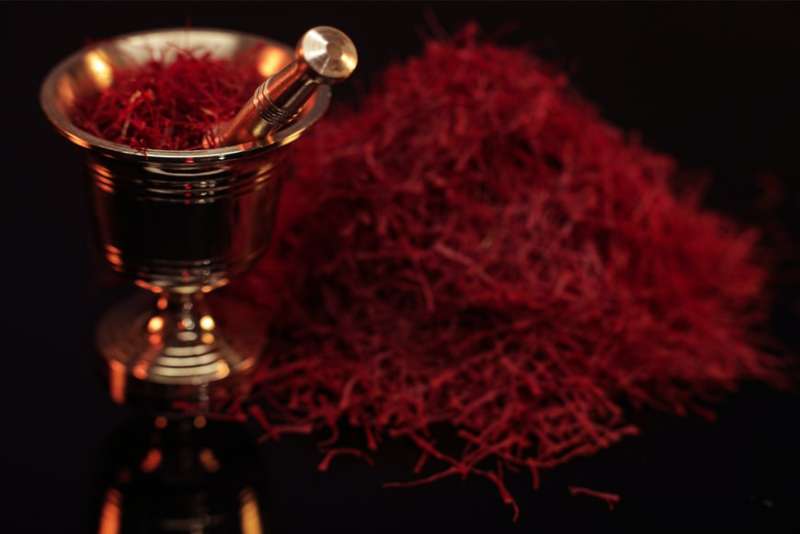
Thanks to its world-renown exotic flavour and aroma, saffron remains a staple ingredient that sits in the deepest part of the pantry in many kitchens all over the world. Not to be forgotten, mind you, but to prolong its shelf life. The chemical elements contained in saffron, which are responsible for the spicy flavour and the hay-like aroma, blend well with other herbs and spices to turn any dish into a gustatory delight.
When it comes to Indian cuisine, saffron is practically indispensable. Whether it’s sweet, savoury or spicy, saffron can almost always be found in Indian food. It serves as an ingredient of spice blends like garam masala. It’s also featured in rice-meat dishes like biryani, its variants and pulao. You can also taste saffron in desserts and sweets, such as kesari bhath, kufil and gulab jamun.
We all know that saffron is costly but many of us are actually not aware that it’s also the most expensive spice in the world. At a price of $2,000 to $10,000 for half a kilo, it is the most expensive food on earth, putting truffles, caviar and real balsamic vinegar to shame. So what's the fuss?
A delicate plant
Not only the spice is grown under special weather conditions, it’s very delicate and blooms for only one week of the year. Furthermore, harvesting the plant is no easy feat. The process of plucking the purple flowers involves six hours a day. This is because a single flower produces just three red strands. This means about 500 grams of dried saffron require a whopping 75,000 flowers. Not to mention the flowers grow only six inches off the ground. Can you imagine spending 6 hours bending and plucking these short flowers? This makes a tedious process, to say the least, for every person involved.Climate change and regional conflict
The majority of saffron (more than 90%) is produced in Iran at present but one-tenth is produced in Kashmir, a region in the northern subcontinent of India. The strands of Kahsmiri saffron are thicker and more fragrant than its Iranian counterpart. In Kashmir, saffron used to be a booming industry with crops selling for as much as 250,000 INR or $4,500 AUD a kilogram.However, the production of saffron in Kashmir has been at one of the lowest recorded in history. With droughts and the still-unfolding effects of climate change on the land, Kashmiri saffron has slowly begun to disappear. Not to mention the ongoing regional conflict. The violence has inevitably become a war on the land, which directly impacts the region’s agriculture. This makes the world’s most expensive spice even more precious.
The rarity of the red strand of saffron can lead to shortcuts from less reliable merchants. In fact, in the market the yellow strands are often coloured with red and mixed into the bunch. The best way to check whether saffron is real or not is to smell it. If it’s sweet-smelling and tastes bitter, it’s most likely real saffron. Another way to check is by soaking a few strands of saffron in water. You should have colour leach but what distinguishes the real one from the fake is that the real strand will remain crimson. If it turns white, then you’re looking at the fake one.
Source: Eater, TimesofIndia and Sativus