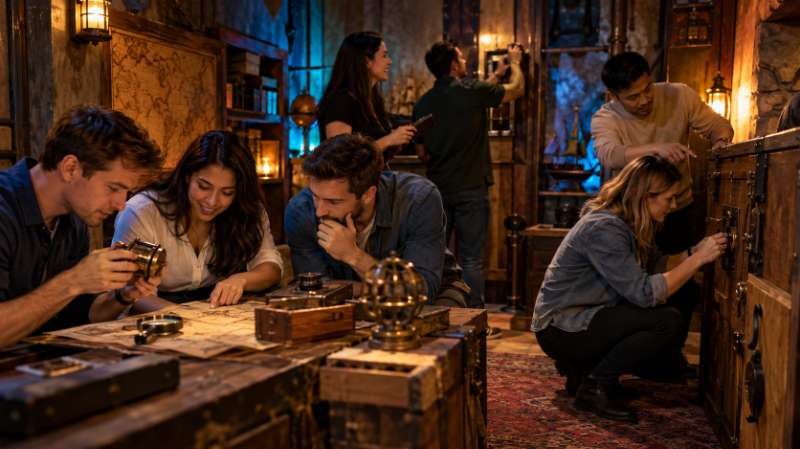
It takes very little time for most company events to become obsolete after the next Monday. Everyone shows up, the event happens, and everyone agrees that it was a lot of fun without the process of team functioning being changed in any way whatsoever. Escape rooms manage to survive the test a little better than bowling or lunch, but certainly not necessarily so. The usefulness of the hour really depends on the room and the way it’s organized.
Room Design Does Most of the Work
A room either forces people to work together or quietly allows them to drift. The mechanism is information. When the clues are dispersed such that none of the players is able to view all of them at once, then progress comes to a halt unless people tell others what they have discovered. This restriction exists in the design of the room, and not in the briefing.
When rooms are designed on the premise of just one puzzle sequence, a completely new experience emerges. The most assertive member leads the way while the rest of the team members watch. In other words, the session reinforces the current setup of the team. When booking the venue for the session, inquire about the number of puzzles that can be solved simultaneously.
The First Ten Minutes Set the Pattern
Under time pressure, groups fall back on office habits within about two minutes. The quiet specialist stays quiet. The manager starts allocating. A game master who frames the session properly can interrupt that, usually by asking players to call out findings rather than hold them, and by making clear that requesting a clue is part of the game rather than a failure.
Teams that treat hints as defeat tend to lose ten minutes to a puzzle nobody was going to solve. Teams that ask early cover more of the room and finish with more to talk about.
Group Size and Room Allocation
Every room carries a minimum and maximum player count tied to its story and its floor space. Eight people in a room designed for five creates bystanders. Four in a room designed for eight creates a slow hour. The Great Escape in Bendigo has four different rooms: Bank Heist, The Orphanage, A Wizard’s Quest and Pirates of the Mediterranean, allowing a group of 16 to 24 people to play simultaneously and then compare their results.
Who you put into each room is as important as how many there are. Keeping intact departments together tests nothing anyone needs tested. Mixing people who rarely work side by side is where escape room team building earns its place in the working day. Groups larger than eight people are treated as large-group reservations or as multi-room reservations, which enables the decision to be made prior to their arrival at the reception area.
What the Session Actually Reveals
Sixty minutes of constrained problem-solving produces evidence that most corporate team building formats never generate. You observe who tests an idea instead of defending it, who monitors which ideas have been tested, and who recognizes when a fellow participant stops contributing. Nothing requires the facilitator to point this out.
It is during the debrief that the worth is revealed. Taking fifteen minutes to review the positive and negative elements fifteen minutes later transforms an enjoyable hour into something useful. Skip it and you have run an outing.
Fitting It Into a Bendigo Workday
This place is located at 155a Lyttleton Terrace, and it is in the middle of the town, very close to Pall Mall and the View Street restaurants. This means that arranging for lunch before or after the game will not be a problem. The duration of the game is 60 minutes with a check-in period of 15 minutes, which means that one should plan for 75 minutes for each room. This implies that a team building escape room session takes some time in an afternoon rather than the entire working day.
For those driving up from Melbourne, it would take about two hours both ways; thus, having a late morning booking is advisable. Weekdays afternoons are calmer compared to the weekend afternoons. This venue is closed on Mondays. Planning for logistics is vital for the success of any escape room team building activity; thus, most planners go about it by checking which escape rooms in Bendigo are available for the selected day.
FAQs
1. Why do escape rooms work well for corporate team building?
They create shared pressure with no rank attached. Progress depends on people passing information quickly, so communication habits become visible within minutes rather than staying hidden behind normal workplace roles.
2. How many people can join a team building escape room session?
Each room sets its own minimum and maximum, usually between two and eight players. Larger groups are split across several rooms running at once, then brought back together for comparison.
3. Is escape room team building suitable for remote or hybrid teams meeting in person for the first time?
Yes. The room gives people a task to focus on, which removes the pressure of small talk. Colleagues who have only met on video settle within the first ten minutes.