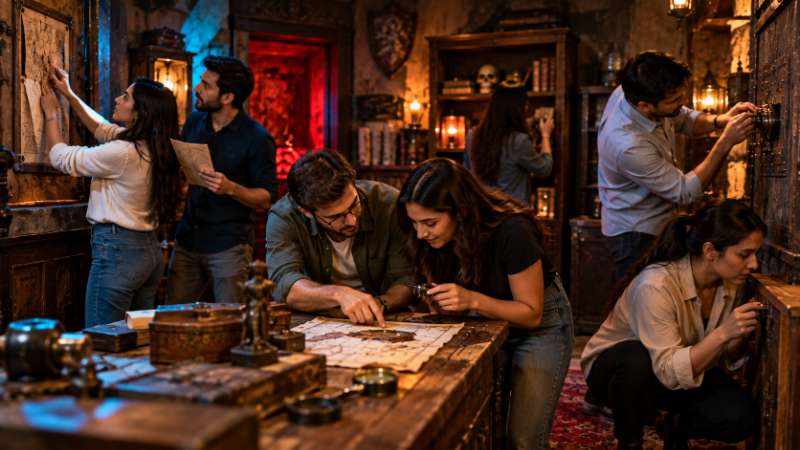
Most Adelaide-based companies choose to have an escape room adventure to either achieving some change in the way that they communicate with one another or just an hour’s worth of plain fun outside the office space. What happens is mostly dependent on the escape room rather than the team. The design decides whether twelve colleagues work as a single unit or split into three people solving and nine standing near the door.
The design problem most venues never solve
Plenty of rooms are still built in a straight line. One lock opens one drawer, which holds the clue for the next lock. That structure caps participation at whoever is standing closest to it. Everyone else waits their turn and slowly checks out.
Rooms built on parallel threads behave differently. Several tasks run at once, so people sort themselves without being told to. The detail-focused staff member takes the searching. Someone who thinks spatially handles the mechanical puzzles. The quiet analyst ends up holding information nobody else can see. A corporate team building escape room only produces useful behaviour when there is enough real work to go around, which is also why mechanism-driven rooms tend to outperform padlock-heavy ones for work groups.
What quietly goes wrong
Two failures repeat. The first is hierarchy. If the most senior person starts directing traffic in the opening five minutes, the group reverts to its normal shape and nobody learns anything new about anyone. Well-built games counter this by scattering information across the space, so no single player can hold the whole picture.
The second is crowding. Ten people in a game designed for six is not a bigger experience, it is a smaller one for most of them. Player limits exist for a structural reason, and ignoring them is the quickest way to lose half your group's attention inside fifteen minutes.
Splitting a larger team beats squeezing everyone in
For groups above eight, the stronger structure is several smaller teams running different games simultaneously. Each group gets a genuine job rather than a share of one. The comparison afterwards, who solved what and how they got there, generates more useful conversation than a single crowded hour ever does. The Klemzig site runs five distinct games, including Dr Frankenstein, The Wild West and The Inside Job, which makes a multi-room split practical for a department of twenty.
Planning the session in Adelaide's north-east
Travel time secretly determines how engaged or irritated guests are when they arrive. Venue location is at 358 North East Road, taking only about fifteen minutes to reach from Adelaide CBD, excluding peak hours, along the same route as the O-Bahn, making it easily accessible to workers who travel from both the city and the north-eastern suburbs.
The games last for an hour and the gates are open from 10:30 am on all days of the week. It is recommended for groups booking escape rooms in Klemzig during weekdays in the afternoon to allocate fifteen minutes for check-in and twenty minutes for the debriefing process. That puts the whole thing under two hours. A corporate team building escape room is also easier to justify internally than most team building activities Adelaide offices default to, because it costs half an afternoon rather than a full day off-site, and Tuesday and Thursday sessions are usually the quietest if you have several teams running at once.
What to ask before you book
Ask how many players each room actually holds, and whether its puzzles run in parallel or in sequence. Ask how hints are handled, because a game master who steps in too early removes the productive frustration the hour depends on. Check the fear rating if the group is mixed. Nobody learns much about a colleague while trying to leave the building.
Then plan the twenty minutes afterwards, which is the part most organisers skip. Ask who spotted the detail that broke the endgame open, who was left without a task, and what the group would do differently. That conversation is where a corporate team building escape room stops being an outing and becomes something a manager can actually use on Monday.
FAQs
1. What makes escape rooms effective for corporate team building compared to typical workshops?
Escape room puts everyone under pressure because of a limited time period, thus behavior comes naturally without pretending. Communication skills, teamwork, and problem-solving abilities will become visible within sixty minutes.
2. How large can a corporate team building escape room session be?
Individual rooms have set player limits, usually up to eight. Larger departments are best split across multiple rooms running simultaneously, which the Klemzig venue can arrange as a multi-room challenge.
3. Is escape room team building effective for teams that don't know each other well yet?
Yes. Shared unfamiliarity removes the usual hierarchy, and a common goal gives new colleagues an immediate reason to talk. Sixty minutes of joint problem-solving builds familiarity faster than structured introductions.