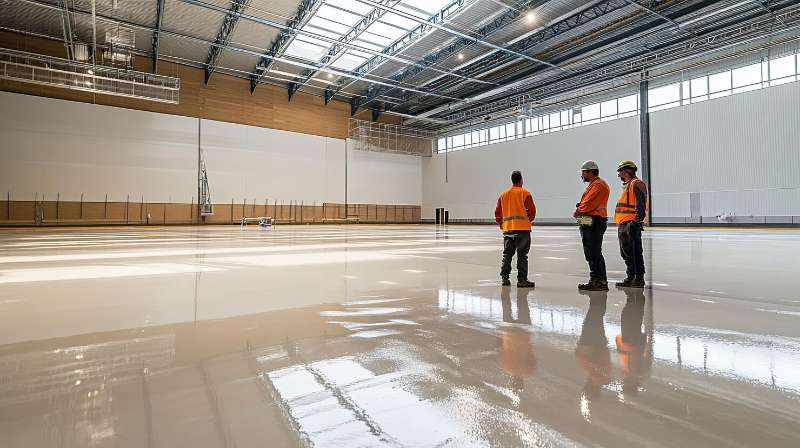
Melbourne distribution centres and manufacturers are budgeting $35 to $160 per square metre for a coated industrial floor in 2026. That spread is wide for good reason. Warehouse flooring quotes move on slab condition, load type, and how many hours your operation can afford to stand still.
Below are the real price bands and the line items that quietly inflate a tender. We have recoated live plants for PrixCar at Altona North and Scania at Dandenong. These figures come from Melbourne sites, not a national average.
What facilities are paying per square metre in 2026?
Dust-proofed and sealed slabs sit at the bottom of the market. Grinding with a sealant costs around $35-$55 for each square metre. It is appropriate for dry racks, palletising, and low-volume parking bays.
Industrial-grade epoxy paint that is designed for forklift trucks ranges from $60 to $120 per square metre. Polyaspartic and MMA fast-curing paints are priced at an additional 20-40 per cent premium. You are buying time as much as material.
Scale matters more than most operators expect. A warehouse of 5,000 square metres is always faster than a workshop of 200 square metres. The factors of mobilisation, machinery rental, and setting up the workforce do not relate to size.
Why do two tenders for the same slab differ by $40 per m²?
Preparation is where quotes separate. Diamond grinding or shot blasting to the specified surface profile adds $8 to $20 per square metre. No contractor should be trimming that step.
Older industrial slabs across Melbourne's west and north carry oil, tyre residue, and failed paint. Contaminated concrete typically adds $8 to $15 per square metre to preparation. High humidity readings mean a moisture barrier, which adds $12 to $25 per square metre.
Read the exclusions before comparing headline rates. A cheap number usually means shallow preparation. Shallow preparation is the most common reason concrete coatings peel within three years.
Ask for four items on every quote. Preparation method and depth, repair allowance for joints and spalls, film thickness with coat count, and reinstatement including line marking. Quotes that omit these are not comparable.
The cost most operators leave out of the budget
Downtime is frequently larger than the floor itself. Standard epoxy needs about 24 hours before foot traffic and 48 to 72 hours before vehicles. A full chemical cure takes up to seven days.
For a facility running double shifts, seven days of lost throughput dwarfs the gap between two quotes. Our MMA floors return to service within a couple of hours. That is why we specified them for the QV Melbourne carpark.
Budget separately for joint sealing, crack repair, coving, and line marking. Line marking is very often a separate item. It catches people out at the invoice stage.
Most Melbourne industrial work happens over a weekend shutdown. Book the site assessment early, because winter slab temperatures slow curing and change the schedule.
Matching the system to how your site actually runs
Dry storage rarely justifies a premium specification. Grind and seal handle it well. Our Urban Warehouse finish was built for exactly that brief.
Wash bays, food production areas, and cold rooms are a different problem. Polyurethane cement tolerates moisture, thermal shock, and steam cleaning. Standard concrete coatings will fail under those conditions.
Where loaded forklifts run the same aisles daily, specify build thickness rather than gloss level. An epoxy coating quoted without a stated film thickness is not a real specification. Our industrial flooring team puts thickness, slip classification, and data sheets on every quote.
Fifteen years of concrete coatings work on Victorian industrial sites taught us one thing. The slab decides the floor, not the brochure. Two buildings on the same estate can need different systems.
Our guide to warehouse flooring for Australian businesses covers system selection in more detail.
Frequently asked questions
1. How much to charge per m² of flooring?
The cost of installation is between $35 and $160 per square metre in Melbourne. The sealed concrete floors have the lowest costs, while the fast-curing systems have the highest costs. Preparation, moisture control, and site access shift every quote.
2. What is the cheapest flooring for a Melbourne warehouse?
Grind and seal is the cheapest, from around $35 per square metre. It controls dust and cleans easily. It will not withstand chemical spills, heavy impact, or constant loaded forklift traffic.
3. Do I need slip-resistant ratings for commercial facilities?
Yes. Work health and safety law obliges you to control slip risk. Specify surfaces classified to AS 4586, then follow HB 198:2014 guidance for each specific traffic and wash-down zone.
Getting an accurate number for your site
The useful question is not what a floor costs per square metre. It is what that floor costs across ten years of forklift traffic and wash-downs. Bring us your slab age, traffic loads, and available shutdown window.
Visit the Thomastown showroom or book a site assessment at (03) 9465 1183. We will specify a warehouse flooring system that suits how you actually operate. Every epoxy coating option gets costed against the alternatives.