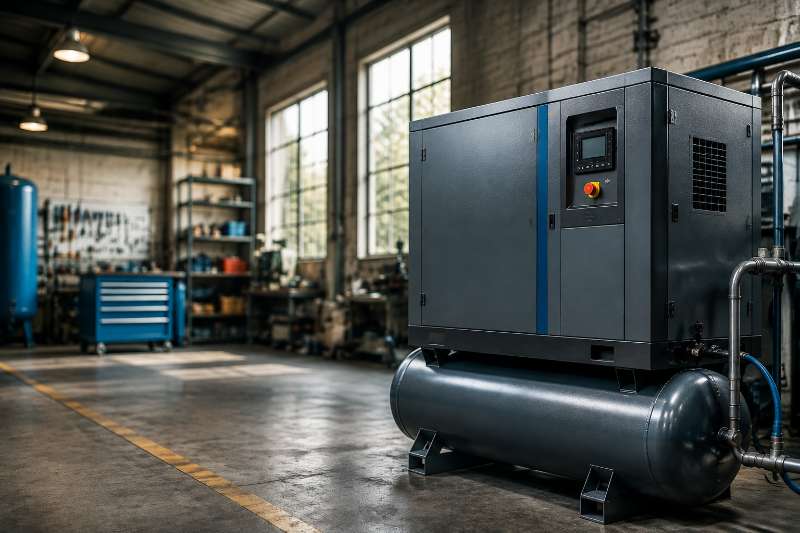
TL;DR
A VSD (Variable Speed Drive) air compressor automatically adjusts its motor speed to match your actual air demand — instead of running flat-out all day regardless of load. In Sydney, where Australian Energy Regulator data confirms industrial electricity prices have climbed roughly 25% over the past five years, that inefficiency has become expensive. Switching from a fixed-speed rotary screw compressor to a VSD model typically cuts compressed air energy costs by 35–50%. For a 30 kW compressor running 40 hours per week in a Sydney workshop, that can mean $4,000–$8,000 in annual savings.
The Real Cost Problem Hitting Sydney Workshops Right Now
If your electricity bill has quietly become your biggest monthly headache, you are not imagining it. Australian industrial electricity prices have risen roughly 25% over the past five years, and the Australian Energy Regulator approved further increases of up to 9.7% for 2025–26.
For workshop managers and operations teams running compressed air around the clock, this matters more than most. Compressed air is often called "the fourth utility" — after electricity, gas, and water — and it is almost always the most expensive one to generate. Here is the part most buyers do not know: the upfront purchase price of a compressor accounts for only 10–15% of its total lifetime cost. Electricity accounts for roughly 70%. That ratio means a compressor choice made on sticker price alone can quietly cost you tens of thousands of dollars more over a decade.
A VSD air compressor in Sydney changes that equation. Here is how, and whether it is the right move for your operation.
Key Insights
- Australian industrial electricity costs rose ~25% over five years, with a further 9.7% approved for 2025–26 (AER)
- Electricity makes up 70% of a compressor's total lifetime cost — not the purchase price
- A single 1/8-inch air leak at 100 PSI wastes ~25 CFM — the full output of a 7.5 HP compressor
- VSD compressors match motor speed to actual demand, cutting energy use by 35–50%
- Fixed-speed compressors run at 100% motor speed even when demand is at 40% — that gap is pure waste
- Demand fluctuates in 88% of all compressed air installations — making VSD a logical fit for most Sydney workshops
- Typical payback period on a VSD upgrade: 2–4 years depending on operating hours and tariff rate
- The Federal Government's energy-efficient asset deductions may apply — confirm with your accountant
What Is a VSD Air Compressor and How Is It Different from What Most Workshops Are Running?
A Variable Speed Drive air compressor controls the motor's RPM — its rotational speed — using an inverter that reads live system pressure and adjusts output accordingly. When air demand drops, the motor slows down. When demand spikes, it speeds up. It is always producing exactly what the system needs.
A standard fixed-speed rotary screw compressor — what most Sydney workshops currently run — operates differently. When it reaches target pressure, it does not slow down. It unloads: the compression stops but the motor keeps spinning, consuming electricity for nothing. Then it reloads, consuming a surge of power at startup. This unload-reload cycle repeats constantly throughout the day, and every cycle costs money without producing a single cubic foot of useful air.
Here is the problem in numbers. If your workshop's actual air demand averages 50–60% of your compressor's rated output — which is typical — a fixed-speed machine is running at full power 100% of the time to deliver 60% of its capacity. A VSD compressor runs its motor at roughly 60% speed and uses power proportionally. That gap between 100% power and 60% load is the waste that VSD eliminates.
How Much Can a VSD Compressor Actually Save a Sydney Business?
The savings range is wide because it depends on operating hours, load profile, electricity tariff, and compressor size — but the numbers are real and well-documented.
- Atlas Copco data shows VSD technology reduces compressor energy costs by 35–50% in variable-demand applications
- A documented Australian case study of a customer upgrading a 15 kW fixed-speed stop-start compressor to VSD recorded $5,000 in annual energy savings
- A 10 HP (7.5 kW) compressor with a 3mm air leak running at 100 PSI wastes approximately $2,000 per year in electricity alone — on top of normal operating costs
For a typical 30–45 kW rotary screw compressor running a Sydney workshop on a standard industrial tariff (approximately $0.20–0.25/kWh), energy savings from VSD can realistically reach $6,000–$12,000 per year. With VSD units carrying a purchase premium over fixed-speed equivalents, payback is typically achieved within 2–4 years — after which the savings continue for the remaining 7–12 years of the unit's service life.
The Federal Government has in recent periods offered deductions on energy-efficient asset upgrades — check with your accountant whether current provisions apply to your compressor investment.
Is a VSD Compressor Right for Every Sydney Workshop?
Not always — and knowing when it is not the right call matters as much as knowing when it is.
VSD is most effective when:
- Your air demand fluctuates significantly throughout the day (most production environments, autobody shops, general workshops)
- Your compressor currently runs for long periods at partial load
- You operate on a time-of-use electricity tariff with peak and off-peak rates
- Your operating hours exceed 3,000 hours per year
A fixed-speed compressor may still make sense when:
- Your air demand is highly consistent and continuous — close to 100% load all day
- You are running a very low number of hours per year (under 1,500)
- Your application requires extremely precise, stable pressure that may not suit variable-speed modulation
According to Atlas Copco, demand fluctuates significantly in 88% of all compressed air installations. That means most Sydney workshops fall into the VSD-suitable category, even if they do not know it yet.
The honest answer: if you do not know your average load factor, that is where to start. A qualified compressed air technician can assess your current system, log your demand profile, and calculate your actual energy spend — giving you a real number to compare against a VSD upgrade quote.
What Does the Upgrade Process Look Like for a Sydney Operation?
Moving from a fixed-speed screw compressor to VSD is not a rip-and-replace job in most cases. The upgrade is typically completed in a planned maintenance window, with the right sequence minimising downtime.
A professional assessment covers:
- Current load profile review — how your demand fluctuates across a working day
- Compressor sizing check — confirming the VSD unit is correctly sized (an oversized VSD compressor does not deliver full energy savings)
- Air system audit — checking for leaks, filter condition, and piping efficiency before the upgrade. There is no point investing in a VSD unit if the system is losing 20% of its output through leaks
- Installation and commissioning — typically one working day for most 15–55 kW units
- Post-installation verification — confirming pressure stability and logging early energy data
At All Air Compressors, our Sydney servicing and repair team can conduct a full compressed air system assessment before recommending any upgrade. We have seen too many businesses invest in a new VSD unit without first fixing the leaks — and end up with a more efficient compressor still supplying a leaking system.
What Happens If You Keep Running a Fixed-Speed Compressor With Rising Energy Costs?
This is the calculation most workshops are not running. A fixed-speed compressor that was reasonably cost-efficient when electricity was $0.16/kWh is a different machine at $0.24/kWh. The unit has not changed — but its cost profile has.
At $0.24/kWh, a 30 kW fixed-speed compressor running 4,000 hours per year costs approximately $28,800 in electricity annually. A VSD equivalent delivering the same air at 65% average load would cost closer to $18,720 — a saving of over $10,000 per year, every year.
Over a 10-year service life, that difference is $100,000. The VSD unit costs more upfront. It does not cost more over a decade.
The other risk of deferring: as electricity prices continue rising — which is the current trajectory in NSW and across the National Electricity Market — the gap between fixed-speed and VSD operating costs widens every year you wait.
What Our Compressed Air Team Sees in Sydney Workshops
Across the Sydney sites our team services, the most common situation we encounter is a workshop running a fixed-speed rotary screw compressor that was correctly sized 8–10 years ago — but the business has since changed. Demand has become more variable, staff hours have shifted, new tools have been added, and sometimes older tools removed.
The compressor is working exactly as designed. The problem is the design no longer matches the load. When we log demand on these sites, we regularly find compressors running at 40–60% average load — sometimes lower. At those load factors, a VSD would recover its cost difference in under three years.
The other consistent finding: most sites have at least one air leak that has never been properly repaired. A system leak audit before a VSD upgrade is not optional — it is the difference between buying efficiency and renting it.
Our preventative maintenance plans include systematic leak detection and load-factor assessment, which gives workshop managers the data to make the VSD decision with real numbers — not estimates.
VSD vs Fixed-Speed: Quick Comparison for Workshop Managers
Factor | Fixed-Speed Rotary Screw | VSD Rotary Screw |
Motor behaviour | Runs at 100% RPM constantly | Adjusts RPM to match demand |
Energy use at 60% load | ~85–90% of full-load power | ~60% of full-load power |
Pressure stability | Cycles between set points | Continuous, precise pressure |
Purchase cost | Lower | 15–25% higher |
Annual energy cost (30 kW, 4,000 hrs, variable load) | ~$28,000–$32,000 | ~$17,000–$20,000 |
Best suited for | Constant, consistent demand | Variable demand (most workshops) |
Payback period | N/A | Typically 2–4 years |
Lifespan | 10–15 years | 10–15 years |
Startup current surges | Yes — at every reload | No — soft start every time |
Frequently Asked Questions
Q: How do I know if my current compressor is wasting energy? A: The clearest sign is a compressor that spends most of the day cycling between loaded and unloaded states — you will hear it repeatedly unloading (the exhaust sound) and then reloading under surge. Another indicator is an electricity bill that has climbed faster than your production output. A demand audit — where a technician logs your pressure and flow data over a full working day — gives you the exact picture. Contact our Sydney team to arrange one.
Q: What size VSD compressor do I need for my workshop? A: Sizing a VSD compressor is not the same as sizing a fixed-speed unit. Because a VSD can modulate output, you typically need a unit rated for your peak demand, not your average. Common workshop sizes in Sydney range from 7.5 kW for a light auto shop to 45 kW or more for a multi-bay manufacturing floor. Oversizing is a common mistake — it reduces the efficiency benefit of VSD technology. We size to your actual peak and average demand, not the biggest unit on the shelf.
Q: Can I upgrade just the drive on my existing compressor, or do I need a new unit? A: In most cases, retrofitting a VSD drive to an existing fixed-speed compressor is technically possible but rarely cost-effective, particularly on units over five years old. The motor may not be rated for variable-frequency operation, and the internal components will not have been designed around the thermal profile of VSD running. A purpose-built VSD compressor is a better investment. We can assess your existing unit and give you an honest recommendation either way — call us on +61 435 166 474.
Q: How often does a VSD air compressor need servicing compared to a fixed-speed unit? A: Service intervals are broadly similar — typically every 2,000–4,000 hours or annually, whichever comes first, depending on the manufacturer. The key difference is that a VSD compressor's reduced startup frequency lowers wear on bearings and motor windings over time, which can translate to fewer emergency repairs. However, the drive unit itself adds an additional maintenance check point. Our air compressor servicing team in Sydney services all major VSD brands and can set up a maintenance schedule from day one of your new unit.
Should You Upgrade? Here Is the Honest Answer
If your workshop is running a fixed-speed compressor, your air demand varies during the day, and you are paying Sydney electricity rates, there is a high probability a VSD upgrade will pay for itself within three years and reduce your operating costs for the decade that follows.
The maths are not complicated. What most workshop managers lack is the demand data to make the calculation confidently. That is what a professional compressed air audit provides.
All Air Compressors services and supplies VSD and fixed-speed rotary screw compressors across Sydney and NSW. If your electricity bill keeps climbing and you want to understand what your current compressor is actually costing you to run, our team can give you real numbers. Browse our products available for sale and hire, or call us directly on +61 435 166 474 to arrange a system assessment.
Written by All Air Compressors — Sydney's Compressed Air Specialists allaircompressors.com.au | +61 435 166 474 | Sydney, NSW