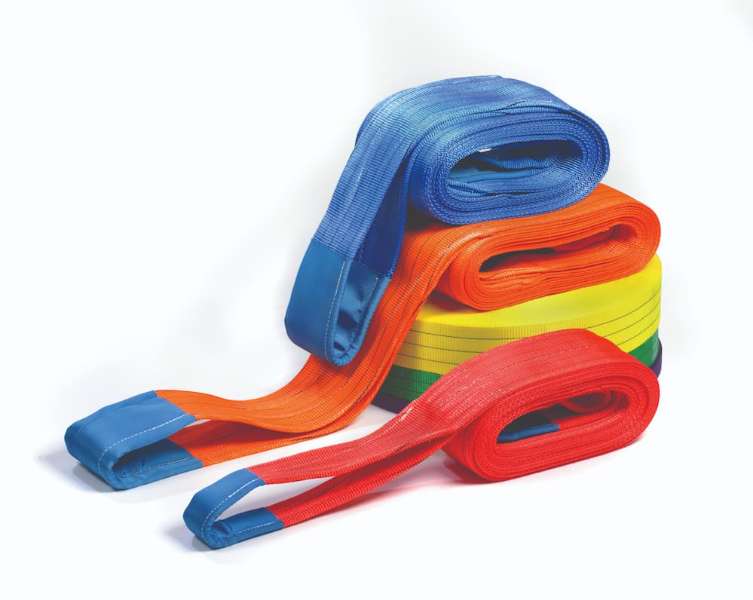
In various industries and sectors, webbing slings have become essential tools for lifting and securing heavy loads. Their reliability, strength, and flexibility make them a popular choice in numerous applications where load handling is an integral part of the work process.
This article will provide a comprehensive explanation of what a webbing sling is, its uses, and its functions.
What is a Webbing Sling?
A webbing sling is a lifting or hoisting strap made from webbing material (often nylon, polyester, or polypropylene)designed to lift and secure heavy loads. This tool is commonly used in industries, construction, mining, and various other applications where heavy loads must be moved or lifted safely.
The main characteristics of a webbing sling are its high strength and flexibility. Webbing straps are designed to withstand loads with high tensile strength and are durable in various weather conditions. Additionally, since they are made from synthetic fibers, they have resistance to chemicals and are often UV resistant.
Webbing slings come in various types and configurations, including:
Round Sling: This sling is circular, very flexible, and suitable for lifting loads that require even load distribution.
Eye-and-Eye Sling: This type resembles a hair tie and has loops at both ends. These loops are used to tie loads or adjust the sling's length.
Endless Sling: This endless sling is in a circular shape without ends, providing flexibility in adjusting the sling's length for various load sizes.
Multi-Leg Sling: This sling has several legs or arms connected to a central point, allowing lifting with multiple attachment points.
Adjustable Sling: A type of sling that can be adjusted in length to adapt to different load sizes.
Webbing slings must be used correctly and follow strict safety guidelines. Each sling should be inspected regularly to ensure no significant damage or wear that could affect its performance. Additionally, their use should be handled by trained and experienced operators to ensure safe and efficient use.
Uses and Functions of Webbing Slings
Webbing slings are typically used to lift and secure heavy loads. They are widely used in industries such as construction, mining, manufacturing, shipping, and various other applications involving the movement or lifting of heavy objects.
Some common uses of webbing slings are as follows:
Lifting Heavy Items:
Used to move heavy items, such as heavy equipment, industrial machinery, containers, pallets, and construction components.
Construction Sector:
Often used to lift beams, steel bars, concrete, and other building materials. These slings enable safe and efficient lifting of loads to the desired position.
Industrial Maintenance and Repair:
Frequently used in the maintenance and repair of large industrial machines. They assist in moving heavy and large machine components with precision and safety.
Maritime and Shipping:
In the shipping and maritime transport world, webbing slings are used to secure cargo on ships or carriers. They ensure cargo remains stable and secure during transit.
Mining Sector:
Used in the mining industry to lift coal, ores, and other heavy loads from mining or extraction sites.
Road Construction or Soil Compaction:
Used to lift and move heavy equipment such as wacker plates or compacting rollers.
Difficult-to-Reach Areas:
Highly useful for lifting items in areas that are hard to reach with other heavy lifting equipment.
Manufacturing Plants:
Used in factories and manufacturing facilities to move heavy and large production equipment and components.
The use of webbing slings must be conducted correctly and according to safety guidelines. Each lifting task should be carefully evaluated, and the appropriate sling should be selected based on the load to be lifted and the environmental conditions of use.
Proper use of slings by trained operators will ensure safety and efficiency in the heavy lifting process.
For more information and product consultations, do not hesitate to contact us at PT. Kompindo Fontana Raya via email at [email protected] or phone at 021 5451040 / 0811 1200 1367.
Frequently Asked Questions About Webbing Sling
Q1: What is a webbing sling, and what is it used for?
A: A webbing sling is a type of lifting or hoisting strap made from webbing material such as nylon, polyester, or polypropylene. It is designed to lift and secure heavy loads safely. Webbing slings are commonly used in various industries, including construction, mining, manufacturing, and shipping, to handle and transport heavy objects, machinery, building materials, and cargo.
Q2: What are the different types of webbing slings available?
A: Webbing slings come in several types, each suited to specific lifting needs:
Round Sling: Circular in shape, ideal for evenly distributing the load.
Eye-and-Eye Sling: Features loops at both ends for easy attachment and length adjustment.
Endless Sling: A continuous loop that offers flexibility for various load sizes.
Multi-Leg Sling: Has multiple arms connected to a central point for lifting with multiple attachment points.
Adjustable Sling: Can be adjusted in length to accommodate different load sizes.
Q3: How should webbing slings be inspected for safety?
A: Webbing slings should be inspected regularly before each use to ensure safety. Check for any signs of wear and tear, cuts, fraying, chemical damage, or UV degradation. Ensure there are no significant damages that could compromise the sling's strength. Additionally, ensure that all fittings and hardware are in good condition. Regular inspections help maintain the sling’s performance and safety.
Q4: Can webbing slings be used in all weather conditions?
A: Yes, webbing slings are designed to be durable and can withstand various weather conditions, including rain and sunlight. They are made from synthetic materials like nylon, polyester, or polypropylene, which are resistant to moisture, chemicals, and UV rays. However, it's important to check the specific material properties of the sling you're using, as some materials may have better resistance to certain environmental factors than others.
Q5: What are some common safety guidelines for using webbing slings?
A: When using webbing slings, follow these safety guidelines to ensure proper handling and lifting:
Always inspect the sling for damage before each use.
Ensure the sling is properly rated for the load being lifted.
Do not exceed the sling's rated load capacity.
Use slings that are appropriate for the load and lifting environment.
Avoid sharp edges that could cut or damage the sling; use protective sleeves if necessary.
Ensure that only trained and experienced operators handle the sling and lifting equipment.
Store slings properly when not in use to prevent damage from environmental factors.