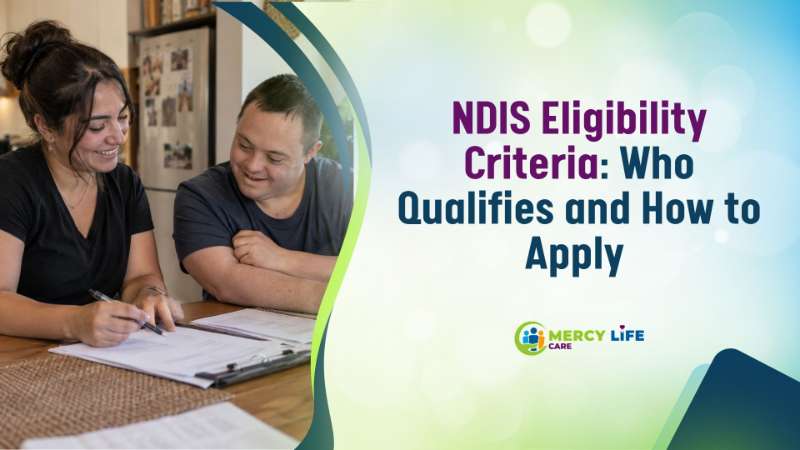
Getting NDIS support starts with three separate tests: your age, where you live, and how your disability affects your daily life. Passing all three is what gets an application through the door. What ends up in an approved plan is a different question entirely, decided case by case.
A lot of people assume a diagnosis alone is enough, or that a specific list of conditions determines the outcome. Neither is quite right. Here's what the National Disability Insurance Agency (NDIA) is actually checking for.
The age and residency tests
You need to be under 65 on the day you submit a complete application — there's no minimum age, so children can apply from birth. Miss the cutoff and a late application won't be accepted, even if everything else checks out, so anyone approaching 65 should get their paperwork moving well ahead of their birthday.
Residency works alongside this. You need to be an Australian citizen, a permanent visa holder, or hold a Protected Special Category Visa (this covers some New Zealand citizens), and you need to actually be living in Australia. The NDIA looks at where your day-to-day life is based, not just what your visa says.
What "disability requirements" actually means
This is where most confusion sits. To meet the disability requirements, five things need to be true at once:
- The disability comes from a recognised impairment (intellectual, cognitive, neurological, sensory, physical, or psychosocial)
- That impairment is permanent, or likely to be
- It substantially reduces your ability to communicate, socialise, learn, get around, manage self-care, or manage day-to-day organisation
- It affects your ability to work, study, or take part in social life
- You're likely to need support for the long term
All five, not two or three. A diagnosis can make some of these easier to demonstrate, but the NDIA is assessing functional impact, not the label itself — which is why two people with an identical diagnosis can end up with very different outcomes. Evidence usually comes from a treating professional who's worked with the person for at least six months.
The early intervention pathway is often overlooked
Early intervention doesn't require the "needed for life" element that the standard pathway does. It applies where a permanent or likely-permanent impairment exists, and where support now is likely to reduce how much support is needed later. It's open to adults, not just children, though children under 6 with developmental delay follow a slightly different version of the requirements.
Working out which pathway actually fits, and what evidence backs it up, is often where an application stalls. A support coordination service can help interpret how the criteria apply to a specific situation and pull together stronger evidence before an application goes in, rather than after a rejection.
No, it isn't means-tested
Income, savings, and Centrelink payments play no part in an NDIS eligibility decision. The NDIA only weighs age, residency, and functional impact — a detail that surprises a lot of first-time applicants.
A change coming for young children
From 1 January 2028, children aged 8 and under with autism or developmental delay assessed as having low-to-moderate support needs will move to the federal government's Thriving Kids program instead of an individual NDIS plan (the program itself begins a staged rollout from 1 October 2026). Children already in the NDIS before that date aren't affected, and children with higher support needs remain eligible as usual. Worth factoring into any planning conversation for a young child now, well ahead of the change.
Common questions
Can you apply if you're over 65?
No — the application has to be complete before the 65th birthday. Someone already over 65 who wasn't previously a participant would generally be pointed toward My Aged Care instead.
Does a diagnosis guarantee eligibility?
No. The NDIA looks at functional impact, not the diagnosis label. This is the single most misunderstood part of the process.
How long does a decision take?
Once an application is complete, the NDIA has 90 days to decide. If more information is requested, they then have 14 days to decide once it's supplied.
What if the answer is no?
An internal review can be requested within 3 months. A different staff member reassesses the decision, and if the outcome doesn't change, it can go to the Administrative Review Tribunal.
Do fluctuating conditions still count as permanent?
Yes, as long as the overall impact is ongoing — a condition that's worse some weeks and better others doesn't fail the permanence test on that basis alone.
Mercy Life Care is a registered NDIS provider supporting participants across Sydney. Learn more at mercylifecare.com.au.