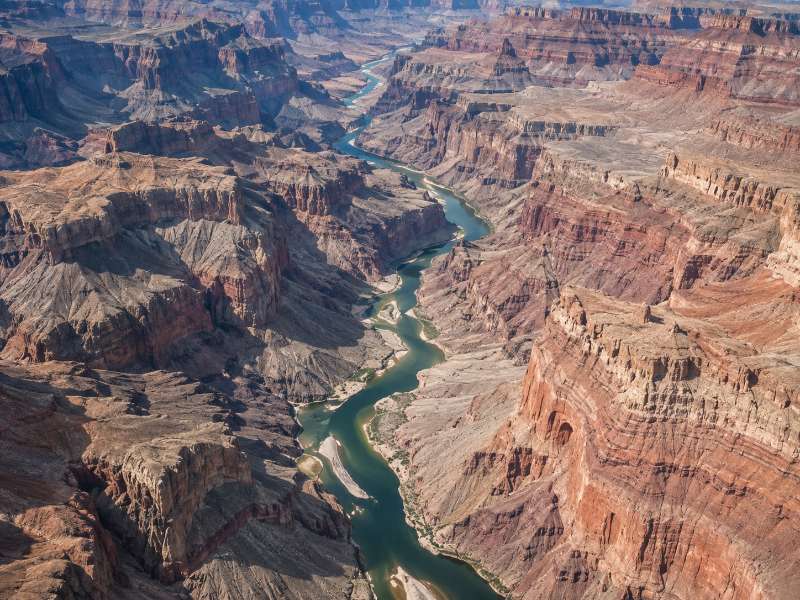
The Grand Canyon is one of those places that is difficult to fully understand until you see it in person. Located in northern Arizona on the Colorado Plateau, it stretches 277 miles, reaches up to 18 miles wide, and is more than a mile deep in places.
What makes the Grand Canyon even more remarkable is its history. Some of the rock exposed in its walls is nearly two billion years old, while the canyon itself was shaped much later as the Colorado River cut through the rising landscape over millions of years.
In this guide, we look at where the Grand Canyon is located, how it formed, how old it really is, and the people who have been connected to this landscape for thousands of years. We also explain why it remains such an important destination for visitors travelling from Las Vegas, Flagstaff, and other nearby cities.
Where Is the Grand Canyon Located?
The Grand Canyon is located entirely within Arizona in the southwestern United States. Grand Canyon National Park covers more than 1.2 million acres, with much of the canyon lying across the Colorado Plateau.
Nearest cities and gateways:
Flagstaff, Arizona: approximately 80 miles south of the South Rim, the most commonly visited entry point
Williams, Arizona: about 60 miles south of the South Rim and home to the historic Grand Canyon Railway
Las Vegas, Nevada: roughly 270 miles to the west, making it the most popular launch point for guided Grand Canyon tours and day trips
Las Vegas is especially convenient for visitors heading to Grand Canyon West, which is approximately 130 miles away on the Hualapai Reservation. Grand Canyon West is separate from Grand Canyon National Park and is owned and operated by the Hualapai Tribe.
Read Also:How Far Is the Grand Canyon from Las Vegas? Drive Times & Best Way to Get There
How Old Is the Grand Canyon?
This is one of the most common questions about the Grand Canyon, but the answer is not as simple as it sounds. It depends on whether you mean the age of the rocks or the age of the canyon itself.
The age of the rocks: up to 2 billion years old
The rock layers exposed inside the Grand Canyon cover an enormous span of time. Near the bottom, the dark metamorphic and igneous rocks known as the Vishnu Basement Rocks are around 1.7 to 2 billion years old, making them some of the oldest rocks visible in the canyon. Above them, younger sedimentary layers record very different environments, including ancient seas, deserts, river systems, and periods of volcanic activity.
The youngest major rocks at the canyon's rim, the pale Kaibab Limestone, formed around 270 million years ago, when a shallow sea covered the region.
The age of the canyon itself: 5 to 6 million years old
The canyon itself is much younger than the rocks around it. In its current form, the Grand Canyon is generally estimated to be around 5 to 6 million years old, based on when the Colorado River began cutting deeply through the landscape.
There is still some debate about whether parts of the canyon may be older. Some studies suggest that earlier sections may have started forming tens of millions of years ago, before the modern Colorado River followed its current route. Other research supports the idea that most of the canyon we recognise today developed within the last 5 to 6 million years as the river became connected to the Gulf of California.
The key distinction: the rocks are ancient, with some nearly 2 billion years old, while the canyon itself is much younger. The rock layers were already in place long before the Colorado River began cutting through them and exposing the landscape we see today.
How the Grand Canyon Was Formed ( A Step-by-Step Timeline)
The Grand Canyon's formation is the story of sediment, time, uplift, and water working together across an almost incomprehensible timescale.
1. Ancient seas lay down the foundation (1.7 billion to 270 million years ago)
Long before the Grand Canyon existed, the region that is now northern Arizona went through many different environments, including ancient seas, rivers, coastal plains, and deserts. Over hundreds of millions of years, sediments such as sand, silt, mud, and marine material built up and gradually hardened into rock.
Each layer in the canyon walls records a different part of that history. The reddish Hermit Formation formed in river and coastal-plain environments, the pale Coconino Sandstone came from vast wind-blown desert dunes, and the Redwall Limestone formed beneath a warm tropical sea.
2. The Colorado Plateau rises (around 70 to 30 million years ago)
Beginning around 70 million years ago, tectonic forces started lifting the Colorado Plateau. Unlike many mountain-building regions, much of the plateau rose while its rock layers remained relatively flat.
This uplift was an important step in the formation of the Grand Canyon. As the land rose, rivers flowing across the plateau gained a steeper downhill gradient, giving them more energy to cut into the rock.
3. The Colorado River begins cutting (about 5 to 6 million years ago)
Older river systems existed in the region before the modern Colorado River formed. Around 5 to 6 million years ago, different sections of the river system became connected, creating a route toward the Gulf of California.
Once this drainage system was established, the Colorado River began cutting more deeply into the Colorado Plateau. This process, known as downcutting, gradually exposed layer after layer of much older rock.
4. Erosion widens and deepens the canyon (5 million years ago to present)
The Colorado River did not shape the Grand Canyon on its own. While the river cut downward, rainfall, freeze-thaw cycles, weathering, and side streams helped break down and widen the canyon walls. Tributaries also carved side canyons, contributing to the buttes, mesas, and other landforms visible today.
The landscape is still changing. The Colorado River continues to move sediment through the canyon, although Glen Canyon Dam has greatly reduced the amount of sediment arriving from upstream since it began regulating the river in 1963. Weathering and erosion also continue along the canyon walls which means the Grand Canyon is still being shaped today.
Native American History and Human Connection
Long before European explorers arrived, people were already living in and around the Grand Canyon. Archaeological evidence shows that humans have used this landscape for nearly 12,000 years, giving the canyon a lopeoples of the canyon
ng history that goes far beyond tourism and exploration.
The Indigenous
Several Native American nations have deep ancestral and cultural ties to the Grand Canyon and the surrounding region:
The Havasupai, whose name means "people of the blue-green waters", have lived in and around Havasu Canyon for generations. Their community of Supai is located within the canyon and is reached by trail, mule, or helicopter.
The Hualapai, meaning "people of the tall pines", have strong ties to the western Grand Canyon. Today, the Hualapai Tribe operates Grand Canyon West, including the well-known Skywalk.
The Navajo Nation borders the Grand Canyon to the east and has a long-standing cultural connection to the surrounding landscape.
The Hopi also have deep ancestral ties to the region, including connections to Ancestral Puebloan communities. Tusayan Pueblo near Desert View is one example of a settlement occupied around 800 years ago.
For these communities, the Grand Canyon is much more than a place to visit. It is part of their history, culture, traditions, and ongoing connection to the land.
European exploration
The first Europeans known to have seen the Grand Canyon were members of a Spanish expedition led by García López de Cárdenas in 1540. They reached the South Rim but were unable to find a practical route down to the Colorado River.
More than three centuries later, John Wesley Powell led one of the most important early river expeditions through the canyon. In 1869, Powell, a Civil War veteran who had lost his right arm, travelled down the Green and Colorado rivers with his crew, documenting the journey and helping bring wider attention to the Grand Canyon.
Becoming a national park
By the early 20th century, efforts to protect the Grand Canyon were growing. President Theodore Roosevelt visited in 1903 and famously urged people to "Leave it as it is. You cannot improve upon it." In 1908, he declared the area a National Monument.
On February 26, 1919, the Grand Canyon officially became a National Park. In 1979, Grand Canyon National Park was also added to the UNESCO World Heritage List for its outstanding natural significance.
Why the Grand Canyon Still Matters Today
More than a century after becoming a national park, the Grand Canyon is still important for much more than its views. It remains a valuable place for scientific research, tourism, conservation, and understanding the geological history of the region.
An unmatched geological record
The Grand Canyon gives visitors a rare look at an enormous stretch of geological time. Its exposed rock layers range from about 270 million to 1.8 billion years old, allowing geologists to study how environments and landscapes changed over hundreds of millions of years.
Because so many of these layers are visible within the canyon walls, the area has become an important place for studying geology and understanding the long history of the Colorado Plateau.
Tourism and conservation
Grand Canyon National Park welcomed about 4.43 million visitors in 2025, making it one of the most visited national parks in the United States. Tourism also supports nearby gateway communities and businesses across northern Arizona.
Managing that level of visitation comes with challenges. The National Park Service works to protect the canyon’s natural and cultural resources while still allowing millions of people to experience the park each year.
It's still forming
The Grand Canyon is not a finished landscape. The Colorado River continues to flow through it, while rain, flash floods, freeze-thaw cycles, and weathering slowly reshape the canyon walls and side canyons.
These changes happen gradually, but they are still happening today. Standing at the rim means looking at a landscape shaped by nearly two billion years of rock history and geological processes that continue to change it.
Conclusion: See This History Firsthand
The Grand Canyon brings together nearly two billion years of geology, deep Indigenous history, and a landscape that is still changing today. Its vast scale, exposed rock layers, and long connection to the people who have lived around it make it far more than just a famous viewpoint. For travellers from Las Vegas, a guided Sweetours tour makes it easier to experience either the South Rim or West Rim while learning more about the history, geology, and stories behind the canyon without having to organise the entire trip yourself.
Book your Grand Canyon adventure today and see the canyon for yourself.
Frequently Asked Questions
How was the Grand Canyon formed?
The Grand Canyon was mainly formed by the Colorado River cutting down through the Colorado Plateau over roughly 5 to 6 million years. As the plateau was uplifted, the river gained a steeper route and more energy to carve through the rock. Rainfall, freeze-thaw cycles, weathering, and tributaries also helped widen and deepen the canyon over time.
How old is the Grand Canyon?
The answer depends on whether you mean the rocks or the canyon itself. Some of the oldest exposed rocks are around 1.8 billion years old, while the canyon in its current form is generally considered to be around 5 to 6 million years old. Geologists still debate whether some sections may have begun forming earlier. The Kaibab Limestone at the rim is about 270 million years old.
Where is the Grand Canyon located?
The Grand Canyon is located in northern Arizona, within Grand Canyon National Park on the Colorado Plateau. Flagstaff is about 81 miles by road from the South Rim, while Williams is about 63 miles away. Las Vegas is roughly 278 miles from the South Rim and is a major starting point for guided tours.
What caused the Grand Canyon to form?
Several processes worked together. The uplift of the Colorado Plateau raised the landscape, the Colorado River cut downward through the rock, and weathering and erosion from rain, freeze-thaw cycles, and side streams gradually widened the canyon.
How long did it take to form the Grand Canyon?
Most of the Grand Canyon we see today was carved over the past 5 to 6 million years, although some older canyon features may have existed before the modern Colorado River formed. The rock layers themselves are much older, and erosion is still shaping the canyon today.
Who were the first people to live at the Grand Canyon?
Archaeological evidence shows that people have lived in and around the Grand Canyon for nearly 12,000 years. Several Indigenous nations have deep ancestral and cultural ties to the area, including the Havasupai, Hualapai, Navajo, and Hopi. The Hualapai Tribe also operates Grand Canyon West, including the Skywalk.
When did the Grand Canyon become a national park?
Grand Canyon National Park was officially established on February 26, 1919. Theodore Roosevelt visited the canyon in 1903 and declared it a National Monument in 1908. In 1979, Grand Canyon National Park was added to the UNESCO World Heritage List for its outstanding natural significance.
Can you visit the Grand Canyon from Las Vegas?
Yes. Las Vegas is a major gateway for trips to the Grand Canyon. Grand Canyon West is about 130 miles from Las Vegas and is located on Hualapai tribal land, separate from Grand Canyon National Park. Sweetours offers guided tours from Las Vegas to both the West Rim