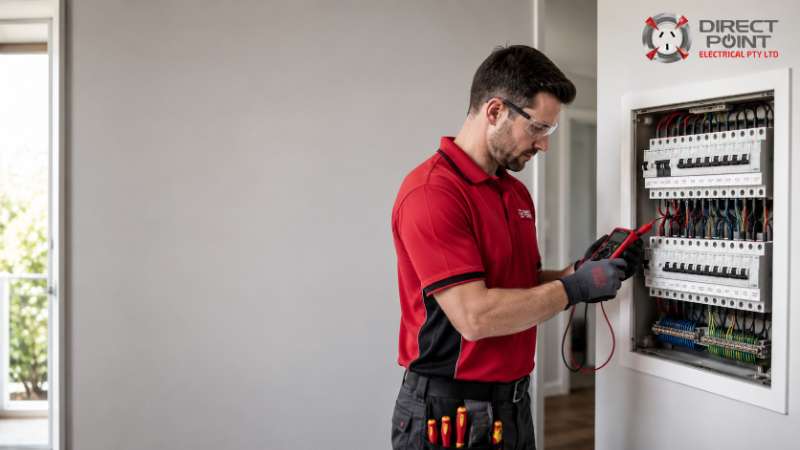
A switchboard needs upgrading when it still uses ceramic fuses, has no safety switches, trips repeatedly, or has no spare capacity for new circuits. Boards installed in South East Melbourne homes before the mid-1990s were designed for a fraction of today's electrical load. A licensed electrician can usually complete a residential upgrade in 4–8 hours, adding RCD protection, labelled circuits, and capacity for air conditioning, EV charging and induction cooking.
A switchboard needs upgrading when it can no longer protect the people using the electricity behind it. The clearest indicators are ceramic rewirable fuses rather than circuit breakers, no safety switches (RCDs), a board with no spare ways, breakers that trip whenever the heater and kettle run together, or scorch marks and a warm cover. Homes across Berwick, Pakenham, Cranbourne and West Gippsland built before the mid-1990s were wired for a stove, a few lights and a television — not for ducted heating, three air conditioners, a home office and a car charging in the garage.
What does a switchboard actually do in my home?
A switchboard is the control point that takes incoming supply from the street and distributes it across every circuit in the property, cutting power when a fault occurs. Every light, power point and appliance runs through it.
A modern board does three jobs an older one often cannot:
Circuit breakers isolate a circuit drawing more current than the wiring can safely carry
Safety switches (RCDs) cut power in roughly 30 milliseconds when current leaks to earth — the fault that causes electric shock
Clear labelling and spare capacity so a fault can be isolated in seconds and new circuits added later
Ceramic fuses perform only the first function, and they perform it slowly. That is why so many of the older weatherboard and brick-veneer homes we work on across Casey and Cardinia end up on the switchboard upgrade list.
What are the signs my switchboard needs upgrading?
The warning signs are usually visible well before anything fails. If two or more of the points below apply, book an inspection rather than waiting for a fault.
Ceramic fuses with fuse wire instead of circuit breakers
No safety switch, or a single RCD covering the whole property
Breakers tripping more than once a month
A board that is full, with no room for another circuit
Buzzing, crackling, a warm cover, or a burning smell
Scorch marks, cracked casing, or exposed wiring
Asbestos backing board, common in Melbourne homes built before 1990
Winter brings these problems to the surface across South East Melbourne. Column heaters, dryers and reverse-cycle units running together push older boards past what they were built to carry, which is why call-outs for tripping breakers climb through July and August. Anything involving heat, smell or sparking should be treated as urgent — our emergency electricians are available for exactly these situations.
Do I need a safety switch, or is a fuse box enough?
A fuse box is not enough. Fuses protect wiring from overload; safety switches protect people from electric shock, and the two are not interchangeable.
Current Australian wiring rules (AS/NZS 3000) require RCD protection on new and altered circuits, so significant electrical work in a Berwick or Officer home will bring parts of the board up to that standard regardless. If you own a rental property in Victoria, safety switch and smoke alarm obligations sit with you as the rental provider, and an out-of-date board makes those annual checks harder to pass.
A practical benchmark: a modern residential board should carry RCD protection across all power and lighting circuits, not just the kitchen.
How does RCD testing fit with a switchboard upgrade?
Installing a safety switch is only half the job — RCDs are mechanical devices that can fail silently, so they need testing at intervals. This is the same principle behind our electrical safety inspection and test and tag service, which covers RCD testing alongside inspection of wiring, cords, outlets and equipment to identify risks before they cause injury.
For workplaces, the benchmark is AS/NZS 3760, the in-service inspection and testing standard, with intervals set by environment:
Installing a safety switch is only half the job — RCDs are mechanical devices that can fail silently, so they need testing at intervals. This is the same principle behind our electrical safety inspection and test and tag service, which covers RCD testing alongside inspection of wiring, cords, outlets and equipment to identify risks before they cause injury.
For workplaces, the benchmark is AS/NZS 3760, the in-service inspection and testing standard, with intervals set by environment:
Employers and controllers of premises carry a legal obligation under OHS legislation to eliminate or control the risk of electrical injury, which makes documented testing part of running a compliant site. Businesses across Berwick, Dandenong and the South East pair a commercial switchboard upgrade with a scheduled testing cycle for that reason.
At home the rule is simpler: press the TEST button on each safety switch every three months and confirm the power cuts immediately.
How much does a switchboard upgrade cost in Melbourne?
Most residential switchboard upgrades in Melbourne's South East fall between roughly $900 and $2,500, depending on board size, circuit count and the condition of the existing wiring.
The variables that move the price:
A fixed written quote matters more than the lowest hourly rate. Every job we take across Berwick, Frankston, Pakenham and West Gippsland is quoted in writing before work begins, and any change in scope is confirmed with you before it is actioned — one of the commitments in our 7 Point Customer Guarantee, which also covers 730 days of workmanship warranty. You can request a free quote online at any time.
Do I need a switchboard upgrade before installing air conditioning or an EV charger?
Often, yes. High-draw equipment generally requires its own dedicated circuit, and the board needs both physical space and spare capacity to accommodate one.
The four installations that most commonly trigger an upgrade in our service area:
Ducted or split system air conditioning — dedicated circuits and higher sustained load (air conditioning installation)
EV chargers — a 7kW charger draws roughly what an entire older home once did (EV charger installation)
Induction cooktops — replacing gas with induction adds a substantial dedicated circuit (oven and cooktop installation)
Renovations and extensions — new rooms, new lighting, new power points (renovation electrical work)
Board capacity is checked before we quote any of this work, which avoids the scenario where equipment is delivered to a Cranbourne or Clyde North home and cannot be safely connected.
How does the Direct Point Switchboard Safety Assessment work?
The Direct Point Switchboard Safety Assessment is the on-site evaluation our electricians run before recommending any board work, so the quote reflects your actual property rather than a generic package. It covers five areas:
Board type and age — fuses or breakers, RCD coverage, backing board material
Load and capacity — what the property currently draws against what the board can carry
Circuit condition — labelling, terminations, signs of heat damage or moisture ingress
Compliance status — safety switch coverage, smoke alarms, earthing
Future requirements — air conditioning, EV charging, solar or renovations planned within the next few years
Point five is the one most quotes skip. Upgrading a board with no spare ways means paying twice when the EV charger arrives eighteen months later.
Direct Point Electrical has been a family-owned business operating across South East Melbourne and West Gippsland since 2012, based at Berwick and working from Mount Waverley through to Western Port Bay. Our electricians are licensed, insured, NECA members and police checked, under Electrical License REC 22004. The Switchboard Safety Assessment forms part of our residential and commercial service, and every job is backed by the 730-day workmanship guarantee.
Frequently Asked Question
Q: How do I know if I have a safety switch?
A: Open your switchboard cover and look for a switch with a TEST button on it. That is your safety switch. If every switch on the board is a plain breaker or a ceramic fuse with no test button, you have no RCD protection. Press the test button every three months — the power should cut immediately. If it doesn't, call a licensed electrician.
Q: Can I upgrade the switchboard myself?
A: No. Switchboard work in Victoria must be carried out by a licensed electrician and requires a Certificate of Electrical Safety. Working on a live board is one of the more dangerous jobs in the trade, because the main incoming supply stays live throughout. It is also a condition of most home insurance policies that electrical work is completed by a licensed contractor.
Q: How long will my power be off during the upgrade?
A: Usually 4–8 hours for a standard residential board, though larger homes or boards with asbestos backing take longer. We confirm the expected outage window before the day so you can plan around fridges, freezers and anyone working from home.
Q: My breaker only trips occasionally. Can I leave it?
A: A breaker that trips is doing its job, but repeat trips mean something is wrong — an overloaded circuit, a failing appliance, or a wiring fault. Resetting it without finding the cause is how small faults become fires. If it happens more than once a month, have it checked.
Q: What is the difference between a circuit breaker and a safety switch?
A: A circuit breaker protects the wiring by cutting power when a circuit draws too much current. A safety switch protects people by cutting power when current leaks to earth, which is what happens when someone touches a live part. A board can have plenty of breakers and still offer no shock protection at all.
Q: Does an old switchboard affect my home insurance or property sale?
A: It can. Buyers' building inspections routinely flag ceramic fuses and missing safety switches, and it becomes a negotiating point on price. For Victorian rental properties, electrical safety obligations sit with the rental provider, so an outdated board is a compliance problem as well as a safety one.
Q: How often does a workplace need test and tag?
A: Under AS/NZS 3760 it depends on the environment — every 3 months on construction and demolition sites, 6 months in factories and warehouses, 12 months in offices and retail where cords flex or take wear, and 5 years in low-risk settings. We can set up a recurring schedule so the records stay current.
Q: Do I need a three-phase switchboard?
A: Most homes run fine on single-phase. Three-phase becomes relevant with large ducted systems, workshops with heavy machinery, multiple EV chargers, or commercial premises. It is worth assessing before an upgrade rather than after, since converting later costs more than allowing for it upfront.
Q: Will an upgrade fix my flickering lights?
A: Sometimes. Flickering can come from a loose connection at the board, which an upgrade resolves. It can also come from a fault further along the circuit, a failing fitting, or a supply issue from the street. An inspection identifies which before any work is quoted.
Q: Do you service my area?
A: We work across South East Melbourne and West Gippsland, including Berwick, Pakenham, Cranbourne, Officer, Clyde North, Narre Warren, Frankston, Lang Lang and surrounding suburbs. Our full list of service areas is on the website, or call 1300 317 328 to confirm availability for your address.
Whether a switchboard needs upgrading comes down to five things: the type of board installed, whether it carries safety switches, how much load the property now draws, its physical condition, and what you plan to add over the next few years. The Direct Point Switchboard Safety Assessment works through all five before a quote is issued, so you are not paying for capacity you don't need or being caught short when the next appliance arrives. If your board still has ceramic fuses, no test buttons, or breakers tripping through winter, have it looked at now rather than after a faul
Direct Point Electrical Pty Ltd 17 High St, Berwick VIC 3806 Phone: 1300 317 328 Open: Mon – Sat, 7:00 – 17:00