Strength training after 60 is the single biggest change I get clients to make, and it's rarely the one they expect. A lot of the people who come through my door have been walking regularly for years. They garden. They chase grandkids around the backyard on weekends. And they're often surprised when I tell them: none of that is enough on its own.
It's not that walking or gardening don't matter. They do. But if strength is the thing you're not training, it's the thing that will fail you first. And when it fails, it doesn't fail gently. It shows up as not being able to get off the floor after a fall, or needing both arms to push up out of a chair.
Here's the way I think about it, and the way I explain it to every client who walks in unsure if it's "too late" for them: we don't get old and then stop moving. We stop moving, and that's what makes us old.
What happens if you skip strength training after 60
Muscle loss doesn't wait until your 60s to start. It begins as early as your 30s, and quietly accelerates every decade after that if nothing is done about it. By the time most people notice it, they're not noticing muscle. They're noticing the consequences: harder stairs, heavier shopping bags, less confidence on uneven ground.
The numbers back this up. After age 30, adults typically lose somewhere between 3% and 8% of their muscle mass per decade, and that pace speeds up again after 60 (Harvard Health; Cleveland Clinic). Left unmanaged, that adds up to roughly a third of total muscle mass lost over a lifetime. It's not a scare stat, it's just what happens by default when muscle isn't regularly stimulated. Which is exactly why "default" isn't good enough.
The goal was never about looking like a bodybuilder. It's about being able to:
- Stand up from a chair without using your hands
- Carry your own shopping in from the car
- Get down on the floor to play with a grandchild, and get back up
- Recover your balance instead of falling when you trip
That's the whole return on investment. Independence, not aesthetics.
The real reason falls happen
Most people assume falls are a balance problem. In my experience, that's only half the story. Balance gets you into a wobble. Strength is what gets you out of it. A person with strong hips, legs, and core can catch themselves. A person without that strength goes down.
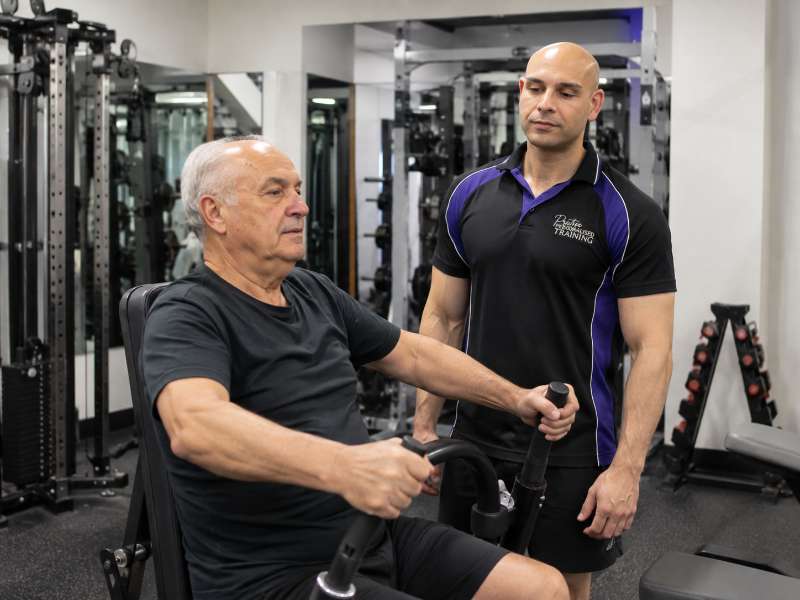
That's why the training I build for clients isn't just about lifting. It targets the muscles around the hips, legs, and core that do the actual work of catching a stumble before it becomes a fall.
Why strength training for over 60s beats walking alone
I'm not here to talk anyone out of walking. Genuinely, keep doing it. But walking on its own doesn't do much to preserve muscle mass or bone density. It's cardiovascular maintenance, not strength maintenance, and after 60 you need both.
What I build for clients instead sits on four pillars:
- Strength training: two to three sessions a week
- Walking: most days, 20 to 40 minutes
- Balance work: a few short sessions a week
- Mobility and flexibility: even 10 minutes a day makes a difference
Together, those four cover far more ground than walking by itself ever could.
"How capable do I want to be at 80?"
That's the question I ask clients to sit with, instead of "how fit can I get." Once you're past a certain point, training isn't about performance. It's about longevity, and about protecting the version of yourself you want to still be in twenty years.
The biggest mistake I see
Doing too little, out of fear of injury. It's understandable, but it's backwards. Being weak is a far bigger injury risk than training is, when the training is done properly and progressively.
If you're managing arthritis, osteoporosis, diabetes, heart disease, or an old injury, that doesn't rule strength training out. It just means the program needs to start at your level and build gradually, not follow a generic template. That's the whole premise behind the five-step system I use with every client: assess first, personalise the plan, coach it properly, track what's actually changing, then adjust to sustain it. It's a rehab-aware approach, not a one-size-fits-all workout sheet.
It's never too late to start
I've had clients in their 60s, 70s, and 80s get stronger than they ever thought possible at that age. The body stays remarkably adaptable. The biggest barrier usually isn't the body, it's the belief that it's too late to try.
What tends to surprise people most isn't the physical change. It's watching their confidence come back. Clients who thought their best years were behind them, getting down on the floor with grandchildren again. Better sleep, better posture, steadier blood sugar, less chronic pain. The muscle is really just the mechanism. What it buys you is independence.
Where to start, even without a gym
You don't need equipment or a gym membership to begin. Sitting and standing from a chair, wall push-ups, calf raises, step-ups, and bodyweight squats are all legitimate starting points. The hardest part was never the exercise itself. It's starting.
If you're on the Gold Coast and want strength training after 60 built around where you're actually starting from, get in touch. We begin every new client with an assessment, not a workout. That includes an Evolt 360 body composition scan, so you know exactly where you're starting from before anything else happens. You can book a free assessment at PrestigePT's private studio in Bundall, or reach us on 07 5620 4420 or [email protected].
Written By Shawn Maftounian, Founder & Director of Prestige Personalised Training
Shawn Maftounian is the Founder and Director of Prestige Personalised Training, a private personal training studio in Bundall, Gold Coast. He holds a Bachelor's Degree in Sports from Griffith University, was named Australia's #1 Personal Trainer in 2019, and is one of only three IFBB Certified Trainers in Australia. His approach to training over-60s was recently featured in Starts at 60, where he told the outlet: "We don't stop exercising because we get old, we get old because we stop moving."