Saddle Chair vs Office Chair vs Kneeling Chair: What the Evidence Actually Says
For decades, the standard response to workplace back pain was simply to buy a "better" office chair. However, as our understanding of occupational biomechanics has evolved, it has become abundantly clear that standard 90-degree seating is fundamentally flawed for active, forward-leaning professions.
Today, health professionals, ergonomists, and practice owners are faced with three primary seating interventions: the traditional ergonomic office chair, the kneeling chair, and the saddle chair. But which one actually prevents musculoskeletal disorders (MSDs)?
In this comprehensive, evidence-based guide, we break down the clinical biomechanics of all three seating options, analyse what the peer-reviewed evidence actually says, and provide a definitive recommendation guide based on your specific profession and working style.
The Biomechanical Baseline: The Importance of Pelvic Tilt
To understand why different chairs yield different results, we must first understand the pelvis. The human spine is naturally shaped like an "S" (lumbar lordosis). When you stand, your pelvis is neutral, and this "S" curve is effortlessly maintained, distributing gravity evenly across your intervertebral discs.
When you sit down, the angle of your hips changes everything. If your hips are forced into a 90-degree angle, the pelvis mechanically rolls backwards. This is called a posterior pelvic tilt. This backward roll flattens the lumbar spine, turning the healthy "S" into a damaging "C" shape. This "C" slump dramatically increases anterior disc compression, stretches the posterior longitudinal ligament, and leads to chronic back pain.
The ultimate goal of ergonomic seating is to maintain an anterior pelvic tilt (forward roll) while seated, thereby preserving the spine's natural standing curve. Let us examine how the three main chair types attempt to solve this problem.
1. The Traditional Ergonomic Office Chair
The traditional ergonomic office chair (featuring a flat seat pan, lumbar support dial, armrests, and a high back) is the standard fixture in 99% of corporate environments.
How It Works
These chairs operate on the principle of "passive sitting." They assume the hips will be at a 90-degree angle and attempt to artificially push the lower back into a lordosis using a protruding lumbar support cushion.
The Evidence
Clinical evidence indicates that traditional office chairs are highly effective for reclined, passive tasks (such as taking a phone call or watching a presentation). When a user leans back to a 110-degree angle, the backrest effectively unloads the weight of the torso from the spine.
However, studies show that for active, forward-leaning tasks (typing, dentistry, drafting), traditional chairs fail completely. As soon as the user leans forward away from the backrest, the 90-degree hip angle forces the pelvis into a posterior tilt. The lumbar support becomes useless because the user's back is no longer touching it, resulting in severe spinal compression.
Pros:
Excellent for passive, reclined resting.
Highly adjustable armrests and backrests for varied body types.
Cons:
Forces a 90-degree hip angle, leading to posterior pelvic tilt.
Useless for forward-leaning, precision tasks.
Promotes core muscle atrophy through passive support.
2. The Kneeling Chair
Popularised in the 1970s (often known as the Balans chair), the kneeling chair was the first mainstream attempt to break away from 90-degree seating.
How It Works
A kneeling chair drops the thighs to a downward angle (usually around 110 to 120 degrees) while the user's shins rest on a padded knee/shin block to stop them from sliding forward off the angled seat.
The Evidence
By dropping the thighs, kneeling chairs successfully open the hip angle past 90 degrees. Biomechanically, this is a vast improvement over standard office chairs. Evidence shows that this open angle facilitates an anterior pelvic tilt, which helps maintain the spine's natural "S" curve during forward-leaning tasks.
However, the clinical consensus has shifted regarding long-term use. The primary issue is weight distribution. Because gravity pulls the user down the angled seat pan, a significant portion of the body's weight is transferred directly onto the shins and knees. Over an 8-hour workday, this static pressure restricts venous return (blood circulation) in the lower legs and can exacerbate patellofemoral pain. Furthermore, the shins are locked into place, drastically reducing the user's mobility and preventing them from reaching or turning efficiently.
Pros:
Opens the hip angle, promoting a healthier spinal curve than flat chairs.
Good for short-duration tasks (1–2 hours).
Cons:
Transfers significant compressive load to the knees and shins.
Restricts lower-limb circulation during prolonged use.
Locks the user in a static position, reducing lateral mobility.
3. The Saddle Chair
Designed by an Australian Occupational Therapist, the authentic saddle chair (such as the Bambach Saddle Seat) represents the gold standard for active, precision professions.
How It Works
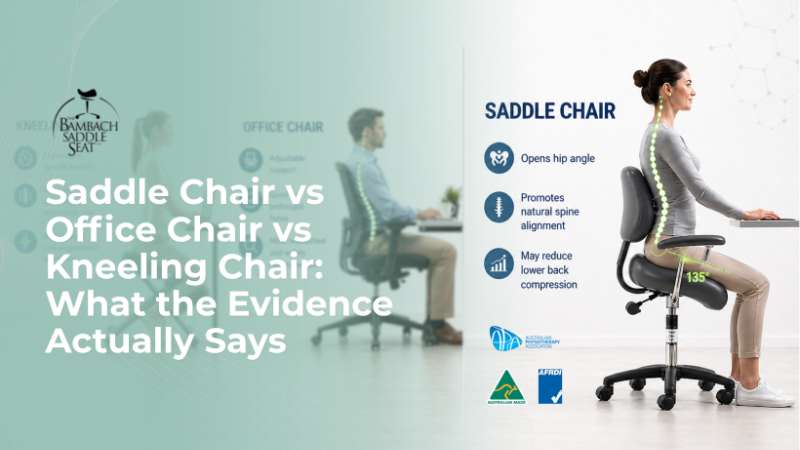
The user straddles the chair as if riding a horse. This unique contoured shape drops the thighs dramatically, creating a 135-degree open hip angle. The practitioner’s feet remain flat on the floor, bearing a portion of the weight and providing a wide, stable base of support.
The Evidence
Peer-reviewed clinical evidence strongly supports the 135-degree saddle posture. Because the hip angle is so wide, the pelvis naturally and effortlessly rotates into an anterior tilt.
Crucially, the saddle chair achieves this without transferring load to the knees (like a kneeling chair) and without requiring external lumbar bracing (like an office chair). The user’s skeletal structure perfectly balances the weight of the torso. Furthermore, the straddle stance allows for "active sitting." The core stabiliser muscles remain engaged, the diaphragm opens for deeper breathing, and the user can easily propel themselves around the room using their legs.
Pros:
Achieves the optimal 135-degree hip angle for natural spinal alignment.
Eliminates pressure on the knees and shins.
Maximises mobility, allowing practitioners to work closer to patients/desks.
Encourages active core engagement.
Cons:
Requires a short (1-2 week) muscular acclimatisation period.
Requires a higher desk or working surface to accommodate the elevated seating position.
The Comparison Table
This table provides a definitive, scannable comparison of the biomechanical impacts of each seating intervention.
Regulatory Standards: Navigating AHPRA, APA, and AFRDI in Australia
When purchasing ergonomic seating for a clinical or corporate environment in Australia, buyers are frequently misled by marketing terminology.
It is a common misconception that ergonomic chairs need to be "AHPRA Approved." The Australian Health Practitioner Regulation Agency (AHPRA) strictly regulates individual healthcare practitioners (like dentists, doctors, and nurses); they do not approve, register, or regulate medical devices, furniture, or seating.
If you are looking for verifiable, clinical-grade seating, you must look for appropriate industry endorsements:
Australian Physiotherapy Association (APA) Endorsement: This is the highest clinical trust signal. The Bambach Saddle Seat is the only seating solution in its class to earn APA endorsement for its evidence-based prevention of spinal injuries.
AFRDI Level 6 Certification: This certification proves the chair has been independently tested to withstand severe, 24/7 commercial use without structural failure.
TGA Registration: In some specific surgical contexts, seating may be listed with the Therapeutic Goods Administration, though this is not mandatory for standard ergonomic chairs.
Practical Recommendation Guide by Profession
Different professions have vastly different biomechanical demands. Here is the evidence-based recommendation for your working style:
For Dental Professionals & Surgeons
Recommendation: The Saddle Chair
Dentists, hygienists, and surgeons cannot lean back into a chair; they must lean forward over a patient. An office chair will destroy a dentist's lower back, and a kneeling chair restricts the mobility needed to move around the operatory. The Bambach Saddle Chair allows the practitioner to straddle the seat, keeping knees clear of the patient, maintaining perfect spinal posture, and allowing for unrestricted mobility.
Learn more on our dedicated Ergonomic Dental Saddle Chairs page.
For Standard Corporate Office Workers
Recommendation: Traditional Office Chair (High-End) OR Hybrid Approach
If your job primarily involves looking straight ahead at a monitor, taking calls, and reading documents, a high-quality traditional office chair that allows you to recline to 110 degrees is highly effective. Many forward-thinking professionals now use a hybrid approach: using an office chair for passive reading, and switching to a saddle chair paired with a standing desk for active typing and focus work.
For Artists, Drafters, and Architects
Recommendation: Saddle Chair or Kneeling Chair
These professions require constant forward-leaning over a drafting table or canvas. A kneeling chair is a viable, affordable option for short bursts of work (1-2 hours). However, for full-time professionals working 8-hour days, the saddle chair is the only clinically viable option that prevents both back slumping and lower-limb circulation issues.
Conclusion
The evidence is clear: when it comes to active, forward-leaning work, the traditional 90-degree office chair is anatomically counterproductive. While the kneeling chair was a step in the right direction, it merely trades spinal pain for knee and shin pressure.
For professionals who rely on their bodies to perform precision work—particularly in dentistry and surgery—the authentic, 135-degree saddle chair remains the ultimate, clinically validated solution for preventing career-ending musculoskeletal disorders.
Frequently Asked Questions (FAQs)
What does the evidence say is the best chair for lower back pain?
Clinical evidence suggests that for passive resting, a reclined ergonomic office chair is highly effective. However, for active, forward-leaning work (like typing or dentistry), evidence heavily favours the saddle chair. By opening the hip angle to 135 degrees, a saddle chair automatically restores the spine's natural curve, removing the compressive load from the lower back discs.
Is a kneeling chair better than an office chair?
Yes, in terms of spinal alignment. A kneeling chair prevents the lower back from slumping by opening the hip angle. However, evidence shows that kneeling chairs are not suitable for full-day use (8+ hours) because they transfer a heavy load to the shins and knees, which can restrict blood circulation and cause joint pain over time.
Are saddle chairs AHPRA approved?
No medical furniture or equipment is "AHPRA approved," because AHPRA only regulates healthcare practitioners in Australia, not products. However, genuine clinical saddle chairs, like the Bambach, are endorsed by the Australian Physiotherapy Association (APA) and tested to severe commercial standards (AFRDI Level 6).
Does it take time to get used to a saddle chair?
Yes. Because a saddle chair promotes "active sitting," you will be engaging core and postural muscles that have likely weakened from years of slumping in standard chairs. Users typically experience mild muscle fatigue for the first one to two weeks. This is a normal physiological adaptation period as your core strengthens to support your newly aligned spine.
Can I use a saddle chair with a standard height desk? Generally, no. Because a saddle chair drops your thighs and elevates your pelvis to achieve the 135-degree angle, you will be sitting significantly higher than you would in a standard chair. You will need a height-adjustable desk, a drafting table, or a clinical operatory setup to use a saddle chair properly without hunching your shoulders.