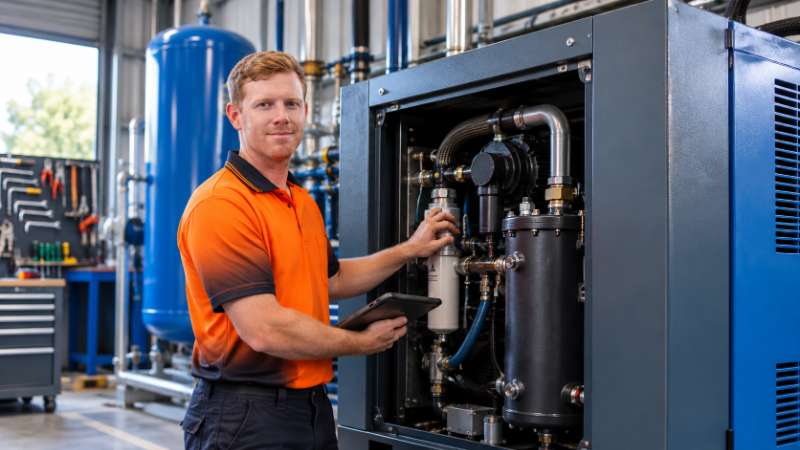
TL;DR
- A rotary screw air compressor is rated for 100% continuous duty: it can run all day without overheating, where a piston compressor is typically limited to 50 to 75% duty cycle
- At sustained outputs above 20 to 25 CFM, a rotary screw almost always costs less per CFM to run than an equivalent piston unit
- Most Sydney production workshops, fabrication shops, and automotive body shops running more than one shift should be on a rotary screw
- A fixed-speed rotary screw still draws 25 to 30% of full-load power when unloaded; a VSD unit eliminates most of that waste for variable-demand operations
- All Air Compressors supplies, installs, and services rotary screw compressors across Sydney and NSW
Is Your Current Compressor Keeping Up With Your Workshop?
If your piston compressor is running hot, struggling during peak production, or tripping out on summer afternoons, you may already have the answer. A rotary screw air compressor is built for continuous duty: 100% run time, all day, without the thermal stress that limits a piston unit. For most Sydney workshops running sustained air demand, the question is not whether to move to a rotary screw. It is when.
The compressor in a busy fabrication shop, CNC machining bay, or automotive body shop runs for hours at a stretch. A piston compressor rated at 50% duty cycle can handle that for a while, but running it past its rating shortens service intervals, increases repair frequency, and eventually results in unplanned downtime. A rotary screw compressor solves the continuous duty problem at the source.
How Does a Rotary Screw Compressor Actually Work?
A rotary screw compressor uses two meshing helical rotors to compress air continuously as it passes along the rotor chambers. There are no valves, no reciprocating pistons, and no dead-centre positions where compression stops. Air flows in one end and compressed air flows out the other, smoothly and without interruption.
Compare that to a piston compressor: compression happens in discrete strokes, heat builds up through each cycle, and the unit needs periods of rest to cool down. A piston unit rated at 75% duty cycle runs 45 minutes every hour. Push it past that rating and you will see overheating shutdowns, accelerated wear on valves and rings, and repair bills that compound over time.
In an oil-injected rotary screw, the oil does three jobs: lubricates the rotor bearings, seals the clearances between the rotors to maintain compression efficiency, and carries heat away from the compression chamber to the oil cooler. That oil circuit is why a rotary screw runs cool enough for continuous duty, and why it requires downstream oil removal filtration before the air reaches tools or processes.
Which Applications Actually Require a Rotary Screw?
A rotary screw is the right choice when the compressor runs under load for more than 60% of the working day. For lighter intermittent use, a quality piston unit does the job at lower purchase cost.
Application | Typical Demand Profile | Right Compressor Type |
Single-bay auto workshop, light tools | Intermittent, short bursts | Piston |
Panel shop / spray booth, one operator | 40 to 60% duty cycle | Piston or entry rotary screw |
Fabrication / metalwork, multiple tools | 60 to 80% duty, sustained | Rotary screw |
Production line, continuous pneumatics | 100% duty cycle | Rotary screw (required) |
CNC machining, air feed plus coolant purge | Sustained, pressure-critical | Rotary screw |
Construction site, towable unit | Intermittent, variable | Diesel rotary screw |
The threshold that matters most is not the compressor's nameplate rating. It is how long your system actually runs under load each day. If you have never measured that, a compressed air system audit can confirm actual duty cycle figures under real operating conditions and tell you whether your current unit is being overworked before you commit to a replacement.
What Does a Rotary Screw Cost to Run Compared to a Piston?
Specific energy is the standard efficiency measure: kilowatts consumed per CFM of output. A well-sized rotary screw typically runs at 0.09 to 0.12 kW per CFM. An equivalent piston unit runs at 0.12 to 0.17 kW per CFM. At 50 CFM and 4,000 hours per year on NSW rates of $0.25 per kWh, that difference works out to roughly $2,000 per year in electricity saved on the rotary screw, before accounting for lower maintenance costs and fewer unplanned repairs.
One trap with fixed-speed rotary screw units: they still draw 25 to 30% of full-load power when running unloaded, venting to the atmosphere while waiting for demand to return. On a variable-demand operation, that idle draw adds up across a shift. A variable speed drive compressor eliminates most of that waste by matching motor speed to actual demand. If your production load varies significantly, VSD is worth specifying from the start.
Oil-Injected or Oil-Free: Which Rotary Screw Do You Need?
For most Sydney workshops, an oil-injected rotary screw is the correct choice. It costs less to purchase, costs less to maintain, and runs reliably for years with regular oil and filter service.
Oil-free rotary screw is required only where compressed air contacts food, pharmaceutical packaging, or precision electronics directly. Rotor clearances in an oil-free unit are maintained without oil injection, which means tighter manufacturing tolerances and a higher purchase cost, typically 30 to 40% more than an equivalent oil-injected unit.
If your application is food processing, beverage packaging, or pharmaceutical production, the oil-free requirement is a compliance matter, not a preference. The existing oil-free air compressor compliance guide covers the food grade and ISO 8573-1 requirements in detail. For every other Sydney workshop application, oil-injected is the practical and economical choice.
How Do You Size a Rotary Screw Compressor for a Sydney Workshop?
Size to peak demand plus a 20 to 25% margin. A compressor running at 95% of rated capacity from day one leaves no headroom for additional equipment, production growth, or the output reduction that comes with heat and filter restriction over time.
Add up the CFM requirements of every tool or process likely to run at the same time, then add 20 to 25%. That is your minimum rated output.
For Sydney workshops in western suburbs where summer ambient temperatures regularly reach 35°C, ask your supplier for performance data at actual operating conditions, not just standard test conditions. A unit sized for a 25°C ambient may trigger high-temperature shutdown in an uncooled bay in January.
Most rotary screw units from 5.5 kW up run on 415V three-phase supply. Confirm your electrical supply before specifying. The compressed air piping installation guide covers how pipe sizing and layout affect delivered pressure at the tool.
What Does Rotary Screw Maintenance Actually Involve?
A rotary screw has fewer moving parts than a piston compressor but more specialised consumables. Standard service items on an oil-injected unit include compressor oil, oil filter, air/oil separator element, and inlet air filter. Typical intervals run 2,000 to 4,000 hours depending on operating conditions.
In hot Sydney summer conditions, oil degrades faster and separator intervals should be checked against actual operating temperature. A blocked separator forces the compressor to work harder and increases oil carryover into the air line. Common failure modes include separator failure, inlet filter collapse under high demand, and thermostatic valve faults. All three are preventable with a structured preventative maintenance schedule.
Frequently Asked Questions
Is a rotary screw compressor worth it for a smaller workshop?
It depends on run time under load. If the compressor runs for more than half the working shift, a rotary screw pays back in running cost and reliability within a few years. For a one-person shop using air in short bursts, a quality piston compressor is the more practical choice at lower purchase cost.
What kW output do I need for a rotary screw compressor?
Add up the CFM of every tool likely to run at once, then add 20 to 25% margin. A rough guide: 1 kW delivers approximately 4 to 5 CFM at 7 bar, so a 7.5 kW unit delivers roughly 30 to 38 CFM. Always ask for the performance curve at your actual operating pressure, not just the headline rating.
How often does a rotary screw compressor need servicing?
Standard service intervals on an oil-injected unit run 2,000 to 4,000 hours depending on the unit and conditions. In hot Sydney workshops, summer heat shortens oil and separator life, so check intervals against actual operating temperature. High-production operations should target 1,000 to 2,000 hour cycles.
Can a rotary screw compressor run continuously all day?
Yes. 100% continuous duty is the design intent. Running at continuous duty does not damage the unit provided the oil cooler is maintained, airflow around the unit is adequate, and the compressor is correctly sized for the load. A piston compressor run at continuous duty will overheat and fail components; a rotary screw will not.
All Air Compressors supplies, installs, and services rotary screw compressors across Sydney and NSW. Call +61 435 166 474 or visit allaircompressors.com.au to discuss your application. Also listed on Top4.