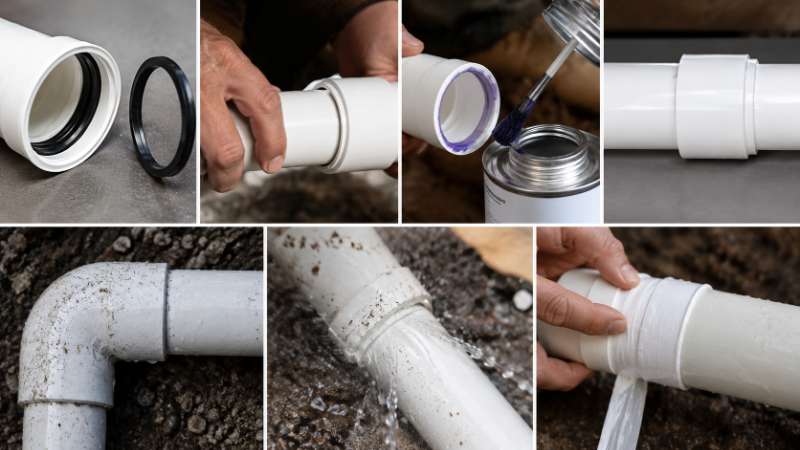
Choosing the way to join PVC pipes is one of the most important choices in a water system, a sewer system or an irrigation system. Make the choice. You could end up with loss of pressure having to come back to fix things or needing to dig up a whole section of the main pipe and replace it. Rubber ring joints, solvent cement joints and threaded or flanged connections each work best in situations. The right PVC pipe joining method depends on the pipe class and the pressure rating. Rubber ring joints, also called push-joints are best for pressure mains such as MPVC and OPVC pipes. Solvent cement is best for diameter UPVC pipes and for work that does not involve pressure. Threaded or flanged joints are used at valves at meters and, for connections.
This guide walks through how each PVC pipe joining method works, when to use it, and how to diagnose and repair a leaking joint on an existing main, whether you're specifying a new pipeline or troubleshooting an old one.
PVC Pipe Joint Types Overview
PVC pipe joint types: pressure vs drainage
PVC pipe in Australian water infrastructure generally falls into two broad categories, and the joint method follows the category:
Pressure pipe (water mains, recycled water, pressure sewer): almost always rubber ring jointed for larger diameters, because a push-fit joint accommodates ground movement and thermal expansion without stressing the pipe wall. Viadux's MPVC and OPVC pressure pipe ranges use this rubber ring joint (RRJ) system as standard.
Non-pressure pipe (stormwater, DWV, gravity drainage): typically solvent cement jointed at smaller diameters, or rubber ring jointed at larger diameters. Viadux's non-pressure PVC pipe range covers both.
Choosing the right joint method by application
As a general rule, if the pipe is going to carry water under pressure and sit in the ground for decades, use a rubber ring. If it's a smaller-diameter line being assembled above ground or in a trench with tight access, solvent cement is faster and doesn't need special jointing tools. Threaded and flanged joints come into play wherever the pipeline needs to connect to a valve, pump, meter, or another material, since they're a mechanical connection rather than a permanent bond.
Rubber Ring (Push-Fit) Joints
How rubber ring joints work
A rubber ring joint uses a factory-formed socket at one end of the pipe, with a rubber sealing ring fitted inside it. The other end, the spigot, is chamfered and lubricated, then pushed into the socket. As it seats, the spigot compresses the rubber ring against both surfaces, forming a watertight seal.
Because the joint isn't rigidly bonded, it can flex slightly to accommodate ground movement, minor misalignment, and thermal expansion or contraction, without placing stress on the pipe wall. This flexibility is why rubber ring joints are the standard choice for buried pressure mains.
Installation step-by-step
Check the spigot end and socket for damage, dirt, or debris before assembly.
Confirm the rubber ring is the correct size and profile for the pipe class, and that it's seated evenly in the socket groove with no twists.
Apply an approved pipe lubricant to the spigot end and the exposed face of the ring. Never use oil-based or petroleum products, as these can degrade the rubber.
Align the pipe lengths and push the spigot into the socket to the manufacturer's insertion mark, using a bar and block, come-along, or excavator bucket for larger diameters.
Check the ring hasn't rolled or displaced during insertion. A partially dislodged ring is one of the most common causes of an early joint leak.
Lubricant selection and application
Use only the lubricant specified by the manufacturer for that particular ring compound. The wrong lubricant, or none at all, increases insertion force, raises the risk of the ring twisting in the groove, and shortens the working life of the seal. Apply a thin, even coat: excess lubricant does nothing to improve the seal and can attract debris to the joint face.
PVC pipe joints: checking for correct seating
Once the spigot is pushed home, to confirm it has reached the insertion depth marked on the barrel, most manufacturers provide a witness line for this purpose. A joint that hasn't been fully pushed in won't achieve full ring compression, making it more likely to leak or pull apart under pressure or thermal movement. On larger diameters, a feeler gauge can confirm even ring compression before backfilling.
Solvent Cement Jointing
How solvent cement bonds PVC
Solvent cement does not connect surfaces the way glue does. By softening PVC at the joint point, solvent cement permits two surfaces to create a single continuous piece of pipe as the solvent evaporates. When applied correctly, solvent-welded joints are usually stronger than what lies on either side of the joint. However, when this is not done right, it is one of the problems that usually occurs with PVC.
PVC pipe joining: surface preparation steps
Cut the pipe square using a proper pipe cutter or fine-tooth saw and a mitre box.
Deburr and lightly chamfer the cut end so it doesn't scrape cement from the socket wall during insertion.
Dry-fit the pipe into the fitting to check for a snug interference fit. It should go roughly a third to two-thirds of the way in by hand.
Clean both surfaces with an approved PVC cleaner/primer to remove surface gloss, dirt, and grease, which otherwise prevent the solvent from softening the PVC evenly.
Application technique and dwell times
The solvent cement should be initially applied to the pipe end, followed by thinner cementing the fitting socket. It is important to act quickly since the solvent starts to evaporate right away. After that, insert the pipe into the fitting turning it by one quarter to uniformly coat it with the cement, then keep it in place for a certain amount of time required by the manufacturer, usually 30 to 60 seconds, to prevent the joint from backing out because of solvent pressure. The good sign that the connection has been made properly is that there is an even bead of cement visible around the joint face.
Cure times before pressure testing
The strength of solvent-welded connections is achieved almost immediately, however curing may take a lot longer. A common practice dictates that you should wait a few hours before disturbing the pipework in question and a day when pressure testing is being made. Please observe the curing time recommended by the manufacturer of the cement as well as the pipe since this varies depending on pipe diameter, temperature, and pressure.
Threaded & Flanged Joints
PVC pipe thread: BSP thread jointing
Usually the ends of a PVC system that are smaller in diameter consist of threaded connections instead of another section of pipe to connect various fittings and devices such as valves, meters, taps, etc. In Australia BSP (British Standard Pipe) threads are generally used for PVC fittings instead of other types of threads available. Before making connection using the thread male ends, a PTFE tape or special sealant is used on the threaded surface and the joint is hand-tightened using a strap wrench avoiding the excessive load on the joint being made.
Flange connection assembly
Flanged connections are located points in tubing which don't require welding. Flanged connections consist of two flat pieces of metal, known as flanges, with a layer of material (usually rubber) in between the two flanges. The bolts holding everything together are then tightened evenly across the connection, which allows the flanges to fit snugly against one another and form a leak-proof connection which can be undone.
PVC Pipe Joint Leak Repair
PVC pipe joint leak repair: diagnosing the cause
There are typically three reasons for a leak at a rubber ring joint – either the rubber ring has become displaced or rolled, or the spigot or socket is damaged or deformed, or the joint was never pushed in fully at the time of installation. A leak at a solvent (chemically) welded joint usually indicates a dry joint, either due to insufficient glue or allowing time for it to set, or because contamination occurred during the installation process. It is also possible that the joint was disturbed before it had time to completely cure. It is essential to excavate and inspect the joint to determine which type of problem you are dealing with.
Rubber ring replacement on existing mains
In cases where the ring has broken or shifted but both the pipe and socket are still intact, the pipe can sometimes be detached, the new ring fitted back into the right position and the joint reassembled using the same lubrication and fitting procedure as in a fresh installation. When withdrawing the pipe is not an option, it is usually a repair clamp that provides the next best solution, and this method is usually faster and more reliable than the previous method mentioned.
Repair vs replacement decision guide
Localised split, crack, or pinhole in the pipe barrel: a repair clamp is usually the fastest permanent fix, restoring pressure integrity without cutting out the damaged section.
Failed joint that can be re-seated: re-jointing (rubber ring) or a new solvent weld (small-diameter, above-ground) may be viable if the pipe ends are undamaged.
Damaged, out-of-round, or badly misaligned pipe ends: cut out the damaged section and rejoin with a Vari-Gib coupling or equivalent restrained coupling, rather than forcing a standard joint over compromised pipe.
Repeated leaks in the same section of ageing main: this is usually a sign the section itself needs replacing rather than repeated point repairs. Talk to your Viadux branch about a replacement pipe spec suited to the application and ground conditions.
Preparing Pipe Ends
PVC pipe ends: cutting, deburring and chamfering
Every joint method in this guide depends on the pipe end being cut square, deburred, and, for rubber ring and solvent cement joints, chamfered to the manufacturer's angle. A poor cut is one of the most avoidable causes of joint failure: it concentrates stress unevenly around the joint, can damage the sealing ring on insertion, or prevent proper solvent contact around the full circumference.
PVC pipe joining after field cutting
Where a standard length has been cut in the field to make up a closing length, the cut end needs to be re-chamfered to the same profile as a factory spigot before it's used in a rubber ring joint, and re-cleaned and primed before solvent cementing. Skipping this step on a field cut is a common, avoidable cause of joint leaks that only shows up once the main is pressurised.
Pressure Testing After Jointing
AS 2419.1 hydrostatic test procedure
Pressure mains in Australia are commonly tested in accordance with AS 2419.1, which sets out the hydrostatic testing procedure for fire and water mains, including test pressures, hold times, and allowable makeup water. Testing should only take place once every joint in the test section, rubber ring and solvent cement alike, has reached the manufacturer's minimum cure or seating time.
Acceptance criteria for new PVC joints
A test section passes when it holds the specified test pressure for the specified hold time within the allowable makeup water volume, with no visible leaks at any joint. Any joint that weeps, sweats, or drops pressure outside the allowable tolerance should be exposed, inspected, and re-made before the section is accepted and backfilled. It's far cheaper to fix at test stage than to excavate a live main later.
Whether you're specifying a new PVC pressure main or diagnosing a joint failure on an existing network, the right product range matters as much as the right technique. Viadux stocks the full spread of , including MPVC, OPVC, UPVC and non-pressure ranges, along with and for existing mains. Full technical specifications for every joint type are available in the .
Need help specifying the right joining method for your next project? Contact your local Viadux branch on 1300 VIADUX (842 389) or visit to talk to a product specialist about your application.