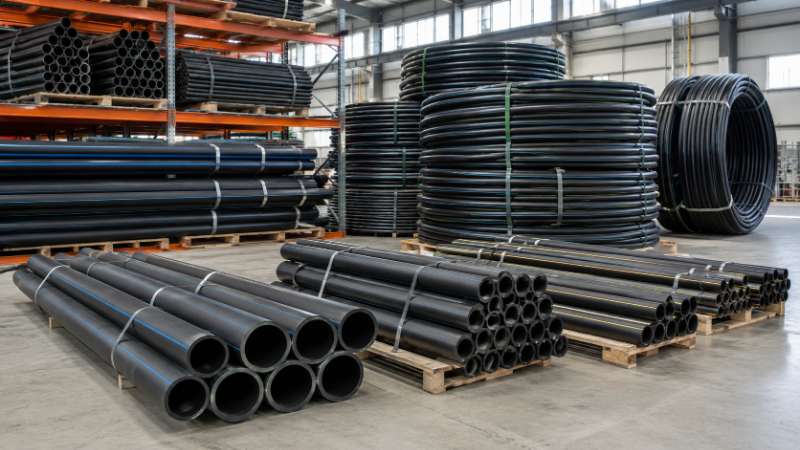
If you've ever stood in front of a pallet of polyethylene pipe and tried to work out whether it's rated for the pressure you need, or why one length is black with a blue stripe and the next is solid orange, you're not alone. PE pipe types in Australia are grouped by two things: the resin grade (PE80, PE100, or a crosslinked variant like PEX-a/PEX-b) and the colour coding that signals what the pipe is designed to carry. Get either one wrong on a specification and you risk supplying a pipe that fails pressure testing or, worse, gets installed in the wrong network entirely.
This guide breaks down what PE pipe stands for, how PE80 compares to PE100, what XA and XB crosslinked grades are used for, and what each colour on the pipe actually means, so you can specify with confidence the first time.
What Does PE Pipe Stand For?
PE pipe is polyethylene pipe, a thermoplastic pressure and non-pressure pipe used across water, gas, sewer, irrigation and mining networks in Australia. It's valued for being lightweight, corrosion-resistant, flexible enough to handle ground movement, and easy to joint using butt welding, electrofusion or mechanical couplings.
PE Pipe Stands For: Polyethylene Explained
Polyethylene is produced by polymerising ethylene gas under controlled pressure and temperature. The density and molecular structure of the resulting resin determines the pipe's strength classification, which is where PE80 and PE100 come in.
The Relationship Between HDPE, MDPE and LDPE
You'll often see HDPE pipe (high-density polyethylene) used almost interchangeably with "PE pipe" in the civil and water sectors, and for pressure pipe applications that's generally accurate, most pressure-rated PE pipe supplied in Australia today is manufactured from high-density resin. Medium-density polyethylene (MDPE) and low-density polyethylene (LDPE) exist but are far less common in pressure pipeline work; MDPE turns up occasionally in gas distribution, while LDPE is mostly used for non-pressure or protective conduit applications rather than water mains.
Viadux supplies a full range of PE100 pressure pipe for potable water, recycled water, sewerage and rural applications across Australia.
PE Pipe Grades: PE80 vs PE100
The number after "PE" refers to the Minimum Required Strength (MRS) classification of the resin, essentially, how much long-term hydrostatic pressure the material can withstand before failure.
PE80 Pipe Meaning and MRS Rating
PE80 pipe uses a resin with an MRS rating of 8.0 MPa. It was the dominant PE pressure pipe grade for decades and is still specified in some legacy networks and lower-pressure applications, but it has largely been superseded in new installations.
PE100 – Higher Strength and Thinner Wall
PE100 pipe uses a resin rated to 10.0 MPa MRS, a 25% strength improvement over PE80. In practice, that means a PE100 pipe can be manufactured with a thinner wall than a PE80 pipe of the same pressure rating and diameter, giving a larger internal bore, better flow characteristics, and less material and freight cost for the equivalent pressure class. This is why PE100 has become the industry standard for new pressure mains in Australia.
When to Specify PE80 vs PE100
As a general rule:
Specify PE100 for new potable water mains, recycled water, pressure sewer and most civil infrastructure projects, it's the current Australian standard and offers better hydraulic performance per dollar.
PE80 may still appear in older as-constructed networks, in some low-pressure rural or irrigation contexts, or where matching existing infrastructure is required.
Always confirm the required pressure class (PN rating) and jointing method against the project's water authority specification before ordering, pressure class and resin grade both need to match the design, not just one or the other.
Crosslinked PE Pipe: XA and XB Grades
Crosslinked polyethylene (PEX) pipe modifies the polymer structure after extrusion by forming chemical bonds, "crosslinks", between polymer chains. This changes how the pipe behaves under heat and pressure compared with standard (non-crosslinked) PE80 or PE100.
PE-Xa Pipe – Radiation Crosslinked
In the PEX-a process, crosslinking is achieved through high-energy radiation (or a peroxide method carried out during extrusion, depending on manufacturer). PEX-a typically achieves the highest degree of crosslinking of the common methods, which translates to strong resistance to stress cracking and good performance at elevated temperatures.
PE-Xb Pipe – Peroxide Crosslinked
PEX-b pipe is crosslinked using a moisture-cure (silane) or peroxide process rather than radiation. It's a widely used and cost-effective crosslinking method, offering a good balance of flexibility and pressure/temperature performance for hot water and pressure surge applications.
Applications: Hot Water, Pressure Surges
Crosslinked PE pipe is specified where standard PE would be marginal, hot water reticulation, applications with frequent pressure surges or water hammer risk, and underfloor heating or similar services where sustained elevated temperature is part of normal operation. If your project involves cyclic pressure loading, it's worth checking surge behaviour early, Viadux's water hammer calculator can help model transient pressure spikes before you lock in pipe class and jointing method.
PE Pipe Colour Codes in Australia
Colour coding on PE pipe isn't cosmetic, it's a safety and identification system so that field crews, from install through to future excavation, know what a buried pipe is carrying without needing to trace records.
PE Pipe Blue – Potable Water (Standard)
Blue stripes on a black pipe (or solid blue) indicate potable (drinking) water. This is the colour you'll see most often on new water main installations.
HDPE Pipe Black – General Purpose and UV Resistant
Solid black HDPE pipe, without coloured stripes, is generally used for general-purpose, non-drinking-water applications, the carbon black content also provides strong UV resistance, which matters for pipe stored or run above ground before installation.
HDPE Pipe Yellow – Gas Distribution
Yellow is reserved for gas distribution pipe in Australia, consistent with the national convention for gas infrastructure. This colour coding is critical, never substitute yellow-striped pipe for a water application or vice versa.
HDPE Pipe Orange – Telecommunications / Conduit
Orange indicates electrical or telecommunications conduit rather than a fluid-carrying pipe. It's a common sight alongside water and gas trenches in shared civil works.
HDPE Pipe Blue – Potable Water Variant
Some manufacturers also offer a solid (rather than striped) blue HDPE pipe as a potable water variant, functionally the same designation as blue-striped pipe, just a different manufacturing presentation.
HDPE Pipe Green – Recycled / Non-Potable Water
Lilac/purple is the more common Australian designation for recycled water in many state guidelines, but green striping also appears for non-potable or recycled water in some networks, always check the relevant water authority's colour convention before ordering, as this is one area where local variation exists.
PE-HD Pipe (High Density PE) Explained
"PE-HD" and "HDPE" refer to the same material family, high-density polyethylene, and the terms are used interchangeably in Australian technical documentation and product literature. When you see PE-HD on a spec sheet, it's describing the same resin density class covered above under PE80/PE100.
PE Pipe Coating Types
Beyond the base resin and colour, some PE pipe applications call for additional surface treatment.
PE Pipe Coating for Corrosive Environments
Where PE pipe or fittings interface with corrosive soils, chemically aggressive effluent, or industrial waste streams, additional protective coatings or compatible fitting materials may be specified to extend service life. Viadux's PE spigot fittings are manufactured from PE100 and offer chemical and corrosion resistance suited to above-ground, below-ground, mining and irrigation applications.
UV-Stabilised Outer Layer Options
For pipe that will be stored, transported, or partially exposed above ground before or after installation, a UV-stabilised outer layer (or the inherent UV resistance of black HDPE) helps prevent premature degradation from sunlight exposure prior to burial.
Choosing the Right PE Grade
Application-Based Grade Selection Guide
Use this as a starting checklist, not a substitute for your water authority's design specification:
Confirm the network type, potable water, recycled water, sewer, gas, or industrial, this determines the required colour code.
Confirm the pressure class (PN rating) required by the design, then match it to PE100 (or PE80 where specified) pipe dimensions.
Check for surge or water hammer risk, if present, confirm whether crosslinked PE or a higher PN class is warranted.
Confirm jointing method, butt welding, electrofusion, mechanical couplings or compression fittings, as this can influence which product range is appropriate.
Verify compliance, PE100 pipe supplied by Viadux is manufactured to AS/NZS 4130 with StandardsMark and WaterMark certification; confirm the same applies to whatever you're specifying.
AS/NZS 4130 Material Classification
AS/NZS 4130 is the governing Australian/New Zealand standard for polyethylene (PE) pipes for pressure applications, covering material classification, dimensions and pressure ratings across the PE80/PE100 grade system described above. Fittings are covered under the related AS/NZS 4129 standard.
Viadux PE Pipe Range
Viadux stocks and distributes PE pipe and fittings across Australia's water infrastructure sector, including PE100 pressure pipe, PE spigot fittings, and gate valves designed for PE pipe systems. For a full technical breakdown across the entire product line, ductile iron, PVC, PE and industrial plastics, the Viadux Product Range Guide is available as a downloadable technical reference, or you can browse the complete product range online.
If you're still working through pipeline sizing or structural design before you get to material selection, Viadux's economic pipeline sizing and buried pipeline structural design calculators are a useful next step.
Need help specifying PE pipe for your next project? Contact Viadux to speak with a technical specialist about grade, colour coding and compliance for your application.