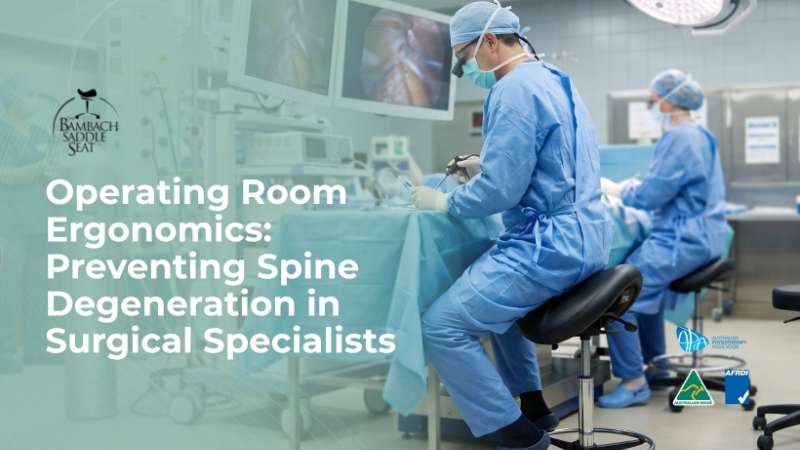
Operating Room Ergonomics: Preventing Spine Degeneration in Surgical Specialists
The operating theatre is one of the most physically demanding clinical environments in Australian healthcare. Whether performing multi-hour laparoscopic procedures, delicate microsurgery under a microscope, or complex podiatric operations, surgeons and surgical nurses routinely endure extreme static loading.
Consequently, while patient outcomes remain the paramount focus of surgical teams, the long-term physical toll on the surgical specialist’s body is severe.
The Silent Crisis in the Operating Theatre: Surgeon MSD Prevalence
Recent systematic reviews and clinical studies published in the Annals of Surgery reveal a critical workplace health crisis: between 70% and 90% of surgical specialists suffer from work-related musculoskeletal disorders (WMSDs) during their careers.
Furthermore, clinical data indicates that the physical strain is concentrated in three primary anatomical areas:
- Cervical Spine & Neck: Up to 80% of surgeons report chronic neck pain caused by prolonged downward gaze through surgical loupes or toward laparoscopic monitors.
- Lumbar Spine & Lower Back: Over 66% suffer from lower back pain resulting from sustained forward flexion without structural pelvic support.
- Shoulder Girdle & Rotator Cuff: Up to 53% experience shoulder impingement caused by holding static arm positions while manipulating long-shafted surgical instruments.
As a result of this unrelenting biomechanical stress, nearly 12% of surgical specialists require practice restrictions or suffer early retirement, while over 50% report that chronic pain directly impairs their daily surgical performance.
Why Traditional Operating Stools Cause Lumbar Collapse
Conventional flat operating stools and standard swivel chairs force the surgeon’s hips into a closed 90-degree angle. Consequently, this closed hip stance tilts the pelvis backward, flattening the natural “S” curve of the lumbar spine into an unhealthy, slumped “C” shape.
When a surgeon leans forward over an operating table or microscope on a flat seat, several severe physiological stressors occur:
- Intense Disc Pressure: Forward slumping on a flat seat increases intra-discal pressure on the L4/L5 lumbar vertebrae by up to 180%, accelerating spinal disc degeneration.
- Static Muscle Fatigue: The erector spinae and neck muscles must contract continuously to prevent the upper body from collapsing forward, leading to muscle hypoxia and painful spasms.
- Diaphragmatic Compression: A slumped lumbar spine compresses the abdominal cavity, restricting deep diaphragmatic breathing and reducing blood oxygenation during critical surgical moments.
Biomechanical Solution: How Bambach Protects Surgical Specialists
Engineered in Sydney by Australian Occupational Therapist Mary Gale, the Bambach Saddle Seat was created specifically to eliminate the postural breakdown inherent in flat seating.
| Operating Theatre Feature | Clinical & Surgical Advantage | Bambach Operating Standard |
| Hands-Free Foot Control | 100% Sterile Field Integrity Eliminates the need to touch hand levers during procedures, keeping hands completely sterile. | Integrated surgical foot-ring allows effortless height adjustment using foot pressure without breaking scrub. |
| AFRDI Level 6 Strength | Heavy Institutional Durability Handles dynamic weight shifts and continuous 24/7 hospital theatre use without mechanical failure. | Independently tested and certified to Australia’s highest severe commercial seating performance standard. |
135-Degree Open Hip Stance for Sustained Neutral Spine
By opening the hip stance to 135 degrees, the Bambach naturally rotates the pelvis forward into a neutral, balanced position. As a result, this structural alignment automatically preserves the spine’s healthy “S” curve without requiring a cumbersome backrest that restricts arm movement.
Hands-Free Foot-Ring Gas Lift for 100% Surgical Field Sterility
Surgeons cannot risk breaking scrub to manually adjust seat height during a procedure. Therefore, Bambach operating theatre chairs feature an optional hands-free foot-control ring. Surgical specialists can effortlessly adjust their height using their foot, preserving complete sterile field integrity throughout long operations.
Medical-Grade Antimicrobial Vinyl & AFRDI Level 6 Certification
Hospital operating theatres demand rigorous infection control. Bambach seats are hand-upholstered in seamless, medical-grade antimicrobial vinyl that withstands surgical fluids, betadine, blood, and harsh chemical disinfectants. Furthermore, every chair is independently tested to AFRDI Level 6 (Severe Commercial Use), ensuring structural stability under dynamic clinical loads.
Operating Stool Comparison: Conventional Stool vs. Bambach Saddle Chair
| Feature / Criteria | Conventional Flat Operating Stool | Bambach Surgical Ergonomic Saddle Chair |
| Hip Stance Angle | Closed 90° Pinches hip flexors and tilts pelvis backward. | Open 135° Rotates pelvis forward into neutral anatomical balance. |
| Spinal Alignment | Slumped “C” Curve High intra-discal pressure and spinal fatigue. | Natural “S” Curve Self-supporting upright alignment without lumbar strain. |
| Sterile Height Adjustment | Manual Hand Lever Requires breaking scrub or calling assistant. | Hands-Free Foot Ring Adjust height with foot to maintain 100% sterility. |
| Pelvic Stability | Flat Surface Sit bones slide, causing asymmetrical slumping. | Continuous-Contour Lock Solid seat pan locks sit bones for precise hand stability. |
| Infection Control | Standard Seams Fluids and bacteria penetrate stitched seams. | Seamless Medical Vinyl Fluid-resistant, non-porous, and hospital disinfectant ready. |
| Structural Standard | Uncertified / Basic Light commercial rating; prone to wear. | AFRDI Level 6 Certified Independently tested for severe hospital theatre use. |
Protect Your Surgical Career
Your surgical expertise relies entirely on your physical health and fine-motor precision. Therefore, stop allowing unsupportive, flat operating stools to compromise your spine and shorten your clinical career.
Explore the complete Bambach Ergonomic Saddle Chair Range or read our Australian Case Studies to discover how clinical seating transforms surgical endurance.
Ready to protect your operating room team? Contact us today!
Frequently Asked Questions
Why do over 70% of dental professionals experience chronic back and neck pain?
Dental procedures require clinicians to maintain static forward-lean postures over open patient mouths. On traditional flat chairs, this forces the hips into a 90-degree angle, flattening the lower spine's natural "S" curve into a slumped "C" shape and multiplying lumbar disc pressure.
What is the main advantage of a continuous-contour saddle chair over a split-seat design?
A continuous-contour seat provides a solid, unbroken surface that firmly locks the sit bones in place. Split-seat designs feature two separate moving pads that shift under dynamic body weight, creating lower-body instability that forces lumbar and shoulder muscles to tense up to maintain hand precision.
How does opening the hip angle to 135 degrees benefit dental hygienists?
Opening the hip angle to 135 degrees rotates the pelvis forward into a neutral position. This naturally restores the spine's healthy "S" curve, allowing dental hygienists to lean forward over patients without collapsing their lower back or compressing their abdominal cavity.
Are continuous-contour saddle seats easier to clean according to dental hygiene standards?
Yes. Continuous-contour seats feature a smooth, seamless surface upholstered in medical-grade vinyl. Unlike split-seat chairs with central gaps that trap aerosols, fluids, and dust, continuous seats can be rapidly decontaminated using standard hospital disinfectant wipes.
Why is AFRDI Level 6 certification important for dental practice chairs?
AFRDI Level 6 is Australia's highest independent structural testing standard for severe commercial use. It verifies that the chair frame, gas lift mechanism, and base can handle continuous heavy daily use and dynamic weight shifts in busy dental practices without mechanical failure.
Can a saddle chair help improve hand stability during delicate procedures like endodontics?
Yes. Fine-motor precision in the hands relies on core and shoulder relaxation. By providing a rock-solid, anchored pelvic base, a continuous-contour saddle chair eliminates lower-body wobble, allowing the shoulder girdle and arms to remain relaxed during high-precision dental tasks.