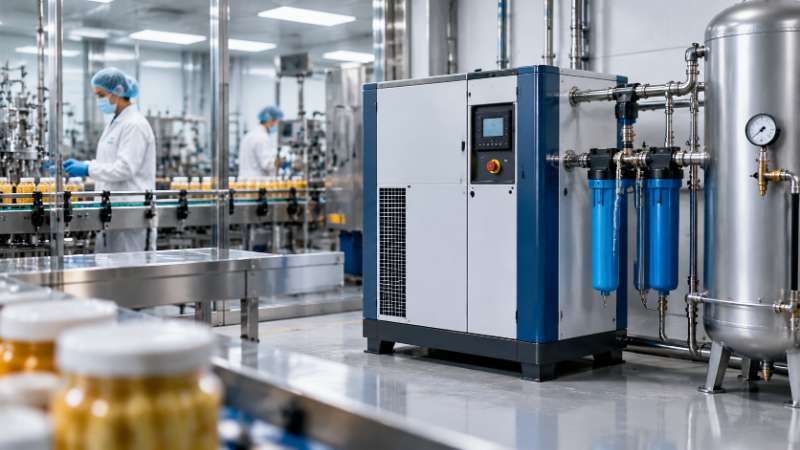
Oil-Free Air Compressor in Sydney: What Food and Pharma Manufacturers Actually Need
TL;DR
An oil-free air compressor eliminates oil from the compression stage entirely, producing air that meets ISO 8573-1 Class 0 for total oil content. Sydney food manufacturers, pharmaceutical facilities, and auto-paint shops increasingly need this because HACCP audits, SQF, BRC, and FSSC 22000 certifications require documented evidence that compressed air meets defined purity standards. While an oil-lubricated compressor with downstream filtration can technically achieve ISO 8573-1 Class 1 compliance, a single degraded coalescing filter can push oil content ten times above the Class 1 threshold without triggering an alarm. For applications where air contacts food, packaging, or sterile surfaces, a true oil-free compressor eliminates contamination risk at the source.
What Is Driving Sydney Facilities to Switch Right Now
Food safety certification requirements in Australia have tightened over recent years. FSSC 22000 explicitly requires documented inspection and testing of all compressors and air treatment equipment to prove compliance.
At the same time, compressed air audits are increasing across SQF and BRC-certified facilities. When an auditor asks for compressed air quality records and your system uses an oil-lubricated compressor, the burden of proof is on you. You need filter change records, dew point monitoring logs, and service history all pointing in the same direction. Any gap puts certification at risk.
Energy costs add further pressure. With industrial electricity prices in Sydney rising roughly 25% over five years, the energy penalty of running oversized filtration downstream of an oil-lubricated compressor is significant. A true oil-free compressor eliminates the heavy downstream filtration train needed to achieve food-grade air, reducing maintenance costs and eliminating pressure drops across multiple filter stages.
Here is what the standards require and how the technical differences break down for Sydney workshops running or considering an oil-free compressor.
Key Insights
- ISO 8573-1:2010 is the internationally recognised standard classifying compressed air by particulate class, water class (dew point), and oil class. Food contact applications require Class 1 or Class 0 for total oil.
- Class 0 means oil content is lower than Class 1 (0.003 mg/m³ total oil) as agreed between manufacturer and user. A true oil-free compressor achieves Class 0 without filtration.
- A degraded coalescing filter on an oil-lubricated compressor can push oil carryover ten times above the Class 1 threshold with no visible warning to the operator.
- HACCP food safety programs in Australia must include compressed air as a hazard control point where air contacts food, product, or packaging.
- FSSC 22000, SQF, and BRC all require documented compressed air quality evidence during audits.
- "Technically oil-free" air (filtered oil-lubricated output) and "true oil-free" air (produced natively) are not the same under ISO 8573-1. Only a native oil-free unit guarantees zero oil introduction at compression.
- A pressure dew point (PDP) of -40°C is required where compressed air contacts food directly, necessitating a desiccant dryer downstream regardless of compressor type.
- For Sydney auto-paint shops, oil contamination causes fish-eye defects, adhesion failures, and paint warranty exposures.
What ISO 8573-1 Actually Requires for Food Production
ISO 8573-1 classifies compressed air across three contamination axes: solid particulates, water (pressure dew point), and oil (total liquid and vapour). Each axis receives a class rating from 0 to 6, where lower numbers indicate cleaner air.
For food manufacturing, the relevant oil classes are:
- Class 1: Total oil content below 0.01 mg/m³
- Class 0: Total oil content below Class 1 limits, as agreed between parties
Where air directly contacts food, packaging, or product surfaces, Class 1 is the minimum and Class 0 is standard practice.
The water axis is equally important. A pressure dew point of -40°C (Class 3 or better under ISO 8573-1) is required for direct food contact air, making a desiccant dryer mandatory for food production regardless of compressor type.
Compliance under ISO 8573-1 is not a static condition. It is a live operational state that drifts as filters load, desiccant saturates, and compressor wear increases oil carryover. An installation certificate says nothing about air quality twelve months later.
The Real Difference Between "Technically Oil-Free" and True Oil-Free
An oil-lubricated rotary screw compressor with coalescing filters, activated carbon filters, and a desiccant dryer can achieve ISO 8573-1 Class 1 for oil when perfectly maintained. The industry terms this outcome "technically oil-free." However, compliance depends on every filter and dryer performing correctly simultaneously.
A single coalescing filter exceeding its service life by a few weeks can increase oil carryover tenfold. The compressor continues running without triggering alarms, while product is exposed to oil above the Class 1 threshold, causing a silent HACCP failure.
A true oil-free compressor introduces no oil during compression. ISO 8573-1 Class 0 for total oil is achieved without relying on downstream filtration to remove compressor-introduced oil. Downstream filtration is still needed for particulates and moisture, but the oil contamination pathway is closed at the source.
Food safety auditors know this difference. Some certification schemes now specify oil-free compressors for high-risk applications rather than accepting filtered oil-lubricated configurations.
Our Sydney compressed air system servicing team regularly assesses food production sites and documents system maintenance to support HACCP and certification audits.
Which Industries in Sydney Actually Need an Oil-Free Compressor
True oil-free compressors are specified where contamination poses food safety, quality, or product integrity risks:
- Food and beverage manufacturing: Pneumatic conveyors, bottle blowing, packaging lines, valve actuation in food zones, and product line purging.
- Pharmaceutical and medical device manufacturing: Sterile environments where air contamination compromises product integrity.
- Electronics manufacturing: Circuit board assembly where oil vapour causes adhesion failures.
- Auto-paint finishing: Sydney spray booths requiring oil-free air to prevent fish-eye defects, paint adhesion failures, and warranty claims.
- Dental and medical practices: Clinical settings where oil-free air is standard.
To evaluate whether your current setup delivers compliant air, our team can perform a preventative maintenance review including air quality testing.
What to Look for When Specifying an Oil-Free Compressor in Sydney
Selecting an oil-free compressor involves several operational factors:
- Compressor type: Rotary screw units suit continuous high-volume industrial use; scroll compressors suit lower-flow dental or food lines; piston units suit intermittent light-duty use.
- ISO 8573-1 certification: Request documentation confirming the exact ISO 8573-1 class achieved at the outlet. "Class 0 certified" requires a specific test certificate.
- Downstream treatment: Particulate filters and desiccant dryers remain necessary for moisture and dust control.
- Sydney temperature conditions: Compressor rooms must be adequately ventilated. Summer ambient temperatures exceeding 40°C affect compressor performance and thermal protection.
- Service access and local parts: Confirm local Sydney service availability and stocked air-end parts to avoid operational downtime.
All Air Compressors provides oil-free selection, supply, and installation across Sydney. Explore our products available for sale and hire or call our team on +61 435 166 474.
Frequently Asked Questions
Q: What is the difference between an oil-free and an oil-lubricated air compressor?
An oil-lubricated compressor uses oil inside the compression chamber to lubricate, cool, and seal rotors. An oil separator removes most oil before distribution, but trace carryover remains. An oil-free compressor uses no oil in the compression stage, utilizing PTFE coatings or water injection instead. The air leaving the compression stage contains zero oil, achieving ISO 8573-1 Class 0 without oil-removal filtration.
Q: Can I use an oil-lubricated compressor with filters to meet food grade requirements?
Yes, in many indirect contact applications. An oil-lubricated compressor with coalescing, carbon, and desiccant filtration can achieve ISO 8573-1 Class 1. However, a degraded filter can fail silently and push oil carryover above threshold limits. For direct food contact or frequent audits, a true oil-free compressor removes this dependency. Contact our Sydney compressor service team to discuss your application.
Q: Does an oil-free compressor still need a dryer and filters?
Yes. An oil-lubricated compressor introduces oil, but an oil-free unit still encounters atmospheric moisture, dust, and microbes. A desiccant dryer is necessary to achieve a -40°C pressure dew point, while particulate filters remove intake dust.
Q: How do I know what ISO 8573-1 class my application actually requires?
Direct contact with food or packaging requires Class 1 or Class 0 for oil, Class 1 for particulates, and a pressure dew point of -40°C or better for water. Indirect contact may allow higher class numbers. Your HACCP program should define compressed air purity requirements for each control point.
The Practical Bottom Line for Sydney Operators
If your Sydney facility produces food, pharmaceuticals, or automotive finishes, you need documented evidence that your compressed air meets ISO 8573-1 at all times. A true oil-free air compressor simplifies compliance by eliminating oil contamination at the source and reducing critical failure points.
Read more about compressed air maintenance in the All Air Compressors resource hub, or call our Sydney team on +61 435 166 474 to discuss oil-free compressor options and compliance support.
Written by All Air Compressors — Sydney's Compressed Air Specialists
allaircompressors.com.au | +61 435 166 474 | Sydney, NSW