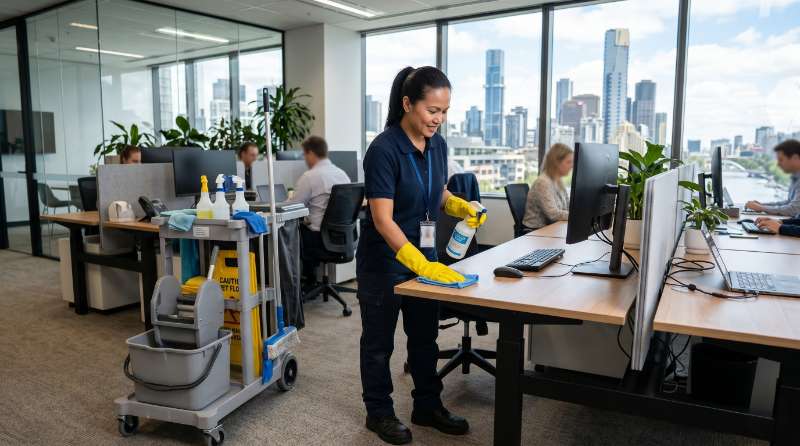
If there's one thing Melbourne businesses consistently underestimate, it's how much office winter cleaning in Melbourne actually needs to change once the cold sets in. The assumption that a year-round schedule holds up through June, July, and August is one of the most common — and most costly — facilities management blind spots. Cold-weather conditions fundamentally change the contamination load in any shared workspace, and offices that don't adjust their cleaning frequency pay for it in sick days and reduced team output.
TL;DR
Office winter cleaning in Melbourne isn't just a seasonal preference — it's a hygiene necessity. Closed buildings and recirculated heating systems allow germs to circulate up to 3x faster than in warmer months, making June through August the highest-risk period in the workplace calendar. Smart businesses temporarily scale up their cleaning during this window to get ahead of flu waves before they move through the team. Those who keep a flat schedule tend to find out the hard way — through absenteeism, reduced productivity, and reactive clean-ups after illness has already spread.
Why Does Melbourne's Winter Make Offices Dirtier Faster?
Melbourne's winter drives offices dirtier faster because sealed buildings and running heating systems create exactly the conditions pathogens need to spread — low ventilation, higher surface contact, and more time spent indoors by staff who are already more susceptible to illness.
Drop to 5–8°C overnight — as Melbourne regularly does between June and August — and the building response is predictable: windows get sealed, heating runs continuously, and staff compress their movement into warm zones where shared surfaces get touched constantly.
Most cleaning contracts don't account for this. Schedules get set at the start of a tenancy and rarely revisited — meaning the same twice-weekly arrangement that handled a ventilated summer building is expected to cope with a sealed, flu-season winter one. It can't.
Here's what actually changes in winter that a flat schedule misses:
- Closed ventilation — without open windows diluting the air, airborne droplets stay suspended longer and travel further between workstations
- Higher surface contact rates — cold staff move faster between warm spaces, touching doors, lift buttons, and shared equipment more frequently
- Mud and moisture at entries — wet-weather foot traffic deposits organic debris on hard floors that becomes a bacterial breeding ground if not treated correctly
- Flu waves with nowhere to go — Victoria's peak flu period runs July through September; in a sealed office, a single sick employee can seed contamination across shared surfaces for 48–72 hours before the next scheduled clean
If your office winter cleaning in Melbourne schedule has been sitting unchanged since last year, winter is the right moment to look at it again.
What Areas of a Melbourne Office Need Extra Attention in Winter?
The highest-risk areas in a Melbourne office during winter are the ones staff return to constantly — kitchens, bathrooms, shared entry zones, and meeting rooms — because sealed buildings and running heating systems mean contamination accumulates in these spots faster than any other time of year.
High-contact surfaces — clean at every visit:
- Door handles, push plates, and exit bars
- Lift buttons and intercom panels
- Kitchen appliances — kettle, microwave, fridge handle
- Printer and copier control panels
- Reception desks and sign-in screens
Shared amenity zones — move from 1x to at least 2x per week:
- Staff kitchens — winter humidity accelerates mould growth on wet bench surfaces and around sink areas
- Bathrooms — heating differentials create condensation that speeds up soap scum, grout contamination, and tile mould
- Meeting rooms and breakout areas — high occupancy combined with poor airflow makes these fast-spreading environments
Entry and lobby zones — daily damp treatment during wet weather:
- Ground-floor lobbies and reception floors
- Stairwells and lift lobbies
- Corridors adjacent to external access points
Choosing a commercial cleaning provider who structures their winter visits around these zones specifically — rather than running the same checklist regardless of season — makes a measurable difference to how quickly contamination is controlled. To see the full scope of what's covered, visit our Melbourne office cleaning service page.
How Much More Frequently Should Melbourne Offices Clean in Winter?
The minimum adjustment for any Melbourne office in winter is one additional professional clean per week on top of the existing schedule — with daily high-touch surface disinfection layered in for offices running 20 or more staff.
Office Size | Typical Summer Schedule | Recommended Winter Schedule |
Under 10 staff | 1x per week | 2x per week |
10–30 staff | 2x per week | 3x per week |
30–80 staff | 3x per week | Daily high-touch + 3x full clean |
80+ staff | Daily | Daily + fortnightly deep clean |
For most businesses, the biggest practical gains don't require a complete overhaul of the cleaning contract. Three targeted changes deliver most of the benefit:
- A daily high-touch wipe-down — door handles, kitchen surfaces, bathroom fixtures — running 30–45 minutes per visit
- One additional full clean per week during the June–September window
- A deep clean at the start of winter (late May) and again at the end (mid-September)
Surface disinfection every 48 hours is the threshold where flu transmission in shared workplaces starts to drop meaningfully. In a 30-person office working a five-day week, that translates directly to three professional cleaning visits per week — not the two that most comparable offices default to.
The right office winter cleaning in Melbourne cadence depends on your floor plan, ventilation setup, and headcount — but moving up one tier on the table above is a practical starting point for any Melbourne business heading into June.
What Separates a Winter-Specific Clean from a Standard Commercial Clean?
A genuinely winter-adapted office cleaning process differs from a standard commercial clean in three specific areas — and those differences are what determine whether a Melbourne office comes out of flu season intact or depleted.
Hospital-grade disinfectants on contact surfaces Standard commercial cleaning products aren't formulated for high-transmission environments. In winter, the surface contamination load in a shared Melbourne office is closer to a low-traffic medical facility than a standard workspace — which is why a responsible commercial cleaner should be shifting to clinical-grade disinfectants on all touch points during June through August.
Two-stage floor treatment at building entries A single mop pass at a wet-weather entry point doesn't remove the organic matter that bacteria colonise — it just redistributes it. Effective winter floor treatment involves a dry pass to remove particulate, followed by a damp disinfectant pass. The difference is visible within a week on polished concrete and vinyl surfaces.
Reactive scheduling capacity for illness spikes When a cluster of sick days hits a Melbourne office — which is common in July and August — the ability to add a cleaning visit on short notice is the difference between containing spread and watching it move across the whole floor. A cleaning provider with fixed, inflexible scheduling doesn't offer this. One with a genuinely flexible roster does.
These aren't premium add-ons. In winter, they're the baseline for responsible office hygiene across Melbourne's commercial and industrial areas.
Does Maintaining a Flat Cleaning Schedule Through Winter Actually Cost More in the Long Run?
Yes — and the maths are straightforward enough that most businesses only need to see them once.
The instinct to treat a cleaning contract as a fixed overhead is understandable. Set it once, budget for it annually, and move on. The problem is that this approach prices winter the same as March, when the actual contamination risk in a sealed Melbourne office in July is an entirely different situation.
When Victoria's winter flu waves arrive — typically peaking in July and August — an office running its March hygiene baseline becomes a fast-transmission environment. The outcome is consistent: illness moves through teams quickly, absenteeism spikes, and the business runs below capacity for an extended period.
Here's what the numbers look like:
- A single employee sick day in Australia costs an estimated $340+ in lost productivity
- A flu wave through a 20-person Melbourne office routinely sidelines 3–5 staff within a week
- That's $1,000–$1,700 in productivity loss from one unchecked winter event
- One additional weekly professional clean costs approximately $150–$300
Research from Safe Work Australia and international occupational health bodies consistently demonstrates that increased surface disinfection frequency in shared winter workspaces reduces respiratory illness transmission by 20–30%. Businesses that scale up cleaning at the start of June see fewer illness clusters by July. Those that hold the flat schedule tend to call in reactive cleans after the damage is already done.
If you're reconsidering your office winter cleaning in Melbourne approach now, before the cold season peaks, you're ahead of most businesses in the same position.
Frequently Asked Questions
Q: How often should a Melbourne office be cleaned in winter? A: For an office running 10–30 staff, three professional cleans per week during winter (June–August) is the recommended minimum. Smaller teams should shift from weekly to twice-weekly. Across all office sizes, daily wipe-downs of high-contact surfaces — handles, kitchen appliances, bathroom fixtures — are a practical addition during flu season. A good commercial cleaning provider can structure a flexible office winter cleaning in Melbourne plan that adjusts to your roster and occupancy.
Q: What surfaces in an office spread the most germs in winter? A: The highest-transmission surfaces in a winter Melbourne office are kitchen appliances (kettle handles, microwave panels, fridge doors), bathroom tap handles and flush buttons, door handles and push plates, and shared printer controls. These are touched repeatedly throughout the day and rarely treated between scheduled professional cleans. During winter, every cleaning visit should include disinfection of these surfaces — not just a surface wipe.
Q: Is the cost of more frequent office cleaning worth it in winter? A: When you run it against the cost of absenteeism, yes — clearly. A single sick team member in an open-plan Melbourne office can set off a chain of illness within 72 hours. One additional commercial office clean in Melbourne per week costs less than the productivity loss from a single employee's sick day. For most businesses, that shift from two to three weekly cleans is the most cost-effective hygiene decision available in winter.
Q: Can you arrange a temporary winter cleaning schedule without changing your contract long-term? A: Yes — seasonal flexibility is something reputable Melbourne commercial cleaners can accommodate. The best arrangement is an increased frequency from June through to October, then a return to the standard schedule once conditions normalise. SM&MN Cleaning offers exactly this for businesses across Greater Dandenong, Monash, Bayside, Casey, Kingston, and the Melbourne CBD fringe — call 1300 142 715 or request a quote at smmnclean.com.au.
Q: Does mould become a problem in Melbourne offices during winter? A: It does, faster than most businesses expect. Cold air hitting heated window surfaces creates condensation, and bathrooms in particular develop conditions where mould establishes within weeks if grout, tiles, and window sills aren't treated consistently. By August, offices that skipped winter-specific bathroom and window cleaning routinely find visible mould that requires a remediation clean — which costs significantly more than prevention.
Q: What does a winter deep clean include that a standard office clean doesn't? A: A winter deep clean extends beyond the standard scope to include grout treatment, window condensation zones, HVAC vent surrounds, appliance interiors in the kitchen, and entry carpet mat extraction. The most effective approach is a deep clean in late May before winter sets in, and a second one in mid-September to clear the residue of the cold season — essentially bookending the highest-risk period with a thorough reset at each end.