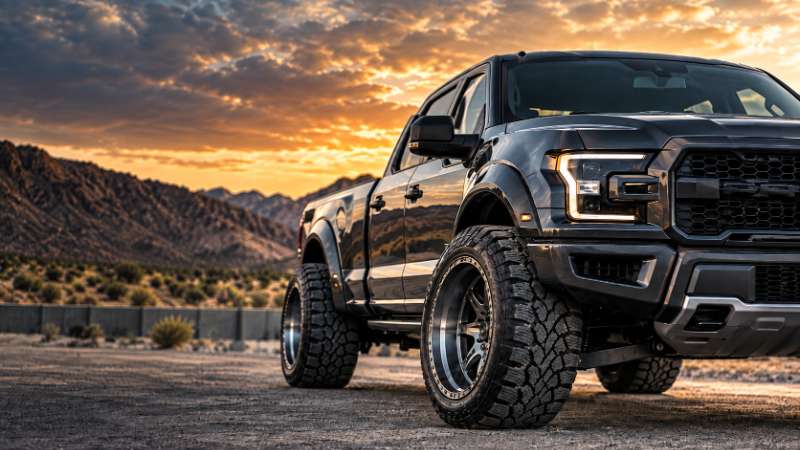
Every truck forum has the same argument. One guy runs -44 offset wheels with 35s and says it drives fine. Another says his steering went vague and his wheel bearings paid the bill. Both can be right. Negative offset wheels push the tire out past the hub, and how far you can go depends on the wheel, the tire, the lift and how you use the truck. Here is how to work it out before you order.
Key Insights
- Negative offset moves the wheel outward from the hub. Every 25.4 mm (1 inch) of offset change moves the wheel centerline 1 inch.
- More offset change means more scrub radius and more leverage on wheel bearings, ball joints and tie rods. You feel it as heavier steering and faster wear.
- No single offset is safe for every truck. Measure the change from your factory offset, then check fender, control arm and tire clearance at full lock and full compression.
- A -12 mm offset is a moderate change on most trucks. A -44 mm offset is a major one and needs alignment, hardware and inspection to match.
What Negative Offset Does to a Truck
Offset is the distance from the wheel's centerline to its mounting surface. With negative offset, the mounting surface sits on the inboard side of the centerline, so the wheel and tire sit farther out than a zero or positive offset wheel of the same width.
A factory wheel with positive offset tucks the tire in toward the suspension. Swap a +35 mm wheel for a -12 mm wheel of the same width and you have moved the wheel 47 mm, about 1.85 inches, and every bit of it goes outward.
Your suspension was designed around a tire contact patch at a set distance from the steering axis. Push the tire out and that distance, the scrub radius, grows. The tire gets a longer lever to twist the steering over a rut, and the same lever loads the wheel bearing, ball joints and tie-rod ends. That is the real cost of stance, and why the amount of change matters more than the number stamped on the wheel.
Offset and Backspacing Math for a 20x10
Here is how a 10-inch wide wheel moves as offset goes negative. Backspacing is estimated as half the wheel width plus the offset in inches (mm divided by 25.4). Real backspacing usually runs close to half an inch higher because the lip adds to overall width, so confirm against the spec sheet.
Offset | Estimated backspacing | Outward shift vs. zero offset |
0 mm | 5.00" | none |
-12 mm | 4.53" | 0.47" |
-24 mm | 4.06" | 0.94" |
-44 mm | 3.27" | 1.73" |
Width matters as much as offset. Go from an 8.5-inch wheel at +35 mm to a 10-inch wheel at -12 mm and the outer face moves out about 2.6 inches (1.85 from offset, 0.75 from the extra half-width). The inner edge only moves out about 1.1 inches (1.85 minus 0.75). You gain suspension clearance on the inside and add a lot of poke on the outside.
Why Everyone Argues About a -12 Offset Wheel on a Truck
A -12 offset wheel on a truck is a moderate change from most factory offsets. It often works with a lift or level and 35-inch tires, and it gets tricky at stock height, where the tire meets the fender lip on compression.
On a lifted truck, the extra room in the wheel well absorbs the change. At stock height, the tire moves out and up into the fender edge, and full-lock turns can bring the inner sidewall close to the control arm or frame. Check the fender lip at full compression and the upper control arm at full lock before you commit. On a daily driver, expect slightly heavier steering and a bit more tire noise on grooved pavement.
Positive vs Negative Offset at a Glance
Positive offset | Negative offset | |
Wheel position | Tucked in | Pushed out |
Steering and bearing load | Lowest | Highest |
Fender clearance | Most room | Least room |
Inner suspension clearance | Least room | Most room |
What -44 Offset Wheels Ask of Your Truck
A -44 offset puts a wheel about 1.7 inches farther out than zero offset. It is a major change in scrub radius and leverage, so treat it as a stance build that needs fender coverage, a good alignment and regular inspection.
Negative offset truck wheels at this level widen the track far past what the suspension was designed around. Expect more steering effort, more tramlining and faster wear on bearings and tie-rod ends. Inspect them more often than the factory schedule, and check local rules on tire coverage.
If a -44 build shakes at speed, do not blame the offset first. Balance, runout and a poor hub fit cause vibration more often than offset does, so rule those out with a road-force balance first.
Wheel Spacers vs Buying the Right Offset
A spacer moves the wheel out the same way negative offset does, but it adds a second mounting interface. If you want the stance, buy the wheel with the right offset.
Spacers can work when they are hub-centric, give full stud thread engagement (at least one stud diameter) and are torqued to spec. But every added joint is one more thing to loosen, and a spacer on an already negative wheel adds even more leverage.
Load Ratings, Hardware and Torque
Every wheel carries a stamped load rating, and that rating belongs to the wheel as designed. Compare it against your axle ratings, and do not assume it carries over to a spacer stack. Aftermarket wheels are commonly tested to SAE J2530, so ask any brand you consider for that documentation.
Match the lug seat to the wheel (conical or ball), torque to your service manual value, and re-check after the first 50 to 100 miles. The PerfectlyTight wheel hardware catalog covers seat types and extended studs.
How to Check Fitment Before You Order
- Write down your factory wheel width and offset.
- Pick a target and work out the change in both. The wheel offset vs backspacing guide has the full breakdown.
- Measure clearance to the fender, control arm and frame at ride height, full lock and full compression.
- Preview the look with the HD Off-Road Vehicle Visualizer.
- Browse the HD Off-Road wheel collection and confirm width, offset and bolt pattern with our team before you buy.
FAQ
Is negative offset bad for your truck?
Not by itself. It increases scrub radius and leverage on bearings, ball joints and tie rods, and wear scales with how far you move from factory offset. A modest change is usually fine. A large one needs closer inspection.
How far will a -12 offset wheel stick out?
About 0.47 inch farther out than a zero offset wheel of the same width, and about 1.85 inches farther than a +35 mm wheel. A wider wheel adds half its extra width to each side on top of that.
Can I run negative offset wheels on a stock-height truck?
Sometimes, at the mild end. Check the fender lip on compression and the control arm at full lock. Larger changes and taller tires usually call for a level or lift.
Do I need spacers with negative offset wheels?
No. The offset already sets the wheel position. A spacer adds leverage and another joint, so buy the offset you want.