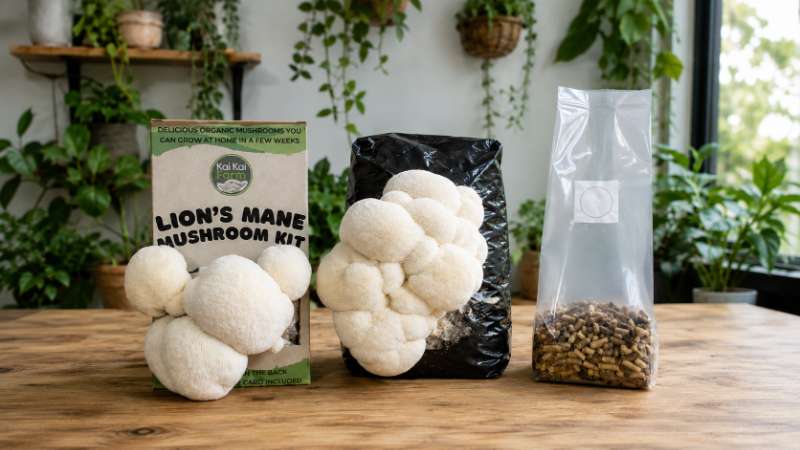
If you've started shopping around, you've probably noticed that "growing your own mushrooms" isn't one product, it's three very different starting points. A mushroom grow kit vs ready-to-fruit block vs DIY substrate comparison usually comes down to how much control you want versus how much time and mess you're willing to take on. We build and sell all three here at Kai Kai Farm on Tamborine Mountain, so this guide walks through what each option actually involves, what it costs, and which one fits your situation.
The Three Ways to Grow, Compared at a Glance
Each row of that table maps to one of the three methods below, so if you already know your priority, speed, volume, or cost per flush, skip ahead to the matching section.
Mushroom Kits: Best for First-Time Growers
A mushroom grow kit is fully colonised substrate, the mycelium has already done the hard work of digesting and taking over the growing medium. All that's left is to open it up, keep it misted, and let it fruit. This is the entry point most people picture when they think about growing mushrooms at home, and it's the format we recommend to almost every first-time grower who messages us on the Gold Coast and beyond.
Pros & Cons
Pros:
No sterile technique required, contamination risk is close to zero if you follow the instructions
Fastest path from "unboxing" to first harvest
Works on a kitchen bench, no dedicated grow space needed
Great for kids, classrooms, and anyone testing the hobby before investing further
Cons:
Smaller total yield than a commercial block, because the bag itself is smaller
Cost per kilo of mushrooms is higher than buying substrate in bulk
Limited to whichever species the kit was inoculated with
Who It's For
If this is your first attempt at growing mushrooms, or you want something that works reliably without any lab-style setup, start here. Our beginner-friendly kits and table top farms are designed so the only decision you need to make is where on the counter to put them.
Ready to see mushrooms in under two weeks? Shop our mushroom grow kits, they ship free Australia-wide, with same-week dispatch from the farm.
Ready-to-Fruit Blocks: Best for Volume & Repeat Growers
A ready-to-fruit mushroom block is the commercial version of the same idea, fully colonised substrate, but in a much larger format, built for growers who want serious volume without running their own lab. Cafés, small-scale sellers, and hobbyists who've outgrown a starter kit tend to move here next.
Pros & Cons
Pros:
Significantly more mushrooms per block than a retail kit
Still no sterile technique required, you're just providing humidity and airflow
Better cost per kilo once you're growing at any real volume
Available as a commercial block for those supplying a kitchen or market stall
Cons:
Needs more dedicated fruiting space than a kit, a tub, tent, or shelf, not just a windowsill
Higher upfront cost per unit than a kit, even though the cost per kilo works out lower
Still a one-off purchase, you're not growing your own spawn for the next round
Who It's For
Ready-to-fruit blocks suit anyone who's already grown a kit or two and wants a bigger, more consistent harvest without learning sterile lab technique. It's also the fastest way into semi-commercial growing if you're supplying a local café or farmers market around the Gold Coast and Scenic Rim.
Growing for volume? Browse our ready-to-fruit blocks or get in touch about wholesale pricing for repeat orders.
DIY Grain Spawn & Substrate: Best for Hobby Cultivators
This is the deep end. Instead of buying pre-colonised material, you buy grain spawn and bulk substrate separately and run the whole process yourself, sterilising, inoculating, waiting for spawn run, then transferring to a fruiting chamber. It's the same core process outlined in our PF Tek for Beginners guide, and it's also the approach the Cornell Small Farms Program points serious growers toward once they're ready to move past a single block.
Pros & Cons
Pros:
By far the lowest cost per kilo once you've built up some technique
Full control over species, substrate mix, and batch size
Scales up as far as your space and sterile setup allow
You can produce your own spawn for future batches rather than repurchasing every time
Cons:
Highest contamination risk of the three methods if hygiene slips
Requires a still-air box or flow hood, sterile jars, and a dedicated incubation space
Longest lead time to harvest, since spawn run happens before fruiting even starts
A failed batch means lost time and materials, not just a refund
What You'll Need to Get Started
Grain spawn or a starter culture, a colonised jar you can expand into bulk substrate
Bulk substrate, pasteurised straw, supplemented sawdust, or a similar bulk medium
Grow bags or a fruiting tub, see our mushroom grow bags range
Sterile technique tools, alcohol, gloves, and a clean workspace at minimum; a still-air box for anything beyond casual batches (our lab supplies collection covers this)
A humidity and airflow setup for the fruiting stage, a simple tent or tub with fresh-air exchange
Who It's For
DIY substrate suits hobbyists who already enjoy the process, not just the harvest, and who are comfortable losing a batch occasionally while they build technique. If cost per kilo matters more to you than convenience, this is where the numbers eventually tip in your favour.
Cost per Kilo Harvested: The Numbers
Cost comparisons shift depending on species, batch size, and how many flushes you get, but the pattern holds across most growers we talk to:
Mushroom kits carry the highest cost per kilo, because you're paying for convenience and a small, guaranteed-to-work format.
Ready-to-fruit blocks roughly halve that cost per kilo once you're harvesting from a full-size block instead of a retail kit.
DIY grain spawn and substrate has the lowest theoretical cost per kilo, but only once you've absorbed a few failed batches while learning technique, and only if your time has no dollar value attached to it.
In practice, most home growers land on a mix: a kit or two to learn the basics, then a ready-to-fruit block once they know they'll use the harvest. Exact pricing changes with the season and species, so check current prices on each collection page rather than relying on a fixed figure here.
Our Recommendation by Experience Level
Never grown a mushroom before? Start with a beginner-friendly kit. Low risk, fast result, and it tells you whether you enjoy the process before you spend more.
Grown a kit successfully and want more? Move to a ready-to-fruit block for a bigger harvest with the same low-effort care routine.
Comfortable with sterile technique, or willing to learn it? Go straight to grain spawn and substrate and start building your own supply chain for future batches.
Supplying a café, restaurant, or market stall? Ready-to-fruit blocks are usually the sweet spot for volume without the lab overhead, our wholesale page has details on ongoing supply.
Frequently Asked Questions
Can I go straight to ready-to-fruit blocks as a beginner?
Yes. Ready-to-fruit blocks don't require sterile technique, you're only responsible for humidity, airflow, and misting, the same as with a retail kit. The main difference is scale: a block needs more dedicated space than a bench-top kit, and produces a noticeably larger harvest. If you're confident you'll use a bigger yield, there's no requirement to "graduate" through a kit first.
Is DIY substrate cheaper in the long run?
Usually, yes, but only after you've built up enough technique to keep contamination rates low. Grain spawn and bulk substrate cost far less per kilo of mushrooms than pre-colonised kits or blocks, because you're paying for raw materials instead of someone else's labour and equipment. Factor in a learning curve, though, most new DIY growers lose at least one batch to contamination before their success rate settles, so budget a little extra material and patience for the first few runs.
Still deciding which format suits your grow space? Our team on Tamborine Mountain answers questions like this most weeks, contact us or read more about our farm and growing philosophy. And if you're ready to start this week, shop the full mushroom growing range, kits ship free Australia-wide, with fresh harvest windows filling up fast heading into the cooler growing months.