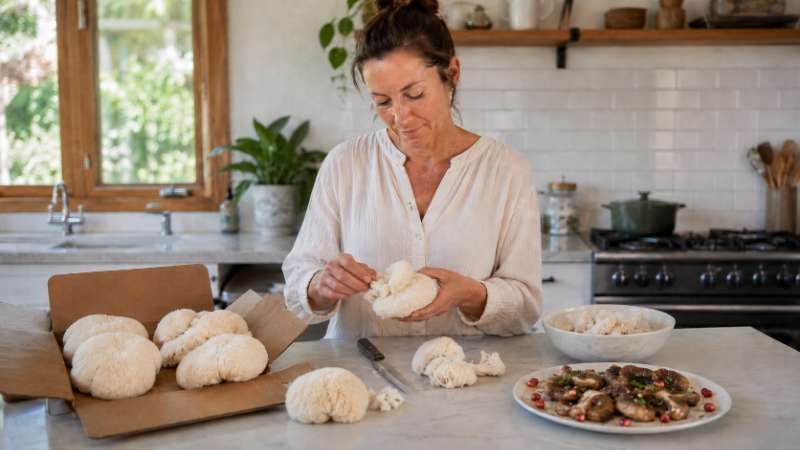
If you walk into a health food shop or scroll through your social media feed you will see the same few names over and over again: Lions Mane, Reishi and Turkey Tail. These are not things. People in China and East Asia have used these mushrooms for hundreds of years.. Lions Mane, Reishi and Turkey Tail are becoming very popular right now because everyone wants to find natural ways to help their brains and their stomachs.
So what is the real difference between a "mushroom" and the regular button mushrooms in your fridge? I want to look at what science tells us and what we still do not know. Also if you live in Australia I will show you where to find Lions Mane and Reishi. You can find Lions Mane and Reishi fresh, dried, as an extract. Even learn how to grow Lions Mane and Reishi at home.
This guide covers everything. I must say that mushrooms are not a replacement for medical treatment. Please just think of mushrooms as a way to help a healthy lifestyle. You should always talk to your doctor or pharmacist before you take mushrooms if you are already taking any medicine.
What Are Medicinal (Functional) Mushrooms?
"Medicinal" or "functional" mushrooms are fungi that are grown and consumed less for their taste and more for specific bioactive compounds they contain, things like beta-glucans, triterpenes and polysaccharides, which are the focus of ongoing scientific research into immune, cognitive and stress-response support.
That's a different job to what most of the fungi in your pantry are doing. A button mushroom, an oyster mushroom or a chestnut mushroom is grown primarily to be delicious, a culinary ingredient first. Functional mushrooms like Reishi and Turkey Tail are grown for their compounds first, flavour second (Reishi, in particular, is genuinely too woody and bitter to cook and eat like a regular mushroom).
Interestingly, a few varieties do both jobs at once. Shiitake and Lion's Mane are two of the best examples, both are genuinely good to cook with, and both carry a track record of interest in functional research. You can see the full spread of what's grown seasonally on Kai Kai Farm's fresh gourmet mushrooms collection, which includes both the purely culinary and the dual-purpose varieties.
Lion's Mane: Benefits & Uses
The Lion's Mane mushroom (Hericium erinaceus) is the one that has the appearance of a white, shaggy "pom-pom" that resembles a sea sponge or even a waterfall rather than a mushroom. The flavor of this edible mushroom is quite mild, with notes similar to seafood (for example, crab or lobster), and this is one of the reasons for its popularity among functional mushrooms.
Originally used in Chinese and Japanese medicine, today the Lion's Mane mushroom is a favorite among nootropics fans due to interest in its compounds related to Nerve Growth Factor (NGF).
Cognitive & Nerve Health Research
What makes Lion's Mane interesting are hericenones and erinacines, natural substances in the fungus, which according to early lab and human studies could potentially be capable of stimulating the production of NGF, the protein responsible for growth, upkeep and regeneration of neurons.
It is fair to state the current scientific evidence in this area, as it is mostly in an early development stage, and based mainly on animal testing and small human trials. Moreover, Lion's Mane is not considered as a clinically tested and approved treatment option for any cognitive disorder. The effects under investigation include potential cognitive enhancing properties like focus and mental clarity, and the benefits for nerves in general.
At Kai Kai Farm, fresh Lion's Mane mushrooms are harvested on Tamborine Mountain and shipped weekly to Gold Coast, Brisbane and interstate metro areas, best pan-seared in butter, or shredded and used the way you'd use pulled pork or crab meat. If you'd rather grow your own (and enjoy multiple flushes from a single kit), the Lion's Mane mushroom grow kit arrives fully colonised and ready to fruit within 14–21 days. For cooking ideas and a closer look at the growing process, our earlier article on growing Lion's Mane at home has three simple recipes to try.
Reishi: Benefits & Uses
The reishi mushroom (Ganoderma) has had such a longstanding role in herbal medicine in East Asia that it has received the name "mushroom of immortality." Unlike lion's mane, which is soft, edible and mild-flavored, reishi is hard, woody and bitter; it is consumed more as a tea, decoction or tincture than as a food.
As with many of the herbs we have been studying, reishi can generally be considered an adaptogen – that is, a plant or substance used traditionally to improve the body's ability to deal with stress. It is high in beta-glucans and triterpenes, and is one of the more extensively studied mushrooms in terms of immunity research.
Kai Kai Farm grows a native Australian Reishi species, Ganoderma steyaertanum, on Tamborine Mountain, a variety naturally adapted to the local climate rather than an imported strain. You can buy it as fresh Reishi mushrooms for home preparation, or grow your own from a Reishi ready-to-fruit block, which produces antler-shaped fruiting bodies over several flushes.
Reishi Extract vs Fresh vs Dried
Because Reishi's key compounds sit in tough, woody fibres, how you prepare it changes how much you actually get out of it:
Fresh or dried, simmered as a tea/decoction: the traditional method, and the one most home users reach for. Roughly 25–30g of Reishi simmered gently in 500ml of water for 20–25 minutes helps draw out the water-soluble triterpenes. This is how Kai Kai Farm recommends preparing its fresh Reishi.
Dried Reishi: essentially the same mushroom with the water removed, giving it a longer shelf life. Dried pieces are simmered the same way as fresh, usually in slightly larger quantities to account for the lost water weight.
Alcohol-based extracts or tinctures: a longer process that involves soaking the mushroom in alcohol over several weeks to pull out additional compounds that don't dissolve well in water alone. This is a more involved, at-home or commercial preparation rather than something most beginners start with.
For most people wanting a straightforward introduction, a simple simmered tea using fresh or dried Reishi is the easiest place to start, no special equipment beyond a pot and a strainer.
Other Medicinal Mushrooms Worth Knowing
Lion's Mane and Reishi tend to get the spotlight, but they're far from the only functional mushrooms worth knowing about:
Turkey Tail (Trametes versicolor) is a fan-shaped, striped polypore that grows on hardwood. It's one of the most extensively studied mushrooms in this category, largely for its polysaccharide content, and, like Reishi, is prepared as a tea or decoction rather than eaten as a meal ingredient.
Shiitake (Lentinula edodes) sits in that dual-purpose category alongside Lion's Mane: genuinely excellent to cook with, and a long-time subject of interest for its lentinan content.
Both Turkey Tail and Shiitake are grown on the same hardwood-based substrates as Reishi, so if you're keen to cultivate a range of functional mushrooms at home, Kai Kai Farm's mushroom growing supplies and pre-mixed substrate blends are built with exactly that mix of species in mind.
How to Add Medicinal Mushrooms to Your Routine
There's no single "right" way to use these mushrooms, it mostly comes down to which variety you're using and how much time you want to spend on preparation:
Cook with the dual-purpose varieties. Lion's Mane and Shiitake can simply be added to meals like any other mushroom, sautéed, roasted, or shredded into a dish.
Simmer the woody varieties into tea. Reishi and Turkey Tail need heat and time to release their compounds, so a daily or few-times-a-week simmered tea is the most common approach.
Grow your own for freshness and cost. A single grow kit or ready-to-fruit block typically produces multiple flushes over its lifespan, which works out considerably cheaper per gram than buying pre-made extracts, and means you know exactly how it was grown. Kai Kai Farm's full range is in the mushroom grow kits collection, with step-by-step help in the mushroom kit FAQ & guide if you're growing for the first time.
Go deeper with a good reference book. If you want to understand the cultivation side or the broader world of fungi beyond what fits in a blog post, the mushroom & mycology books collection is a good next step.
Where to Buy Lion's Mane & Reishi in Australia
In Australia, Lion's Mane and Reishi are available in a few different formats, and which one suits you depends on how you plan to use them:
Fresh, best for cooking (Lion's Mane) or for preparing your own tea at home (Reishi). Kai Kai Farm ships fresh Lion's Mane and fresh Reishi weekly from Tamborine Mountain to Gold Coast, Brisbane and metro QLD/NSW/VIC.
Grow kits and ready-to-fruit blocks, the most cost-effective option if you're using either mushroom regularly, and the only way to genuinely control how they're grown. Browse the full grow kit and block range to compare formats.
Dried or extracted products, widely available through Australian health food retailers and online supplement brands, though quality and concentration vary significantly between suppliers, so it's worth checking sourcing and extraction method before buying.
Because Kai Kai Farm grows everything on-site with no spray, no pesticides and no synthetic inputs, both the fresh mushrooms and the grow kits give you full visibility over how your Lion's Mane and Reishi were produced, something that's much harder to verify with an imported powder or capsule.
FAQs
Is it safe to take Lion's Mane or Reishi every day? Many people do use these mushrooms regularly, but individual tolerance and any interactions with existing medications or health conditions vary. If you have a medical condition or take regular medication, check with your doctor or pharmacist before adding either to a daily routine.
Can I grow Reishi and Lion's Mane at home in Australia? Yes, both grow well in home conditions with a grow kit or ready-to-fruit block. Lion's Mane fruits relatively quickly (first flush in around 14–21 days), while Reishi is slower and more patient, typically taking several weeks to develop its antler-like form.
Is fresh or dried better for health benefits? Neither is inherently "better", it depends on preparation. For Reishi, both fresh and dried need to be simmered to release their key compounds, so the main difference is shelf life and the water content you're accounting for in your recipe. For Lion's Mane, fresh is generally preferred for cooking, since drying changes the texture significantly.
Do medicinal mushrooms interact with medications? Some functional mushrooms, Reishi included, may interact with certain medications (blood thinners are a commonly cited example). This is exactly why it's worth a quick check with a healthcare provider before starting, particularly if you're on prescribed medication.
Where can I buy Lion's Mane mushrooms in Australia? Fresh Lion's Mane is available direct from growers like Kai Kai Farm, which ships to Gold Coast, Brisbane and metro NSW/VIC, or as a home grow kit shipped free Australia-wide. It's also increasingly available at specialty grocers and farmers' markets.
This article is general information only and isn't intended as medical advice. Speak with your doctor, pharmacist or another qualified healthcare provider before using medicinal mushrooms, especially if you're pregnant, breastfeeding, taking medication, or managing a health condition.