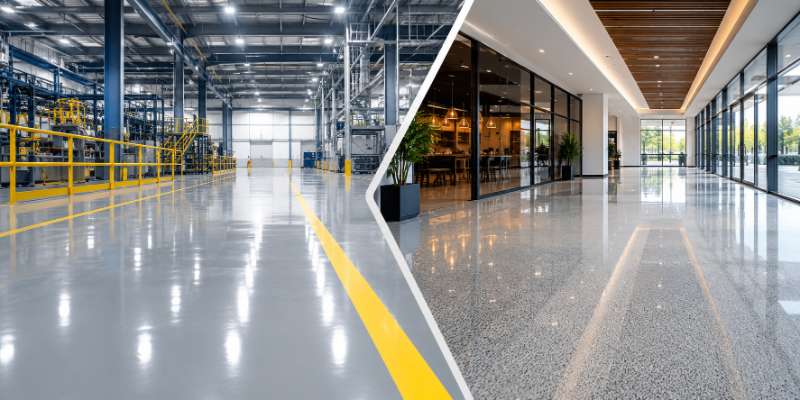
Take a walk around a factory at Campbellfield or a food facility at Dandenong, and you will notice one consistent thing: bare concrete surfaces are being covered. The need for industrial epoxy flooring in Melbourne has increased consistently, and it is not just the warehouses that are responsible for this.
Why demand has grown
Three reasons come up in almost every job.
Compliance is the first. Food, healthcare, and childcare sites need surfaces that clean properly and do not trap bacteria in cracks. A sealed floor makes audits simpler.
Downtime is the second. A worn slab means dust, trip hazards, and patch repairs during trading hours. A coated floor pushes that cycle out by years.
Budget is the third. Replacing a slab is slow and costly. Coating one is neither. That is why commercial epoxy flooring keeps beating tile and vinyl in fitouts across the north and the west.
Matching the system to the space
No single product suits every site. The right build depends on what happens on that floor each day.
| Space | Daily demand | Sensible finish |
| Warehouse | Forklifts, pallet jacks, point loads | Heavy-duty coating with line marking |
| Factory or workshop | Oils, chemicals, dropped tools | Chemical-resistant epoxy build |
| Commercial kitchen | Grease, hot water, hygiene audits | Epoxy with coving and anti-slip |
| Retail or showroom | Foot traffic, appearance | Flake system or decorative overlay |
| Car park and ramps | Weather, turning vehicles | Fast-cure heavy-duty coating |
Getting this wrong is expensive. A thin coating in a busy warehouse will chip under forklift wheels within months. A heavy industrial build in a small café is money you did not need to spend. We went into how these floors cope with constant wheeled traffic in this piece on forklifts and heavy use.
Check what sits outside the square meter rate as well. Coving, line marking, bunding, and anti-slip aggregate are often priced separately. Two quotes can look far apart until you line up what each one actually includes.
The step that decides whether it lasts
Preparation. Not the product. Concrete has to be mechanically ground or shot blasted so the coating can key into the surface. An acid wash on its own does not achieve that. Moisture is the second issue. Plenty of older Melbourne slabs were poured without a vapor barrier underneath. Moisture rising through the concrete is the most common cause of bubbling and peeling coatings. A moisture test before quoting tells you more than any product brochure. When one quote lands well under the rest, skipped preparation is usually the reason.
Melbourne conditions affect the timeline.
Temperature changes how epoxy behaves. Standard systems cure slowly below roughly ten degrees. A July install in an unheated warehouse takes longer to walk on than the same job in February. Humidity matters too. A good installer plans around it rather than pushing ahead and hoping. Expect honest advice on winter timing, and be wary of anyone promising the same turnaround in every season.
When epoxy is not the right call
Sometimes it is not the answer. Say a warehouse only needs a clean, dust-free surface, and appearance is secondary. A grind and seal finish will do that job for less. Where a slab is cracked and still moving, a coating hides the problem rather than fixing it. Repair comes first. Industrial epoxy flooring answers plenty of questions, though not all of them. A contractor worth using will say so before quoting.
What to ask before you sign
Four questions sort most quotes out:
● What surface preparation is included, and by what method?
● Has a moisture test been carried out on the slab?
● What is the cure time before we can trade or load again?
● Can I see a completed site of similar size and use?
That last one matters most. Fifteen years of Melbourne work sit behind our industrial and commercial floor finishes. That covers the Prixcar plant at Altona North through to hospitality fit-outs closer to town. Good commercial epoxy flooring is chosen around the work a space does, not around a product list.
Frequently asked questions
1. How long does an epoxy floor last in a commercial space?
Ten or more years should be considered realistic for retail or office environments, provided that the concrete slab is properly prepared. In heavy industrial areas, floors have to be resurfaced much quicker, normally after five to seven years. Even so, resurfacing is a lot cheaper than rebuilding.
2. Can it be installed without closing the business?
Often, yes. Most industrial epoxy flooring projects are staged in sections, with work done overnight or across a weekend. Fast-cure products shorten the wait before vehicles and stock come back. The installer should walk the site first and plan the staging around your trading hours.
3. Is an epoxy floor slippery when wet?
A gloss coating with nothing added to it will be. Commercial epoxy flooring in kitchens, wash bays, and ramps should have anti-slip aggregate broadcast into the topcoat. Ask for a slip rating suited to the area rather than a general reassurance.