For many yoga teachers, sequencing is one of the most rewarding parts of building a class, and also one of the trickiest. Maybe you are not teaching yet and you have been quietly deepening your own self-practice (go you!), and now you would like to start shaping your own sequences. Either way, here is a simple, repeatable way to sequence a peak pose so your class feels safe, intentional, and satisfying from start to finish.
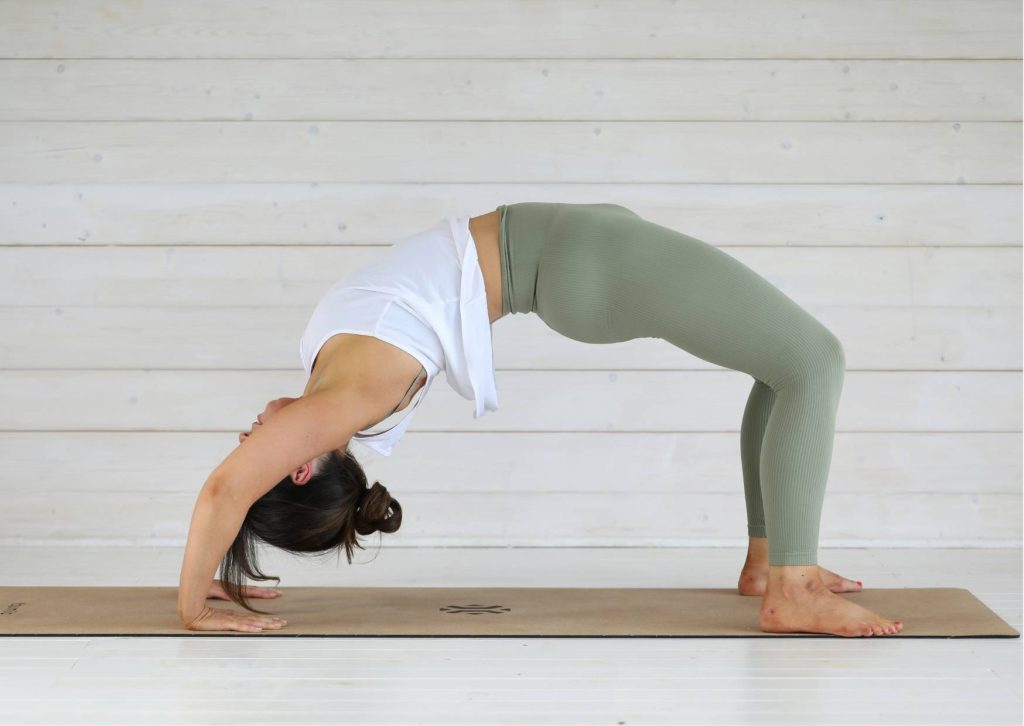
We will use Wheel Pose (Urdhva Dhanurasana) as our example the whole way through.
Start with the shape and the foundation
Before you plan a single warm-up, look closely at the peak pose itself. Wheel Pose is a deep backbend that rests on the hands and feet, so the body forms something close to an upside-down U.
Begin at the foundation. Notice where the hands press and how the feet are positioned, then travel your attention up through the shoulders, spine, hips, and legs. Reading the pose this way shows you exactly which areas need warming and preparing before your students attempt it. Teachers often call this identifying the component parts, and it is the quiet groundwork that makes the rest of your class hold together.
Open the shoulders and chest
Wheel Pose is a heart-opener, so the shoulders need space and the chest needs to open. Start with gentle heart openers early in class, then build toward more progressive ones. This helps students rise through the sternum rather than collapsing into the lower back.
A few options:
- Puppy Pose (Anahatasana)
- Wide-Legged Forward Fold, Variation C (Prasarita Padottanasana C)
- Any posture where the hands can interlace behind the torso
- Locust Pose (Shalabhasana)
- Sphinx Pose or Seal Pose
Warm the spine for full extension
A deep backbend asks a lot of the spine. After a few rounds of Surya Namaskar to build heat, move into preparatory poses that echo the peak pose in a gentler form. These gradually introduce the spine to fuller extension so nothing feels rushed.
A few options:
- Cobra Pose (Bhujangasana)
- Upward-Facing Dog (Urdhva Mukha Svanasana)
- Wild Thing (Camatkarasana)
- Bridge Pose (Setu Bandha Sarvangasana)
Prepare the hips and legs
Open hip flexors allow the front body to lengthen, while strong hip extensors support the back body as it lifts. Balancing both keeps the pose steady rather than strained.
A few options:
- Lizard Pose (Utthan Pristhasana)
- Crescent Lunge (Anjaneyasana)
- Warrior I (Virabhadrasana I)
Lifting the hips up and down, as you do in Bridge Pose, also builds the quadriceps strength needed to raise and hold them. That is why Bridge is usually practised before full Wheel Pose, and why it doubles as a rehearsal for the real thing.
Piece the sequence together
Now you can assemble the class. There is no single rule for sequencing, but this rhythm rarely fails: keep the warm-up gentle, deepen into stronger asanas after Surya Namaskar, work through each component part you identified, and then guide students into the peak pose once their bodies are genuinely ready.
Just as importantly, close with neutralising poses and counterposes. After a big backbend, students need time to let the spine, muscles, and joints settle again before they rest in Savasana. Skipping this step is one of the most common ways a well-built class loses its shape at the very end.
Quick recap
- Select your peak pose
- Look at the foundation of the pose
- Look at the shape of the body in the pose
- Identify the component parts, the areas that need warming and preparing
- Begin the class with gentle, targeted warm-ups
- Progress after Surya Namaskar with preparatory poses
- Let students rehearse a gentler or modified version
- Guide the class into the peak pose
- Close with neutralising poses and counterposes
Sequencing is a skill that grows every time you teach, and it becomes second nature with practice. If you would like to keep refining it, you are always welcome to join us on the beach and watch how our teachers build toward a peak pose in real time. You can see the current yoga class schedule any time.
And if you want to go deeper into the craft of teaching, we would love to welcome you to our Hatha Vinyasa Yoga Teacher Training in Sanur, Bali. It is a warm, close-knit group where sequencing like this becomes part of who you are as a teacher.