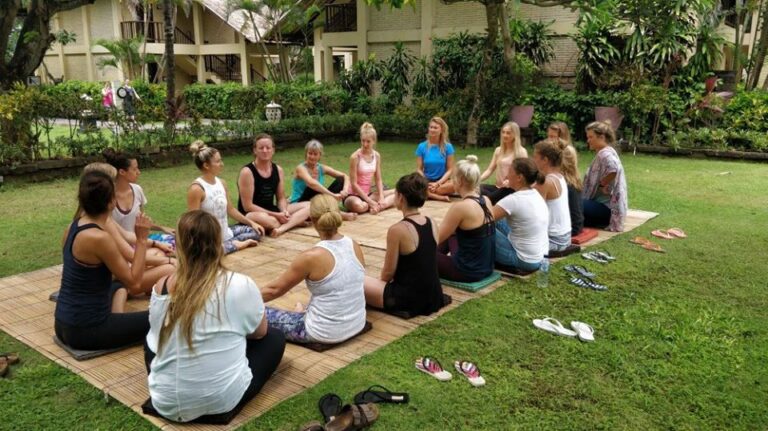
No matter how experienced they are on the mat, many of our yoga students still ask us how to meditate. Meditation shows up in many everyday forms too, in the quiet of painting, tidying a room, or even a long drive with no music on. This article focuses on the more traditional, seated style you will usually be guided through in a yoga class.
Meditation is a foundation stone of yoga practice, which is why almost every class we teach includes it in some form. Depending on the teacher, that might mean five quiet minutes at the start, or a longer stretch of ten to fifteen minutes woven into the beginning or end of the session. It is completely normal for new students to find this still, quiet time trickier than the physical postures that come before or after it.
5 Key points for those who wish to begin exploring how to meditate.
So the next time your teacher simply says "now, let's meditate," we hope it feels a little less daunting. Here are five things worth keeping in mind as you start out.
1. Why do you want to learn how to meditate?
Is it to quiet a busy mind? To feel calmer day to day? To sharpen your focus? Or maybe someone you trust simply suggested you try it.
Meditation is a deeply personal practice, and no teacher can tell you in advance exactly how it will land for you. Choosing to learn how to meditate already means you sense there is something in it worth exploring, so it is worth taking a moment to ask yourself why. Which parts of your life could use a little more steadiness and attention?
Sitting with that question before you begin can give your practice a clearer sense of direction from the very first session.
2. Start with your breath
The breath is the simplest, most accessible anchor for any beginner. Before worrying about clearing your mind completely, which is a common misconception about meditation, just notice your breath moving in and out.
A gentle place to start is counting each inhale and exhale to the same length, four counts in, four counts out, for example. If your attention wanders, and it will, simply guide it back to the breath without judging yourself for drifting. This is not a sign you are doing it wrong. It is, in fact, the practice itself.
3. Allow the resistance
By now you might notice some restlessness creeping in. Whether it shows up as fidgeting or racing thoughts, the first few minutes are often the hardest part of sitting still. Know that this resistance is a completely normal part of learning how to meditate, not a sign you are failing at it.
Try noticing when it arises, and gently, what might be behind it. Then, just as easily as the thought appeared, practice letting it go rather than following it.
4. Find a style you like
Once you are comfortable with simple breath awareness, guided meditations can be a useful next step, helping you build up the ability to sit for longer stretches. Plenty of free options exist online, and many people find them especially helpful for settling the mind before sleep.
Do not stop at the first style you try, though. Just as with yoga, different meditation approaches and voices will resonate with different people. If nothing clicks straight away, stay curious rather than discouraged. Everyone's path into meditation looks a little different, and part of the value lies in the self-awareness you build while looking for the approach that suits you.
5. Be consistent
Finally, consistency matters more than duration. A few minutes of alternate nostril breathing or an equal-count breath, in for four and out for four, is a fine place to begin, even at just five minutes a day.
Build up gradually and you will likely notice more ease and confidence over time. Some days you might sit for thirty minutes, other days only ten, and that is perfectly fine.
There is no such thing as a bad meditation.
Our teachers offer private meditation sessions, and several of our weekly Hatha classes include extended meditation time for anyone who wants to go deeper.
Meditation is also woven throughout our yoga teacher training, for students who want to understand and eventually share the practice with others.