If you have a dog or cat, you're dealing with waste every single day. Most Australians do what the council recommends: bag it and bin it. But those plastic bags and everything inside them, go straight to landfill, where they sit for decades without breaking down.
There's a better way. With the right system, dog and cat waste can be safely composted at home, transformed into a soil-enriching amendment for your garden. No smell. No pathogens. No guilt.
This guide walks you through exactly how to do it using the Pet-Kashi bokashi method, an anaerobic fermentation process that neutralises odours, suppresses harmful bacteria, and turns pet waste into something genuinely useful for your soil.
Why You Shouldn't Throw Pet Waste in the Regular Bin
Most people know that tossing food scraps in the bin is wasteful. Pet waste is no different.
Dog and cat faeces are rich in nitrogen and organic matter. In the right conditions, that material becomes valuable humus that feeds soil microbes and improves drainage. In landfill, sealed inside a plastic bag, it produces methane — a greenhouse gas far more potent than CO₂.
Australians own approximately 28.5 million pets, with dogs and cats making up the majority. That's an enormous volume of waste going to landfill every day that doesn't have to.
Can You Compost Pet Waste? (And Is It Safe?)
Yes, with the right method and the right precautions.
The concern with composting carnivore waste (dogs and cats eat meat) is that it can carry harmful pathogens like E. coli, Salmonella, and Toxocara roundworm eggs. Traditional hot composting can neutralise these, but it requires sustained temperatures above 60°C, which is very difficult to achieve consistently in a home compost heap.
Bokashi fermentation is different. The process works through acidic fermentation (dropping the pH to around 4), which creates an environment hostile to harmful bacteria. It doesn't require heat, doesn't require turning, and works in a sealed, airtight container on your back porch or balcony.
One important rule: finished pet waste bokashi should only be dug into ornamental garden beds, not vegetable patches. More on that below.
What Is Bokashi, and How Does Pet-Kashi Work?
Bokashi is a Japanese fermentation method originally developed for kitchen food waste. It uses Effective Microorganisms (EM-1®) — a blend of lactic acid bacteria, yeasts, and phototrophic bacteria — to ferment organic material anaerobically (without oxygen).
Pet-Kashi is a bokashi system specifically formulated for pet waste. Unlike standard bokashi bran, Pet-Kashi includes two key additions:
Zeolite — a natural volcanic mineral that adsorbs ammonia and sulphur compounds, eliminating odour instantly on contact
Malted Barley — a source of natural enzymes that accelerates the breakdown of tough protein-based organic matter found in carnivore faeces
The result is a system designed from the ground up for the high-protein, high-odour challenge that dog and cat waste presents.
Shop the Pet-Kashi Starter Kit — 15L bin, 1.25kg bran, masher & tongs
What You'll Need for Pet Waste Composting
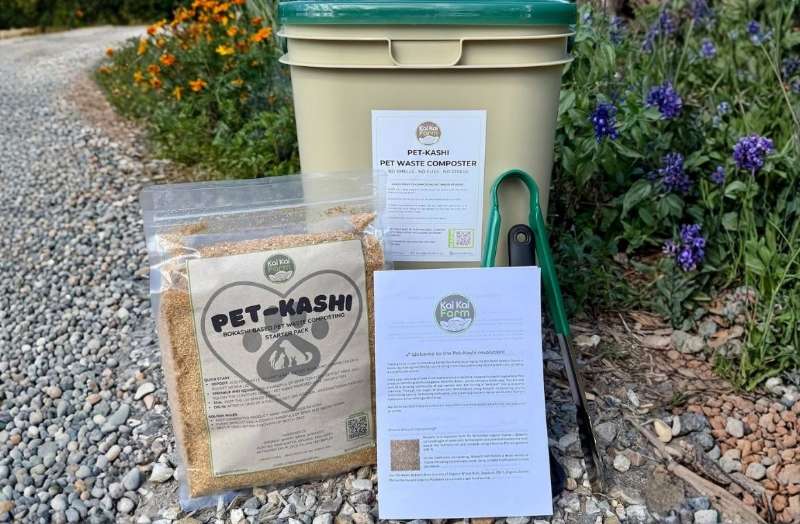
Pet-Kashi Starter Kit — includes a 15L airtight bin, 1.25kg of Pet-Kashi bran, a heavy-duty masher, and precision tongs
A spot outdoors or in a garage (out of direct sunlight is ideal)
A garden bed or lawn area for the finished product
That's it. No electricity, no turning, no adding carbon materials, no special drainage.
Step-by-Step: How to Compost Pet Waste with Pet-Kashi
Step 1: Deposit
Collect the waste as you normally would — with a bag or using the included tongs — and place it directly into the Pet-Kashi bucket. You can add dog waste, cat litter tray solids, rabbit droppings, guinea pig bedding, and bird cage waste.
What not to add: large amounts of liquid urine, cat litter with chemical binders (clay-based litters are fine in small amounts), or any treated/medicated waste.
Step 2: Sprinkle and Squish
Add a generous handful of Pet-Kashi bran over each deposit. Then use the included masher to compress the contents firmly to the bottom of the bucket.
This is the single most important step and the one most people skip. Removing oxygen is essential. Bokashi fermentation is an anaerobic process — the microbes in Pet-Kashi bran work without air. If oxygen pockets remain, the process shifts from fermentation to putrefaction, which causes odour and reduces effectiveness. Squish every time, without fail.
Step 3: Seal
Replace the lid tightly after every use. The dual-seal lid on the Pet-Kashi bin maintains the oxygen-free environment between deposits. If you're leaving it for more than a few hours, make sure the lid is pressed firmly shut.
Step 4: Wait and Repeat
Continue adding waste, sprinkling bran, and squishing daily until the bucket is full. At full capacity, seal the bin completely and leave it undisturbed for 14 days. During this curing phase, the fermentation process finishes and the pH drops to a level that suppresses pathogens.
You can have a second bin on the go during this time so you're never without a working system.
Step 5: Dig In
After 14 days, the fermented material is ready to go into the ground. Dig a trench or hole approximately 20–30cm deep in your ornamental garden bed, lawn, or around fruit trees or established shrubs. Add the fermented material and cover completely with soil. Do not leave it exposed on the surface.
Over the following 2–4 weeks, soil microbes will break the pre-digested material down fully into stable humus.
Keep the finished product away from vegetable gardens and edible plants as a precaution, even after the full fermentation and soil-integration process.
Tips for Success
Smell coming from the bin? The most likely cause is insufficient squishing — oxygen pockets are present. Open the bin, add another handful of bran, squish firmly, reseal, and allow 24–48 hours for the fermentation to re-establish.
White mould on the surface? This is normal and a sign the fermentation is working well. White, fluffy growth is beneficial mycelium. Discard the batch only if you see black, blue, or green mould, which indicates putrefaction.
Bin filling up too fast? Consider our refill pack of Pet-Kashi bran and running two bins simultaneously — one actively filling, one curing.
Which Pets Can You Use Pet-Kashi For?
Pet-Kashi is formulated primarily for dogs and cats, whose high-protein carnivore waste is the most challenging to compost safely. The Zeolite and EM-1® combination is calibrated specifically for this.
It also works well for:
Rabbits and guinea pigs — their herbivore waste and hay bedding break down quickly
Chickens and birds — cage waste and litter composts efficiently with Pet-Kashi bran
Small animals — mice, rats, ferrets
It is not suitable for human waste or large livestock volumes.
Why Pet-Kashi Is Better Than Alternatives
Frequently Asked Questions
Is composted dog waste safe for the garden?
After a full 14-day fermentation followed by 2–4 weeks of soil integration, the pathogen load is reduced to safe levels for ornamental gardens. Always keep it away from edible crops as an extra precaution.
How long does Pet-Kashi fermentation take?
Active filling takes as long as your pet produces waste. Once the bin is sealed, the curing phase takes 14 days. Soil integration takes a further 2–4 weeks.
Can I use Pet-Kashi in a small backyard or on a balcony?
Yes. The airtight, dual-seal lid means the process produces no meaningful odour when sealed correctly. Many apartment-dwellers use it on their balcony.
Does Pet-Kashi work for cat litter?
Yes, for clay-based or biodegradable litters in reasonable quantities. Avoid large amounts of silica crystal litter or litters with chemical deodorisers, as these can disrupt the fermentation.
How much Pet-Kashi bran do I use per deposit?
A generous handful (approximately 30–50g) per deposit. For larger dogs, use slightly more. It's hard to over-apply.
What happens if I don't squish?
Without squishing, oxygen remains trapped in the bucket. This disrupts the anaerobic fermentation and can cause the batch to putrefy rather than ferment — producing odour and reducing the pathogen-suppression effect.
Ready to Start? Grab Your Pet-Kashi from Kai Kai Farm!
The Pet-Kashi Starter Kit includes everything you need to begin immediately — a 15L heavy-duty bin, 1.25kg of bran, the Master Masher, precision tongs, and a step-by-step handbook. It's a complete system, tested and used on our own farm at Tamborine Mountain, QLD.
Shop the Pet-Kashi Starter Kit
Refill bran only — 2.5kg Pet-Kashi Organic Bokashi Bran
Have questions about the Pet-Kashi system? Read our complete Bokashi FAQ or get in touch with the team — we're happy to help.