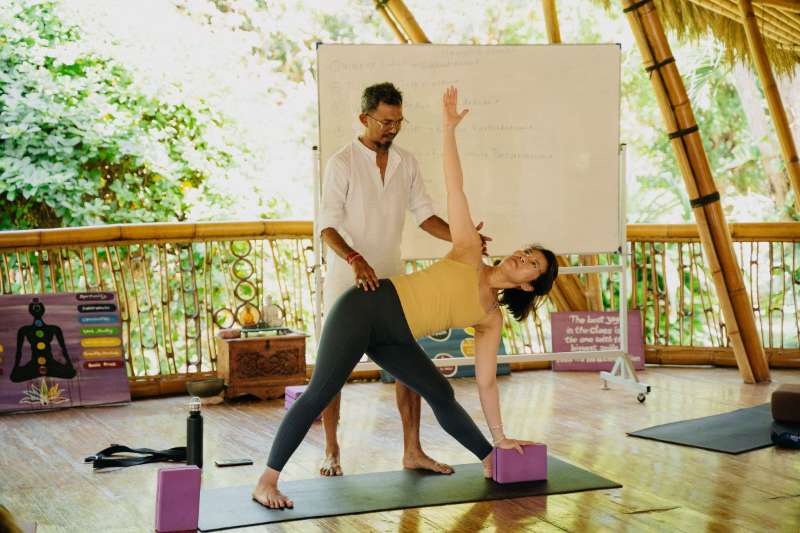
If you have ever rolled up your mat after a class and thought, I would love to teach this one day, you are not alone. It is one of the most common feelings a regular practice creates, and it is also one of the most common questions we hear at the studio. The good news is that the path from curious student to certified teacher is more straightforward than most people expect. This guide walks you through it, step by step, the way we would explain it to someone sitting across from us in the shala.
Is Teaching Yoga Right for You?
Before looking at programs and certificates, it is worth pausing on the real question underneath all of this: do you want to teach, or do you simply want to go deeper into your own practice? Both are completely valid reasons to train, and at PONO we see both kinds of students in every intake. Some arrive certain they want to lead classes back home. Others come purely to understand yoga more fully for themselves, and only decide whether to teach once the training is underway.
A simple way to check your own motivation is to ask whether you feel pulled toward the practice itself, including the philosophy, the breath, the anatomy, not just the idea of standing at the front of a room. If that curiosity is there, you are ready for the next step.
Step 1: Deepen Your Own Practice
Every good teacher starts as a committed student. Before any certification, it helps to build a consistent personal practice so that the training itself builds on something rather than starting from zero. This does not mean you need years of experience. It means showing up regularly, in a few different styles, so your body and breath are already somewhat familiar with what a teacher training will ask of them.
If you are based in or visiting Bali, our daily yoga classes in Sanur are open to all levels, with styles ranging from gentle Yin and Restorative through to dynamic Vinyasa and Hatha Flow. No booking is needed, you simply arrive 20 - 30 minutes early. Spending a few weeks moving through different styles before a training is one of the best ways to arrive feeling grounded rather than overwhelmed.
Step 2: Choose a 200-Hour Training
The 200-hour Yoga Teacher Training is the internationally recognised starting point for anyone who wants to teach. It is the qualification studios, gyms, and retreat centres look for worldwide, and it is also the foundation every more advanced certification builds on later.
When comparing programs, look past the price tag alone and ask what is actually included in the days themselves. A few things worth checking for any school you are considering:
Is the school accredited by Yoga Alliance, and at what level?
How many students are in each intake? Smaller groups generally mean more individual feedback during posture labs and practice teaching.
Does the curriculum cover anatomy, philosophy, and teaching methodology, not just asana?
What is included beyond tuition, such as meals, accommodation, or extra practice time?
Our own 200-hour YTT in Bali runs for 27 days and covers all eight limbs of yoga, including asana, pranayama, meditation, yoga anatomy, philosophy, subtle body anatomy, and supervised practice teaching. Groups are limited to 20 students, and the training includes daily breakfast, unlimited classes for two weeks before and after the course, a spa treatment and Ayurvedic consultation, and a closing graduation dinner. Here is the current tuition:
- Standard price: USD $2,950
- Early-bird price: USD $2,450
Full payment upfront secures the early-bird rate. Tuition and accommodation at our own Kolonial House guesthouse are arranged separately, and a course-only option without accommodation is also available if you prefer to organise your own stay.
Step 3: Get Certified and Register with Yoga Alliance
Once you complete a 200-hour program at a Yoga Alliance accredited school, you receive a certificate that allows you to register as an RYT 200, the most widely recognised teaching credential in the world. Registration with Yoga Alliance itself is optional, but it does make your certification easy to verify for studios and clients who check the directory.
Our own program is accredited under Yoga Alliance's RYS 200 standard, and graduates are eligible to register as RYT 200 on completion. The certificate is recognised globally, with or without that additional registration step.
Step 4: Gain Teaching Experience
Certification is the qualification. Confidence comes from time on the mat in front of real students, and that only builds with practice. Many new teachers start by offering free or low-cost classes to friends, family, or local community groups before moving into studio or gym settings.
If you trained with us, you are welcome to apply for an optional post-graduation internship to teach at the studio, which is one of the most direct ways to build real teaching hours in a supportive environment before stepping out on your own.
Step 5: Specialise or Continue (300-Hour)
A 300-hour training is a worthwhile next step once you have been teaching for a while and want to deepen a particular area, whether that is therapeutic alignment, a specific style, or working toward the RYT 500 designation. It is not something most new teachers need right away. The 200-hour is the qualification that gets you in the room teaching, and the 300-hour is something to consider once you already know which direction your teaching is heading.
Where to Teach and Realistic Earnings
Newly certified teachers generally start in one or more of these settings:
Local studios, as a casual or guest teacher
Gyms and fitness centres offering group classes
Private one-to-one sessions
Community centres, retreats, or corporate wellness sessions
Online classes for students anywhere in the world
Income varies enormously depending on location, experience, and how many classes you teach, so we would rather be honest than give you a number that does not hold up. What we can say is that most teachers build their income gradually, often combining a few of the settings above rather than relying on one single source from day one. Treat your first year of teaching as the stage where you build a reputation and a routine, and let the income follow from there.
Ready to take the first step? Visit our YTT page for upcoming intake dates, or get in touch with our team if you would like to talk it through first. We answer every message personally, and we are always happy to help you figure out if this is the right time for you.