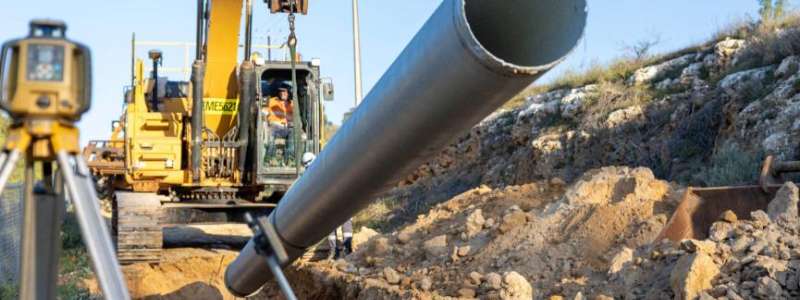
When the Greenways Irrigation Trust secured government funding to upgrade its river pumping station and pipeline network, the project carried weight far beyond a simple infrastructure refresh. The trust — a community body made up of commercial farmers and domestic residents along the Murray River — depends on this pipeline to deliver the water that keeps local farmland productive. For growers in the region, a modernised, higher-capacity system means the difference between sticking with existing crops and transitioning to higher-value produce such as almonds and citrus. It's a clear example of how the right pipe infrastructure decision can directly influence agricultural outcomes for an entire community.
A Project Built on Collaboration
Viadux SA partnered with contractor Exact Contracting from the earliest planning stages of the upgrade. Rather than defaulting to a familiar material, the project team undertook a genuine evaluation of what would perform best for this specific application: a long-distance pipeline drawing directly from the Murray River, servicing a mix of commercial and residential users.
That evaluation led the team to specify Flowtite Glass Reinforced Polymer (GRP) pipe, sourced through Viadux's GRP systems range. The choice reflects the kind of technical, materials-led decision-making that defines Viadux's approach to industry case studies across the water infrastructure sector — matching pipe material to the real-world demands of the project rather than convention alone.
Why GRP Won Out Over Alternative Materials
The specification process weighed GRP against several other viable options, including PVC, polyethylene, ductile iron, and mild steel. Each of these materials is well proven in Australian water infrastructure, so the decision came down to which one delivered the best combination of performance, cost efficiency, and sustainability for this particular pipeline.
Two factors tipped the balance decisively toward GRP:
Pipe length and jointing method. Flowtite GRP can be supplied in 13-metre lengths, joined using a rubber ring system rather than welding. On a pipeline of this scale, that difference compounds quickly. Longer pipe sections mean fewer joints across the full run, which translates directly into reduced freight movements and faster installation on site. Compared to shorter-length materials, or products that require welded joints, the labour and time savings were substantial.
Local manufacturing. Flowtite GRP used on this project is produced locally in Lonsdale, South Australia. Sourcing a locally manufactured product rather than importing materials or trucking them long distances brought clear efficiencies in delivery lead times and cost — critical on a project with defined government funding timelines. It also meant Viadux could commit to direct-to-site delivery scheduled around the contractor's installation program, rather than working around long supply chains.
Custom Lengths for a Better Fit
Because Viadux worked closely with both the trust and Exact Contracting throughout planning, the team was able to source custom 13-metre pipe lengths tailored to the specific requirements of this pipeline route. This kind of close-to-source, project-specific sourcing is only possible with strong supplier relationships and local manufacturing access — both of which underpin Viadux's broader product range and its ability to support civil and irrigation contractors with the right specification, not just the nearest available stock.
Sustainability as a Practical Outcome, Not a Slogan
GRP pipe's environmental credentials were a genuine factor in the specification decision, not an afterthought. The manufacturing process behind GRP has a comparatively low environmental footprint, and the material's lightweight nature — combined with its extended pipe lengths and rubber ring jointing — means fewer truck movements, less on-site machinery time, and a lower overall carbon footprint for the installation phase.
For a project centred on sustainable regional water use, that alignment mattered. The Greenways upgrade isn't just about moving more water more reliably — it's about doing so in a way that reflects the values of the community it serves.
The Result: A Pipeline Built for the Next Generation of Growers
The upgraded pumping station and pipeline give the Greenways Irrigation Trust the capacity and reliability needed to support both existing farming operations and future crop diversification. For commercial growers, that opens the door to higher-yield or higher-value plantings. For residential users along the network, it means a more secure and modern water supply drawn from the Murray.
None of this would have been possible without close coordination between three parties: the trust, who understood the community's long-term water needs; Exact Contracting, who managed the on-ground delivery; and Viadux, who brought the technical pipe expertise and local supply chain to make the right material choice a practical reality.
A Model for Regional Irrigation Infrastructure
The Greenways project is a useful reference point for other irrigation trusts, water authorities, and civil contractors weighing up pipe material options for river-fed or long-distance irrigation networks. The core lesson isn't that GRP is always the answer — it's that a proper materials evaluation, backed by local manufacturing and genuine collaboration between trust, contractor, and supplier, produces better outcomes than defaulting to whatever's been used before.
Viadux continues to support irrigation and civil infrastructure projects across South Australia and nationally, drawing on more than a century of pipeline supply experience alongside modern materials like GRP. To explore how the right pipe specification could benefit your next irrigation or water infrastructure project, get in touch with the Viadux team or browse the full range of case studies from projects around the country.
Word count: ~1,000