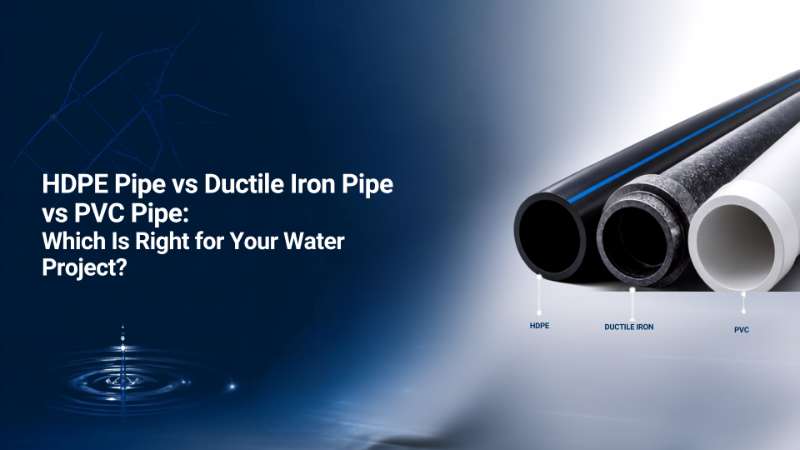
When you are trying to decide between HDPE pipe, ductile iron pipe and PVC pipe you need to think about things. What kind of pressure and depth will the pipeline have to deal with? What are the ground conditions like where the pipeline's going?. How many joints will the pipeline need?
HDPE pipe is a choice for long pipelines that do not need a lot of joints especially when you are working with corrosive ground or you want to bury the pipeline without digging a trench. Ductile iron pipe is better for pressure pipelines like the main pipes that carry a lot of water and for fire hydrants. PVC pipe is an option when you are working with lower pressure pipelines and you want to save money like with gravity pipelines and pipelines that carry water to homes.
If you choose the pipe material you might end up using a pipe that is too strong for what you need which is a waste of money.. You might use a pipe that is not strong enough which can be very bad if the pipeline is going to be underground for a long time, like 80 years or more. You have to think about HDPE pipe and ductile iron pipe and PVC pipe to make the choice.
This guide walks through how the three materials stack up, when each one is the right call, and where to go for pipe sizing, ductile iron pipe specifications, or a PVC products range once you've settled on a direction.
Quick 3-Way Comparison Table
HDPE / PE Pipe — When to Specify
HDPE (high-density polyethylene, also called PE pipe) is the material of choice whenever a pipeline needs to go into the ground with the fewest possible joints and the least disruption above it.
Trenchless and directional drilling applications
Because HDPE arrives on coils or in long lengths and joins by butt fusion, it's the standard choice for horizontal directional drilling, pipe bursting, and other trenchless methods where open-cut excavation isn't practical — road crossings, waterway crossings, and reinstatement-sensitive sites.
Corrosive soils and aggressive environments
HDPE doesn't corrode, so it holds up in acidic, saline, or reactive ground where metallic pipe would need extra lining or cathodic protection. It's also a common choice for reuse water, effluent transfer, and mining slurry lines for the same reason.
Long continuous runs with minimum joints
Every joint is a potential leak point. Fusion-welded HDPE effectively becomes one continuous pipe, which is why it's favoured for rising mains and long transmission runs where joint integrity over decades matters more than upfront pipe cost.
HDPE to PVC pipe connection at transitions
Most networks aren't single-material end to end — a trenchless HDPE section often needs to tie into an existing PVC or ductile iron reticulation network. This is a common point of installation error, so the transition fitting and coupling need to be rated for both pipe types, not just bolted together on assumption.
Ductile Iron Pipe — When to Specify
Ductile iron earns its place wherever the pipeline has to carry high pressure, take repeated fitting connections, or move large volumes reliably for the long term.
High-pressure trunk mains
Ductile iron's strength-to-wall-thickness ratio makes it the standard for trunk mains and transmission pipelines carrying high flow at high pressure, where a failure would take out supply to a large area.
Fittings-dense distribution networks
In sections of network with frequent tees, bends, valves, and offtakes, ductile iron's rigidity and restrained-joint options handle repeated fitting loads better than flexible pipe materials.
Fire hydrant ring mains
Hydrant reticulation needs to deliver sudden high-flow demand reliably under pressure, which is exactly the load profile ductile iron is built for — see how it's specified on projects like the Hamilton-Grampians pipeline case study, a 52km ductile iron trunk main delivering 2,000 megalitres a year for Wannon Water.
PVC Pipe — When to Specify
PVC (available as PVC-U, PVC-M, and PVC-O) remains the workhorse material for the majority of Australia's reticulation network, and for good reason.
Lower pressure gravity and reticulation systems
For gravity sewer, stormwater, and standard-pressure water reticulation, PVC delivers the corrosion resistance and hydraulic smoothness the job needs without paying for strength the pipeline doesn't require.
Cost-effective shorter-run projects
Where a project doesn't call for trenchless installation or trunk-main pressure ratings, PVC generally offers the lowest installed cost per metre for the performance class — a factor that matters on tighter civil and subdivision budgets.
Residential and light civil applications
Subdivisions, residential reticulation, and light commercial connections are PVC's core territory: proven, standards-compliant, and straightforward to install and maintain.
Water Pipe Material Types by Application Matrix
Different parts of a network call for different materials — most well-designed systems use more than one.
Cost Per Metre Comparison
When you compare the costs of HDPE, ductile iron and PVC pipe you have to think about more than the price tag on the pipe. Ductile iron pipe usually costs the most per metre because it is really strong and heavy.. This extra cost is made up for in areas where the water pressure is really high or where there are a lot of fittings because you would need to use a lot more of a lighter material to get the same strength.
HDPE pipe can be more expensive than PVC pipe to start with. It can be installed in a way that does not need trenches and it has fewer joints so the total cost of installing it can be lower than other options. You have to consider the cost of digging and other construction work when you are deciding which type of pipe to use.
For water pressure systems PVC pipe is usually the cheapest option, which is why it is used for most of Australias water network. PVC pipe is a choice for standard systems and that is why it is so widely used. PVC pipe and HDPE pipe and ductile iron pipe all have their advantages and disadvantages but PVC pipe is generally the most cost-effective option, for standard-pressure systems. For a project-specific comparison, get in touch with your nearest Viadux branch — pricing depends on diameter, pressure class, and site conditions.
Australian Standards Reference by Material
Specifying to the correct Australian Standard is non-negotiable for water authority approval. As a quick reference:
HDPE pipe — AS/NZS 4130 (polyethylene pipes for pressure applications)
Ductile iron pipe — AS/NZS 2280 (ductile iron pipes and fittings)
PVC pipe — AS/NZS 1477 (PVC pipes and fittings for pressure applications)
Always confirm the current edition and any water-authority-specific addenda with your Viadux representative before finalising a specification — standards are periodically updated and some authorities apply additional local requirements.
How Viadux Can Help You Choose
With more than 120 years in Australian water infrastructure and Australia's largest ductile iron pipe distribution capability, Viadux stocks HDPE, ductile iron, and PVC pipe systems side by side — which means the recommendation you get isn't skewed toward whichever material happens to be on the shelf. If you're specifying a mixed-material network, comparing options for an upcoming trunk main or reticulation upgrade, or just need the transition fittings to join two pipe types cleanly, our full product range and technical team can help you land on the right combination the first time. Download the Viadux product range guide for detailed specifications across all three materials, or contact your nearest branch to talk through your project.