What Is HDPE Pipe?
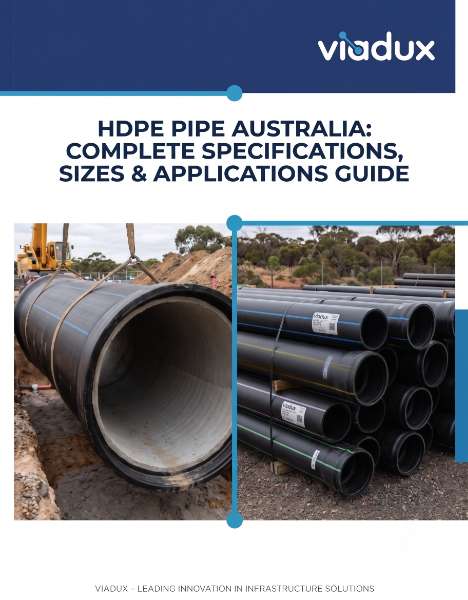
HDPE pipe — also called PE pipe or HD pipe — is a thermoplastic pressure pipe made from high-density polyethylene resin. It is one of Australia's most specified pipeline materials due to its corrosion resistance, flexibility, and long service life. The black colour common to Australian HDPE pipe comes from carbon black, added as a UV stabiliser for exposed installations.
PE80 vs PE100 — What the Grade Number Means
PE100 is now the standard grade for new Australian installations. Viadux supplies PE 100 pipe for civil, industrial, and irrigation projects.
HDPE Pipe Specifications & Performance
Pressure rating is determined by the SDR (Standard Dimension Ratio) — the ratio of outside diameter to wall thickness. A lower SDR means a thicker wall and higher pressure rating. The Hazen-Williams roughness coefficient for HDPE is C = 150 — significantly smoother than ductile iron or PVC over time, reducing head losses and pumping energy costs.
HDPE pipe has a design life exceeding 50 years when correctly specified and operated within its ratings — making it highly competitive on whole-of-life cost.
HDPE Pipe Advantages and Disadvantages
Key Advantages Over PVC, Ductile Iron, and Steel
Fully corrosion and chemical resistant — no cathodic protection needed
Leak-free jointing — butt-fusion and electrofusion joints are as strong as the pipe wall
Flexible — accommodates ground movement and seismic activity
Lightweight — easier to handle and transport than DI or steel
Limitations to Know
Higher thermal expansion than metals — must be managed in above-ground runs
Fusion jointing requires trained operators and calibrated equipment
Not self-supporting over long spans without adequate support spacing
HDPE Pipe Applications in Australia
Water Mains and Potable Water
PE100 pipe to PN 12.5 or PN 16 is the standard choice for reticulation mains. It is inert, WaterMark-certified, and approved for direct burial. Explore how Viadux supports civil infrastructure and major projects.
Drainage and Stormwater
For non-pressure applications, Viadux supplies PE non-pressure pipe including StormFLO — lighter, more flexible, and more chemical-resistant than concrete alternatives.
Mining and Industrial
HDPE is extensively used in Australian mining for dewatering, mineral slurry pipelines, and tailings transport. View industrial project case studies on the Viadux website.
Australian Standards & Compliance
AS/NZS 4130 is the primary standard for polyethylene pressure pipes in Australia, specifying material designations, dimensions, SDR/PN ratings, marking, and testing requirements. WaterMark certification is required for potable water applications. WSAA WSA PS-104 adds third-party certification and full material traceability requirements adopted by most Australian water utilities.
Viadux HDPE Pipe Range & How to Order
Viadux is one of Australia's leading HDPE pipe distributors, serving civil, industrial, and irrigation markets through a national branch network. The Plastic Products range covers the full PE pipeline spectrum:
PE 100 Pipe — AS/NZS 4130 certified PE100 pressure pipe
PE Pressure Fittings — spigot fittings for butt-fusion jointing
PE Electrofusion Fittings — Friatec couplers, tees, and elbows
PE Compression Fittings — Philmac fittings for smaller diameters
PE Non-Pressure Pipe — drainage and stormwater including StormFLO
To order, download the Viadux Product Range Guide or contact your nearest Viadux branch. For project-specific technical advice, call 1300 VIADUX (842 389).