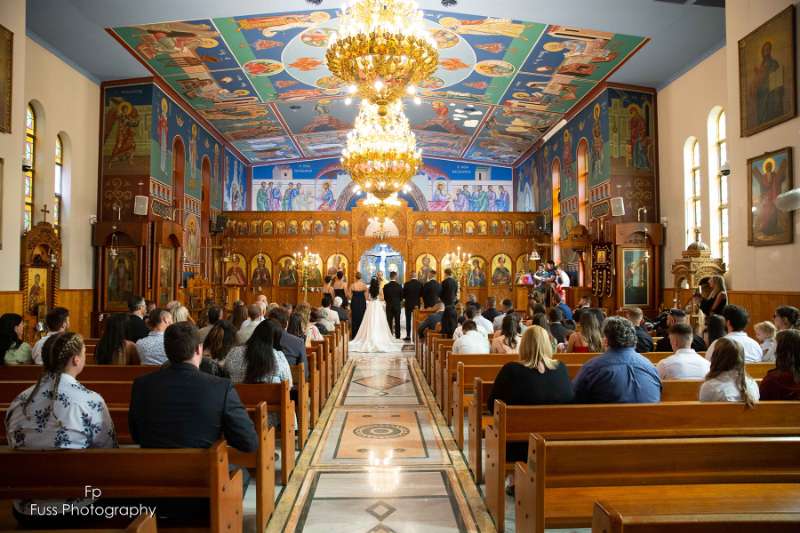
A Greek Orthodox wedding is not a single moment — it's a full day of sacred rituals, joyful family celebration, and cultural tradition woven together. Photographing it well requires more than a good camera. You need a photographer who understands the order of service, knows the significance of the stefana, and can work quietly in a dimly lit Byzantine church without disrupting the priest or the family. That's exactly what Fuss Photography has done for hundreds of Greek families across Sydney since 2000.
Why Do Greek Orthodox Weddings Require a Specialist Photographer?
Greek Orthodox weddings follow a specific liturgical structure that's different from civil or other religious ceremonies. The ceremony itself typically runs for two hours and includes multiple distinct rituals — each with its own moment worth capturing.
A general wedding photographer who hasn't worked a Greek Orthodox service before may miss the coin exchange (arravones), hesitate during the stefana crowning, or be caught off guard by the koumbaro and koumbara roles. These are not background moments. They are the heart of the ceremony.
Beyond the order of service, Greek weddings involve large, multi-generational families with strong expectations around family photos. Knowing how to coordinate extended family groups — including grandparents, godparents, and children from both sides — is a skill that comes from experience, not improvisation.
What Are the Key Ceremonies to Capture at a Greek Orthodox Wedding?
Here are the core moments every Greek Orthodox wedding photographer must be ready for:
Stefana (crowning ceremony): The most visually significant moment. The crowns are placed on the bride and groom's heads and linked by a ribbon — timing and positioning matter enormously here.
Coin exchange (arravones): Rings and coins are exchanged three times, symbolising the couple's shared future.
Ring blessing: The priest blesses the rings before they are placed on the couple's fingers.
Candle lighting: The couple hold lit candles throughout parts of the ceremony — soft, warm light that creates beautiful natural photography opportunities.
First dance as married couple: The Isaiah Dance, where the priest leads the couple three times around the altar table.
Koumbaro and Koumbara roles: The wedding sponsors play an active part throughout — swapping the stefana, holding candles, and signing the registry. They deserve dedicated coverage.
Missing any of these is not a small oversight. For Greek families, these are the photos that will hang on walls for generations.
What Are the Photography Challenges Inside Sydney's Orthodox Churches?
Greek Orthodox churches are visually stunning — but technically demanding. Here's what makes them difficult to shoot in:
Low light: Many Sydney Orthodox churches use warm, indirect lighting with minimal overhead illumination. Photographers need to shoot confidently at high ISO without introducing heavy grain.
No-flash rules: Most Greek Orthodox churches in Sydney prohibit flash photography during the ceremony. This is non-negotiable. A photographer who brings a flash and fires it during the stefana will not be welcomed back.
Long aisles and restricted movement: Some churches have long central aisles with seating on both sides, limiting where you can stand and move during the procession and ceremony.
Priest movement: The priest moves around the altar table multiple times during the service. Anticipating this movement — knowing where to be before it happens — separates experienced Orthodox wedding photographers from everyone else.
Capturing emotion without disruption: The goal is to be invisible. Every photo should look like it was taken by a guest who happened to have a great camera.
Which Greek Orthodox Churches in Sydney Should You Know About?
If you're getting married at one of Sydney's Greek Orthodox churches, here's what to expect photographically at each location:
St. Sophia Cathedral, Paddington: One of Sydney's most prominent Greek Orthodox churches. High ceilings, beautiful iconostasis, and moderate natural light through tall windows.
St. Panteleimon Greek Orthodox Church, Rockdale: A popular choice for families in Sydney's south. More intimate setting with warm interior lighting.
Holy Trinity Greek Orthodox Church, Dulwich Hill: Classic Orthodox interior with traditional decoration. Strong community ties and often hosts larger weddings.
Annunciation Greek Orthodox Church, Redfern: A historic church in the inner west. Tight spaces require careful positioning throughout the ceremony.
Fuss Photography has worked at all of these venues and understands the specific access points, lighting conditions, and restrictions at each one.
What Reception Traditions Should a Greek Wedding Photographer Capture?
The ceremony is only half the story. Greek wedding receptions have their own set of traditions that need to be covered:
Plate smashing (tsougrisma): A high-energy moment early in the reception — blink and you'll miss the smash, the reaction, and the laughter.
Money dance (kalamatiano): Guests pin money to the couple as they dance. This is a long, joyful tradition that involves almost everyone in the room. Wide shots, crowd shots, and close-ups of the couple all matter here.
'Opa' moments: Spontaneous and unscripted — the photographer needs to stay alert throughout the night.
Multi-generational family shots: Greek receptions always involve large family groupings. Planning these in advance (with a shot list from the couple) makes it possible to cover everyone without the evening stalling.
A Greek wedding reception is loud, warm, and full of movement. The photography should reflect that energy.
How Should You Brief Your Photographer Before a Greek Orthodox Wedding?
A pre-wedding briefing is not optional for a Greek Orthodox wedding — it's essential. Here's what to go through together:
Share the order of service: Give your photographer a printed or written copy. Every church follows a similar structure, but timing varies.
List your must-have family shots: Write out who needs to be in which group photos. Include names and relationships so the photographer can call people by name and move efficiently.
Explain the significance of each tradition: Even experienced Greek Orthodox photographers benefit from understanding which moments matter most to your specific family.
Meet beforehand: A brief in-person or video consultation before the wedding day allows the photographer to ask questions, understand your priorities, and arrive prepared — not guessing.
Fuss Photography includes a consultation with every booking specifically for this reason.
What Does a Typical Greek Orthodox Wedding Day Timeline Look Like?
Morning — Church preparation: Bridal prep, groom prep, arrival photos, and pre-ceremony shots outside the church.
2-hour ceremony: The full Orthodox service including all traditions from arravones to the Isaiah Dance.
Post-ceremony: Bridal party portraits, family group photos, and couple portraits — often at a nearby park or Sydney landmark.
Reception: Arrival, formalities, kalamatiano, speeches, plate smashing, dancing, cake cutting, and late-night candid coverage.
A typical Greek wedding requires a minimum of 8–10 hours of photography coverage to do the day justice. Fuss Photography's packages are designed with this in mind.
FAQs: Greek Orthodox Wedding Photography in Sydney
How long is a Greek Orthodox wedding ceremony?
Most Greek Orthodox ceremonies run between 90 minutes and 2 hours. The length depends on the priest and the number of additional blessings or traditions included. Plan your photography coverage to begin well before the ceremony and extend well after — the moments immediately following the service are some of the most photographable of the entire day.
Can you use flash inside a Greek Orthodox church in Sydney?
Generally, no. Most Greek Orthodox churches in Sydney prohibit flash photography during the ceremony out of respect for the liturgy. Any photographer you hire must be fully capable of shooting in low-light conditions without flash. Ask specifically about this during your consultation — it's one of the most important technical questions you can ask.
Do you need special permission to photograph a Greek Orthodox ceremony?
In most cases, the couple or their families will need to confirm photography arrangements with the church and priest in advance. Some churches have specific rules about where photographers can stand, whether video lighting is permitted, and how many photographers are allowed inside. Fuss Photography can advise on this based on your specific church.
What makes Fuss Photography different for Greek Orthodox weddings?
Fuss Photography has photographed Greek Orthodox weddings across Sydney since 2000. That's over two decades of understanding the ceremony structure, the family dynamics, the church restrictions, and the reception traditions. You're not explaining what the stefana is or why the koumbaro matters — we already know, and we'll be in position before it happens.
How far in advance should we book a Greek Orthodox wedding photographer?
For popular dates — particularly Saturdays from October through April — booking 12 months in advance is strongly recommended. Greek Orthodox weddings often involve larger guest lists and more complex logistics, so early confirmation gives everyone more time to plan properly.
Ready to Book a Greek Orthodox Wedding Photographer in Sydney?
Greek Orthodox weddings are among the most layered and beautiful ceremonies you'll ever photograph — but they require a photographer who has done this before, many times, and knows exactly where to be at every moment. From the stefana crowning at St. Sophia Cathedral to the kalamatiano at the reception, every tradition deserves coverage that does it justice.
Fuss Photography has been Sydney's trusted specialist in Greek Orthodox wedding photography since 2000. Packages start from $1,250.