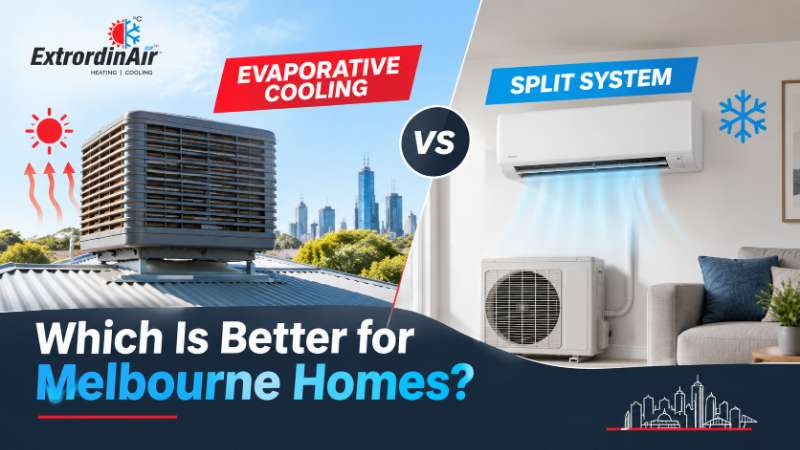
Evaporative Cooling vs Split System: Which Is Best for Your Melbourne Home?
Choosing between evaporative cooling and a split system is not simply a matter of deciding which air conditioner is "better". The two systems cool your home in fundamentally different ways, and each suits different homes, budgets, and comfort preferences.
For Melbourne homeowners, the decision becomes particularly interesting. Our summers can bring stretches of hot, dry weather, but Melbourne is also known for rapidly changing conditions.
So, evaporative cooling vs split system: which should you choose?
TL;DR: Evaporative Cooling vs Split System
Evaporative cooling is generally better suited to homeowners who want fresh-air, whole-home cooling with relatively low electricity consumption during Melbourne's dry summer conditions. A reverse-cycle split system provides more precise temperature control, works effectively regardless of outdoor humidity, and can both cool in summer and heat in winter.
The right choice depends on your home's size, layout, insulation, existing heating, how many rooms you want to cool, and whether you want heating and cooling from the same system.
ExtrordinAir installs both evaporative and split-system air conditioning across Melbourne's northern and western suburbs, so the decision can be based on the property rather than pushing one system type.
Table of Contents
• How Does Evaporative Cooling Work?
• How Does a Split System Work?
• Evaporative Cooling vs Split System: Quick Comparison
• When Does Evaporative Cooling Make More Sense?
• When Is a Split System the Better Fit?
• What About Melbourne's Weather?
• What About Running Costs?
• Should You Replace an Old Evaporative Cooler With a Split System?
• What If You Want Whole-Home Heating and Cooling?
• Get the System Matched to Your Melbourne Home
• Frequently Asked Questions
How Does Evaporative Cooling Work?
Evaporative cooling draws warm outside air through water-soaked cooling pads. As the water evaporates, heat is removed from the air before a fan distributes the cooler air throughout the house.
Unlike refrigerated air conditioning, evaporative cooling continually introduces fresh outside air. Windows or doors need to remain partially open so warm air can escape.
This makes it particularly suited to dry conditions and homes where owners like having doors and windows open during summer.
ExtrordinAir installs systems from brands including Breezair, Bonaire, Braemar, and Brivis, and services evaporative cooling across Melbourne's north and west.
How Does a Split System Work?
A split-system air conditioner uses refrigerant to transfer heat between an indoor and outdoor unit.
During summer, heat is removed from inside the room and transferred outdoors. With a reverse-cycle system, the process can be reversed during winter to provide heating.
Unlike evaporative cooling, refrigerated air conditioning generally operates most effectively with doors and windows closed.
Individual split systems are particularly practical for bedrooms, living rooms, apartments, home offices, and other spaces where you only need to condition specific rooms.
Evaporative Cooling vs Split System: Quick Comparison
Evaporative cooling uses water evaporation and fresh outside air, while a split system uses refrigerated cooling and primarily recirculates indoor air. Evaporative cooling is designed for cooling only, whereas a reverse-cycle split system can provide both heating and cooling. Evaporative systems generally suit whole-home cooling in hot, dry weather, while split systems provide precise room-by-room temperature control across a wider range of conditions.
This is why there is not a universal winner. The better system depends on how you actually use your home.
When Does Evaporative Cooling Make More Sense?
• You Want to Cool the Whole House: A ducted evaporative system distributes air through outlets around the home, making it practical when several rooms need cooling simultaneously. For families using bedrooms, living areas, and kitchens throughout the day, this can be more convenient than installing individual wall units in every room.
• You Like Fresh Air and Open Windows: Evaporative cooling is unusual because opening a window is part of normal operation. Fresh cooled air enters the house while warmer air exits through open windows or doors. This can work particularly well with Melbourne homes designed around open-plan living and indoor-outdoor spaces.
• You Already Have Ducted Gas Heating: Some Melbourne homes already have gas ducted heating for winter but no whole-home summer cooling. Because evaporative cooling operates through its own system, it can complement an existing gas heating setup without requiring homeowners to immediately replace the heating system.
When Is a Split System the Better Fit?
• You Only Need to Condition Certain Rooms: If most of your time is spent in the living room during the day and bedroom at night, conditioning the entire house may not make sense. A split system lets you heat or cool the room you are actually using.
• You Want Heating and Cooling From One Unit: Reverse-cycle split systems provide both refrigerated cooling and heating. That makes them particularly attractive when replacing inefficient standalone heaters or when a room currently has no permanent heating.
• You Want Precise Temperature Control: A split system lets you select a target temperature and uses inverter technology to adjust output as the room approaches that setting. Evaporative cooling is more dependent on outside temperature and humidity, so it does not offer the same level of precise temperature control.
• Your Home Cannot Easily Accommodate Ductwork: Apartments, townhouses, and some established Melbourne homes may have limited roof or underfloor space. A wall-mounted split system can sometimes provide a much simpler solution, subject to suitable indoor and outdoor unit locations.
What About Melbourne's Weather?
This is where the decision becomes more property-specific.
Melbourne regularly experiences hot, dry summer weather, conditions that suit evaporative cooling particularly well. However, refrigerated systems are not dependent on evaporation and can maintain more consistent temperature control across a broader range of conditions.
Instead of asking, "Which air conditioner is best?", a more useful question is: "Which system best matches how many rooms I use, my existing heating, my home's layout, and the way I want to cool it?"
That is the question worth answering before requesting quotes.
What About Running Costs?
Running costs depend on more than the system type.
The size and efficiency of the unit, thermostat settings, house insulation, how long the system operates, and the number of rooms being conditioned can all affect electricity use.
Evaporative cooling typically uses electricity for the fan and water pump rather than a refrigeration compressor. Split systems use compressor-driven refrigeration but allow homeowners to condition individual rooms instead of necessarily cooling the entire house.
This means comparing running costs without considering how the household uses each system can be misleading.
Should You Replace an Old Evaporative Cooler With a Split System?
Not automatically.
If your existing evaporative cooler has reached the end of its life, you have several possible paths:
1. Replace it with a newer evaporative system.
2. Install one or more reverse-cycle split systems.
3. Consider multi-head air conditioning for several rooms.
4. Move to ducted reverse-cycle air conditioning for whole-home heating and cooling.
The best option depends on the existing ductwork, house layout, heating system, electrical capacity, and budget.
For homeowners searching for an air conditioning installer "near me" in Melbourne's north or west, an in-home assessment can be more useful than choosing a system purely from specifications online.
ExtrordinAir provides free in-home consultations and written quotes for air conditioning installations.
What If You Want Whole-Home Heating and Cooling?
Neither a single split system nor evaporative cooling necessarily answers every whole-home requirement.
Ducted reverse-cycle air conditioning is another option. It provides refrigerated heating and cooling through ducts and can incorporate zoning to control different areas of the house.
ExtrordinAir's comparison of system types places ducted refrigerated air conditioning as a whole-home heating-and-cooling option, while evaporative cooling provides cooling only and split systems work particularly well room by room.
This is why homeowners renovating or replacing multiple ageing systems should compare evaporative, split, and ducted reverse-cycle options rather than limiting the decision to two systems.
Get the System Matched to Your Melbourne Home
The best air conditioning system is not necessarily the biggest or most expensive one: it is the system correctly matched to your home's layout and how your household uses it.
ExtrordinAir has more than 25 years of experience with heating and cooling and is based at 32 Parer Road, Airport West VIC 3042, servicing Melbourne's northern and western suburbs.
For homeowners comparing evaporative cooling and split-system air conditioning, ExtrordinAir can assess the property and recommend suitable options.
Call (03) 9330 0277 or book a free in-home assessment with ExtrordinAir.
Frequently Asked Questions
Is evaporative cooling good for Melbourne?
Yes. Evaporative cooling can work effectively during Melbourne's hot, dry summer conditions. Performance depends on outdoor temperature and humidity because evaporative systems cool air through water evaporation.
Is a split system cheaper to run than evaporative cooling?
There is not one answer for every home. Evaporative systems typically have relatively low electrical demand, while split systems let you condition individual rooms instead of the entire house. Actual running costs depend on system efficiency, usage, home size, insulation, and temperature settings.
Can evaporative cooling also heat my home?
No. Evaporative cooling is a cooling-only system. Homeowners wanting heating and cooling from one appliance can consider reverse-cycle split systems or ducted reverse-cycle air conditioning.
Can I leave the windows open with evaporative cooling?
Yes. Evaporative cooling requires some windows or doors to be open so warm indoor air can escape while fresh cooled air enters the home.
Is a split system suitable for a Melbourne bedroom?
Yes. Split systems are commonly used for bedrooms because they provide individual temperature control without conditioning the entire house. Correct system sizing and placement are important for comfort and efficiency.
Who installs evaporative and split-system air conditioning in Melbourne's north and west?
ExtrordinAirsupplies and installs both evaporative and split-system air conditioning and services areas across Melbourne's northern and western suburbs from its Airport West base.
ExtrordinAir Heating & Cooling
32 Parer Road, Airport West VIC 3042
Phone: (03) 9330 0277