Ergonomic Seating & WHS Compliance in Australia: What Employers Need to Know in 2026
In 2026, Work Health and Safety (WHS) in Australia has evolved significantly. The days of treating workplace safety merely as a checklist for physical hazards—like slips, trips, and heavy lifting—are over. Today, the most insidious threat to employee wellbeing, productivity, and an employer's bottom line is sitting right in front of the desk or the operatory.
For business owners, WHS managers, and HR teams, ensuring [ergonomic seating WHS compliance australia] is no longer a "nice-to-have" employee perk; it is a strict legislative requirement. With compensation claims for physical and psychosocial stress hitting all-time highs, the chair an employee sits in for eight hours a day represents either a massive liability or a powerful preventative tool.
This comprehensive guide explores the financial reality of musculoskeletal disorders in Australia, outlines your obligations under Safe Work Australia, and provides a clear roadmap for mitigating ergonomic risk using clinically validated seating.
The Staggering Cost of Musculoskeletal Disorders (MSDs)
When an employee complains of a "sore back," the consequences for the business are far greater than a few days of sick leave.
Recent data analysis reveals that work-related musculoskeletal disorders (WMSDs) now cost the Australian economy an estimated $55 billion annually when lost productivity, absenteeism, and compensation payouts are factored in. Furthermore, according to Safe Work Australia’s Key Work Health and Safety Statistics, "body stressing" (which includes static posturing and repetitive strain) remains the leading cause of serious workplace injuries, consistently responsible for over 33% of all compensation claims.
For employers, the direct costs of investing in [musculoskeletal disorder prevention seating] are minuscule compared to the indirect costs of an MSD claim:
Workers' Compensation Premiums: A single serious lower back claim can drastically inflate a company's insurance premiums for years.
Presenteeism: Employees working through pain are significantly less productive, highly prone to errors, and experience diminished concentration and focus.
High Turnover: Chronic pain drives skilled employees to leave their professions entirely, resulting in massive recruitment, onboarding, and retraining costs.
Safe Work Australia Obligations: The Employer's Duty of Care
Under the Model WHS Act governed by Safe Work Australia, business owners and Persons Conducting a Business or Undertaking (PCBUs) have a primary duty of care to ensure the physical and mental health of their workers.
Crucially, this legislation dictates that employers must systematically identify and manage hazards that arise from poor workplace design and awkward postures. Simply providing a generic, mass-produced office stool and a desk does not fulfill this duty. If an employee develops a chronic lumbar injury because they were forced to work in a static, unsupported posture, the organisation can be found legally liable for failing to provide adequate ergonomic controls.
To remain compliant in 2026, WHS managers must actively intervene with seating that genuinely supports human biomechanics during specific work tasks, rather than relying on outdated "passive" seating.
The Biomechanics of Compliance: Why Standard Chairs Fail
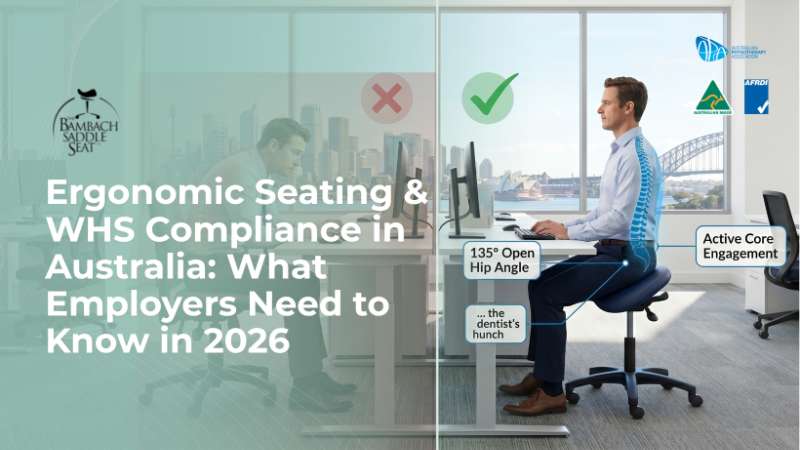
The root cause of seated MSDs lies in the angle of the hips. Standard office and clinical chairs force the user into a 90-degree hip angle. Mechanically, this forces the pelvis to roll backward—a position known as a posterior pelvic tilt.
When the pelvis tilts backward, the spine's natural, healthy "S" curve collapses into a "C" shaped slump. Over an eight-hour shift, this slump places extreme compressive load on the anterior intervertebral discs and overstretches the posterior ligaments.
While high-back executive chairs attempt to push the spine back into shape using adjustable lumbar cushions, these are entirely useless for employees who must lean forward to type, look into a microscope, or perform clinical procedures. The moment the worker leans forward, the backrest is abandoned, and the spine bears the full brunt of the biomechanical load.
The Solution: The 135-Degree Open Hip Angle
To prevent MSDs, WHS interventions must target the foundation of sitting: the pelvis. An authentic saddle chair drops the thighs, creating a 135-degree open hip angle. This automatically rotates the pelvis forward (anterior tilt), stacking the spine into its perfect natural posture without requiring active, exhausting muscle bracing.
Procurement and Certification: The Role of the [AFRDI certified saddle chair]
When procuring ergonomic equipment, HR teams and WHS managers are often bombarded with vague marketing terms like "orthopaedic" or "chiropractor approved." From a compliance and liability perspective, these buzzwords offer zero legal protection.
(Note: It is a common misconception in Australia that workplace furniture needs "AHPRA Approval." AHPRA regulates individual healthcare practitioners, not medical devices or commercial furniture.)
To prove WHS compliance and demonstrate a genuine commitment to hazard mitigation, employers must demand hard, independent certifications:
AFRDI Level 6 Certification: The Australasian Furnishing Research and Development Institute (AFRDI) rigorously tests commercial furniture. Procuring an [AFRDI certified saddle chair] proves to auditors that your equipment has passed extreme stress, durability, and safety tests, and is legally fit for severe, 24/7 commercial use. This certification is an employer's strongest shield against liability claims regarding equipment failure.
Australian Physiotherapy Association (APA) Endorsement: Look for seating that is clinically endorsed by peak bodies. The Bambach Saddle Seat is the only seating solution of its kind to hold this level of clinical validation from the APA for preventing spinal injuries.
A Practical Ergonomic Workstation Checklist for 2026
How do you know if your current workplace setup is compliant and safe? HR and WHS managers can use this quick audit checklist to evaluate their organisation's ergonomic risk:
[ ] Task-Specific Matching: Does the chair actually match the task? (e.g., Forward-leaning tasks like dentistry, drafting, or active typing require a saddle chair, not a heavily reclined executive chair).
[ ] Hip Angle: Does the seating allow for an open hip angle (greater than 90 degrees) to facilitate natural spinal alignment and an anterior pelvic tilt?
[ ] Foot Support: Can the employee place both feet flat on the floor to stabilise their core, widen their base of support, and reduce shoulder girdle strain?
[ ] Independent Certification: Are all office and clinical chairs AFRDI Level 6 certified for severe commercial use?
[ ] Customisation: Is the seating custom-fitted to the individual worker’s height and pelvic width, rather than a generic "one-size-fits-all" approach that can cause soft tissue compression?
[ ] Mobility: Does the chair allow the worker to move freely around their workstation without awkwardly twisting their lower back?
Conclusion: Protect Your Most Valuable Asset
Workplace health and safety in 2026 is a proactive investment, not a reactive cost. Ignoring the biomechanical realities of seated work exposes Australian businesses to billions of dollars in lost productivity, high turnover, and devastating workers' compensation claims.
By transitioning your workforce to clinically validated, anatomically correct seating, you not only ensure strict WHS compliance but also foster a healthier, more productive, and highly engaged team.
Ready to bulletproof your WHS strategy and protect your workforce from chronic pain? Explore our WHS seating solutions and request a workplace trial today.
Frequently Asked Questions (FAQs)
What are an employer’s obligations regarding ergonomic seating in Australia?
Under the Safe Work Australia Model WHS Act, employers have a primary duty of care to provide a safe working environment. This includes systematically identifying and managing ergonomic hazards—such as poor workstation design and sustained awkward postures—that are proven to lead to musculoskeletal disorders (MSDs).
How does an AFRDI Level 6 certification help with WHS compliance?
AFRDI Level 6 is a rigorous, independent testing standard for commercial furniture in Australia and New Zealand. Procuring an [AFRDI certified saddle chair] provides documented proof to WHS auditors and insurers that the equipment provided to staff is structurally safe, highly durable, and fit for severe commercial use, effectively mitigating the employer's liability.
Why is "body stressing" a major concern for HR managers?
Body stressing, which includes injuries caused by static sitting, repetitive strain, and awkward leaning postures, is the leading cause of serious workers' compensation claims in Australia. It leads to long-term absenteeism, high staff turnover, and significantly increased insurance premiums.
Are ergonomic chairs required to be AHPRA approved?
No. AHPRA (the Australian Health Practitioner Regulation Agency) registers and regulates healthcare practitioners (such as doctors, dentists, and physiotherapists). They do not approve or regulate commercial furniture. True clinical validation for seating comes from endorsements by peak bodies like the Australian Physiotherapy Association (APA) and structural testing by AFRDI.
How does [musculoskeletal disorder prevention seating] actually work? Standard chairs force the hips into a 90-degree angle, which collapses the lower spine into a painful slump. Preventative seating, like the Bambach Saddle Seat, opens the hip angle to 135 degrees. This automatically rotates the pelvis forward, maintaining the spine’s natural "S" curve and eliminating the static intervertebral pressure that causes MSDs.