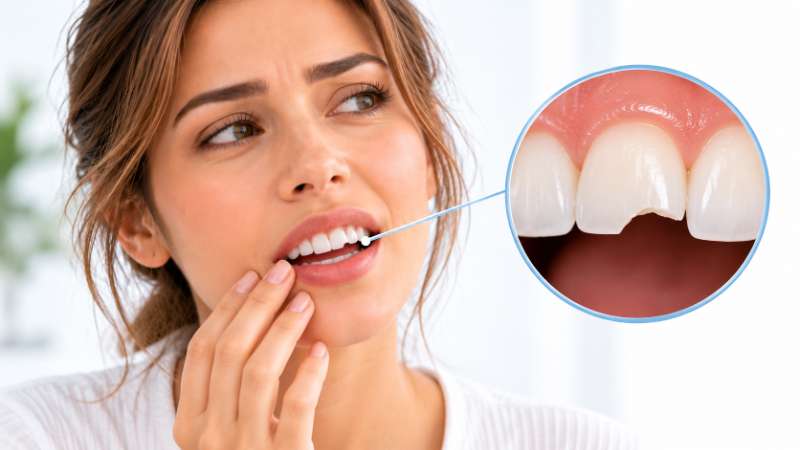
TL;DR
If you chip a tooth, rinse with warm water, keep the fragment in milk, cover any sharp edge, and call a dentist. Do not file the edge smooth or glue it back. Filing removes enamel permanently and superglue is not safe in the mouth, and both make the professional repair harder. Most small chips are fixed in one visit with composite bonding.
A chipped tooth is one of the most common dental emergencies over the Australian summer, and it usually happens doing something ordinary. A nut, a bit of ice, a prawn shell, a bottle cap someone should not have used their teeth on. The first instinct for a lot of people is to reach for a nail file or a tube of superglue, and that is the one thing worth talking you out of before anything else.
Key Insights
Save the fragment in milk. Some chips can be bonded back using the original piece.
Never file the edge smoothly. Enamel does not grow back, and filing creates micro-cracks that invite more chipping.
No pain does not mean no problem. Pulp damage often causes nothing for the first few days.
Pink or red inside the break, facial swelling, or bleeding from the tooth itself all mean same-day care.
What should you do in the first hour after chipping a tooth?
Rinse with warm water, save the fragment in milk, cover any sharp edge, and call a dentist. Those four steps cover almost every case.
Rinse with warm water. This clears debris and lets you see what has happened.
Find the fragment and keep it in milk. Milk preserves the piece far better than water or a tissue, and depending on the break it can sometimes be bonded back.
Stop any bleeding. If your lip, tongue or gum is cut, press clean gauze on it for ten minutes. Bleeding from the tooth itself is different and needs same-day attention.
Cover a sharp edge. Dental wax from a chemist, or sugar-free gum pressed over it, stops it slicing your tongue while you wait.
Cold compress on the outside of your cheek if there is swelling.
Soft food, and chew on the other side.
Call a dentist, even if it feels minor.
Is a slightly chipped tooth an emergency?
Usually not, but it still needs looking at. A slightly chipped tooth with no pain and a smooth edge can generally wait a few days for a normal appointment.
Some things should not wait at all:
Pink or red visible inside the break. That is the pulp, the living tissue inside the tooth.
Bleeding from the tooth itself, rather than from your lip or gum.
Severe or throbbing pain, or pain that builds over hours.
Facial swelling anywhere around the jaw or cheek.
A tooth that feels loose or has moved.
Any of those are a same-day call. Our emergency dental care in Parramatta page covers how to get seen quickly.
Here is the part that catches people out. A chipped tooth with no pain can still have damage running into the pulp, and that damage is often silent at first. By the time it does hurt, the straightforward repair may have become a root canal. A tooth that has stopped hurting after an injury is not necessarily a tooth that has healed.
Why you should not try to fix a chipped tooth at home
There is no safe way to repair a chipped tooth at home, and the two most popular methods both cause damage that cannot be undone.
Filing the edge smooth. Nail files and emery boards remove enamel, and enamel does not grow back. Filing also leaves microscopic cracks along the edge, which is exactly where the next chip starts. People do this to stop the edge catching on their tongue, which is a reasonable goal with a much safer answer: dental wax.
Superglue. Cyanoacrylate is not made for use in the mouth. It bonds instantly to gum and tongue, seals bacteria against the exposed surface, and has to be drilled off before any real repair can begin. Gluing a fragment back usually turns a one-visit fix into something longer.
Chemist temporary filling kits are designed to cover a lost filling for a few days, not to rebuild a chipped edge. They can hide a problem that is quietly getting worse underneath.
None of this is said to make anyone feel silly. Reaching for a file when a sharp edge is cutting your tongue at 9pm is understandable. It is just that the fix usually costs more than the chip did.
How do dentists repair a chipped tooth?
Chipped tooth repair depends on how much tooth is missing and whether the pulp is involved.
Composite bonding covers most everyday chips. Tooth-coloured material is shaped onto the tooth, hardened with a light, then polished, generally in one appointment with no drilling of a healthy tooth. Larger repairs are covered on our cosmetic dentistry page.
What affects chipped tooth repair cost?
Cost is driven by the repair the tooth needs rather than by how big the chip looks. The main factors:
How many teeth are missing. Bonding sits at the lower end, crowns at the higher end.
Whether the pulp is involved. Root canal treatment changes the picture considerably.
Which tooth it is. Front teeth need more careful colour matching.
Your health fund extras cover, which usually contributes to restorative work.
Worth asking about directly at the appointment, once someone has looked at the tooth. Any number quoted before that is a guess.
Frequently Asked Questions
Q: Can a chipped tooth heal on its own? A: No. Enamel has no blood supply and does not regenerate, so a chip stays as it is unless a dentist restores it. What can change is the tooth underneath, since an exposed surface is more vulnerable to sensitivity, decay and further breakage.
Q: My tooth chipped for no reason. Why? A: A tooth that breaks on something soft usually has a weakness already. Common causes are a large old filling, a crack, decay underneath, enamel worn thin by acid, or grinding at night. That is why a chip with no obvious cause is worth investigating rather than just repairing.
Q: Does a chipped tooth with no pain still need treatment? A: Yes. Pain is a poor guide, because nerve damage is often silent in the first few days. Exposed dentine is also more prone to decay and sensitivity over time, so even a comfortable chip is worth having assessed.
Q: How long can I leave a chipped tooth before seeing a dentist? A: A small chip with no pain and no sharp edge can usually wait a few days for a normal appointment. Anything involving pain, swelling, bleeding from the tooth, or visible pink inside the break should be seen the same day.
The Bottom Line
A chipped tooth is rarely as bad as it feels at the moment, and most are fixed in one visit. What makes it worse is filing the edge, gluing it back, and waiting because it does not hurt. Rinse, save the fragment in milk, cover the sharp edge, and ring someone.
You can browse more guides on our dental blog, or get in touch with My Smile Doctors in Parramatta if you have chipped a tooth and want it looked at.
Written by My Smile Doctors, Parramatta Dental Clinic. This article is general information only and is not personal dental advice. Please speak with a registered dental practitioner about your own circumstances.