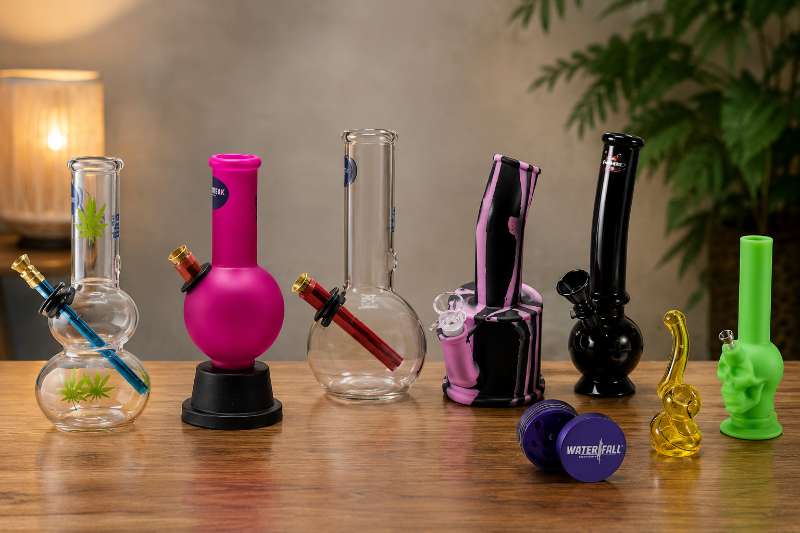
Spending under $50 no longer means settling for something that cracks within a month. We have been selling bongs since 1980. In that time, cheap bongs have improved more in the past five years than in the two decades before them. The glass is better. The joints are cut straighter. Our under-$50 range currently holds 76 pieces, and 51 of them are glass. Here is what genuinely matters at this price, and where the shortcuts still show up.
What does $50 actually buy you in a glass bong
At the $29 to $49 mark you get borosilicate glass with a wall thickness of roughly 3 mm to 4 mm. That is the industry standard, not a compromise. Heavier 5mm-plus glass exists, but it sits well above this budget.
What you give up is complex percolation and hand-finished detail. Expect machine-pulled necks, simpler diffusion and plainer decals. Function stays intact.
Every product is tested before it enters our catalogue. Some pieces never make the range at all. A seam sits wrong, or the stem fits loose, and we leave it out.
Three materials, and who each one suits
Most first-time buyers should start with glass. If you are hard on your gear, our silicone bong range makes more sense at the same price.
Check the joint size before you check the price.
This is the detail that catches people out. Joint size decides which cone piece and downstem will fit later on.
14mm is the most common size and carries the widest accessory support. 10mm turns up on mini bongs and travel pieces. It works well enough. The narrower passage does clog faster with finely ground material, so clean it every few sessions.
Buying a $35 piece with an unusual joint is a false economy. You then spend weeks hunting a matching cone piece. Read the listing first.
Where cheap bongs actually break
Rarely where people expect. After years of processing replacement claims, the pattern is consistent.
Most breakages happen during assembly rather than use. People force a dry stem into a dry grommet and snap the neck. We put the grommet first, and it slides in with almost no pressure.
Thermal shock comes second. Boiling water poured into cold glass will crack it, whatever the price tag. Warm water and isopropyl only.
Our Breakage Replacement Guarantee covers items that arrive damaged, reported within 14 days with photos. It does not cover damage caused afterwards. We would rather say that plainly than surprise you later.
A quick pre-purchase checklist
Joint size listed, ideally 14 mm for accessory compatibility
Borosilicate stated, not just "glass"
Base wide enough to sit stable on a table
Stem and cone piece included, not sold separately
Replacement parts available for that model
Honest answer: when you should spend more
If you use a piece daily and want real percolation, save for the $80 to $150 bracket. That is where multi-perc glass and thicker walls begin.
For everyone else, under $50 is plenty. Across our 7,000-plus customer reviews, the strongest ratings cluster around the $29 to $49 pieces rather than the premium end. Browse the full range of bongs under $50, or the wider glass bongs collection if your budget stretches further.
In Summary
Under $50 buys a genuine borosilicate piece that lasts years. Assemble it carefully and clean it properly, and it will outlive far dearer glass. Check the joint size, pick the material that suits your habits, and ignore anyone claiming price alone decides quality.
FAQs:
1. Are cheap bongs safe to use?
Yes, provided the piece uses proper borosilicate glass or food-grade silicone. Avoid unbranded imports with visible seam flaws. Every item we stock is tested here before it reaches our catalogue.
2. What is the cheapest decent bong in Australia?
Around $29 buys a functional borosilicate glass piece. Below that price point, quality drops sharply. We would much rather sell you one solid $29 bong than a disposable $15 novelty.
3. How long do budget glass bongs last?
Years, with care. Breakage comes from drops and forced stems, not price. Clean weekly with isopropyl, wet the grommet before assembly, and a $35 piece outlasts plenty of expensive ones.