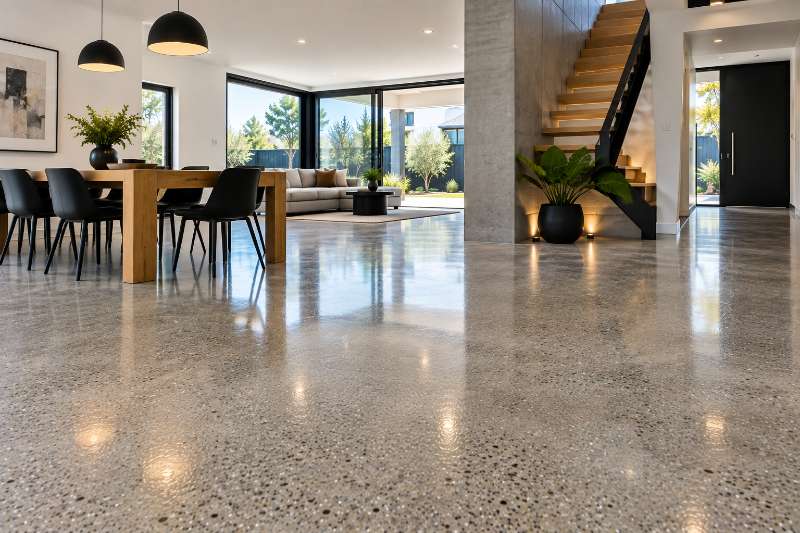
A bare slab is a starting point, not a finish. Fifteen years of finishing floors across Melbourne has taught us one thing. Most people arrive knowing they want better than raw concrete. Very few know which system their slab can actually take, or what that choice costs later. This guide sets out the main concrete floor finishes as what they really are. Four separate processes, each with its own demands on the substrate. Read it, then come and stand on the samples in our Thomastown showroom.
Why a bare slab gets finished
Raw concrete is porous. It gives off fine dust underfoot. It drinks up oil and wine and wears unevenly wherever traffic concentrates. Left alone, a slab in a busy kitchen looks tired inside two years.
Finishing fixes that two ways. The grinding makes the surface ready for the densifier or penetrative sealer to take effect. This makes the wear layer harder and seals up the pores. The second change is visual. Aggregate exposure and sheen decide whether a floor reads soft and domestic or hard and industrial. Those two settings do most of the aesthetic work. We cover them in our guide to choosing the right concrete finishes. This post stays on the systems.
Concrete polishing and the other systems explained
The concrete floor finishes we install come down to four systems. They are not variations on one process.
Mechanical polish
A mechanical polish hardens the slab with a chemical densifier. Diamond tooling then grinds it through progressively finer grits until the concrete itself carries the shine. Nothing sits on top. Only this process is polished concrete. Grind and seal and decorative overlays are sold under that name daily in this industry.
Grind and seal
The slab is ground back to roughly 200 to 400 grit. A topical sealer then goes over it. Less labour, lower cost, and far kinder to an older slab. The look leans towards a warehouse rather than a showroom.
Decorative overlays
A thin cementitious layer is trowelled over what is already there. The finish is built rather than revealed. We install ours over concrete, timber or tiles.
Resurfacing systems
Resurfacing rebuilds a worn, patched or previously coated surface before any finish goes down. It repairs a floor that failed. It is not a look in its own right.
Matching the finish to the space and slab
Start with the slab, not the photo. On site we see forty-year-old slabs carrying unfilled joints and old patch repairs. That history telegraphs through a thin topical coating inside a year. So we inspect before we recommend. Sometimes the answer is no. A cracked, oil-stained slab is not a concrete polishing candidate, and grinding will not make it one. Saying so costs us a job and saves you a floor.
Traffic decides next. Hospitality and retail floors take a beating. Venues like Grill’d, Nando’s and Industry Beans run systems chosen for wear, not shine. PrixCar’s Altona North plant needed an industrial coating with line marking. Token in South Yarra needed the opposite: a warm decorative overlay across the room.
Look comes last. It is the easiest thing to change and the worst place to start.
Frequently asked questions
1. How much does concrete polishing cost in Australia?
Grinding and sealing will cost you $50-$70 per square metre, honing $75, and mechanical polishing over $100 per square metre. Rates in Melbourne are higher. It depends on the state of your slab.
2. How long do polished concrete floors last?
A mechanical polish lasts twenty years or more, because the slab is the wear layer. Grind and seal needs refinishing every five to ten years, because its sealer is topical.
3. What is the difference between polished concrete and grind and seal?
Grind and seal grinds to roughly 200-400 grit, then a topical coating goes on. Mechanical polish uses a densifier and finer diamond tooling to harden the slab. Decide before pouring.
Book a showroom visit.
The right finish depends on the slab, then the traffic, then the look, in that order. Get the order wrong and you pay twice. Bring your plans or a photo of the floor you have. Book a visit and see the full range of concrete floor finishes in person.