TL;DR
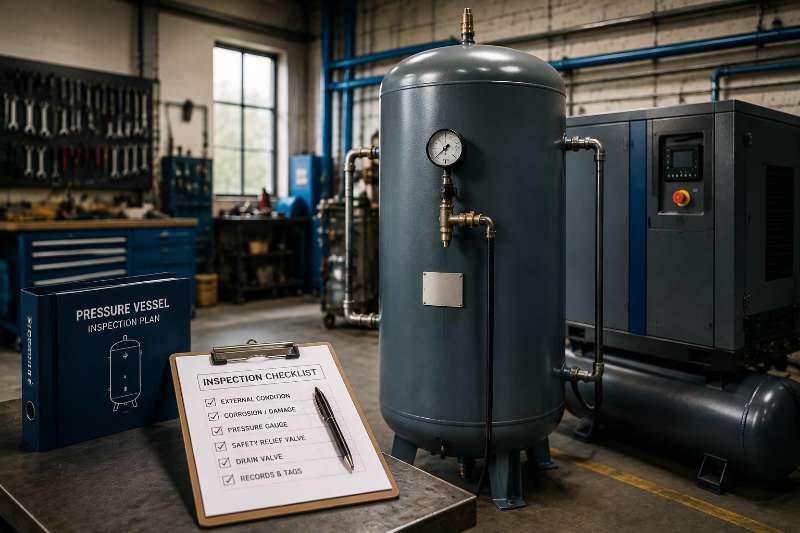
Air receiver tanks connected to industrial air compressors in NSW are classified as pressure vessels under AS 1210:2010 and must be inspected under AS/NZS 3788:2024 Amd 1:2025. External inspections are required every two years, internal inspections every four years, and safety relief valves must be bench tested annually. Operating a non-compliant receiver exposes your business to SafeWork NSW enforcement under Section 19 of the WHS Act (penalties up to $1.6M) and can void public liability insurance. The 2024 standard update explicitly mandates a written inspection plan for every vessel, not just past inspection records.
Why This Matters Right Now for Sydney Workshops
The NSW Resources Regulator issued Safety Bulletin SB24-06 after recording 15 pressurised system incidents over 18 months, including six in a single six-month window. Workers suffered injuries when assuming systems were depressurised. The bulletin explicitly named compressed air lines and called for double-block-and-bleed isolation procedures.
Simultaneously, AS/NZS 3788:2024 Amd 1:2025 introduced a critical compliance mandate: a documented, written inspection plan for each pressure vessel. Holding a simple inspection certificate with a future due date no longer satisfies regulatory standards.
Key Insights
- Current Standard: AS/NZS 3788:2024 Amd 1:2025 governs in-service pressure vessel inspection in NSW.
- Mandatory Intervals: External inspection every 2 years; internal inspection every 4 years; safety relief valves bench tested annually.
- Written Inspection Plan: The 2024 update mandates a written plan outlining inspection methods, components, intervals, and qualified personnel.
- Safety Alert: NSW Safety Bulletin SB24-06 flagged 15 pressurised-system incidents in 18 months.
- Registration Thresholds: SafeWork NSW registration depends on a vessel's $pV$ product under AS 4343:2014, not tank size alone.
- Legal Risks: Uninspected receivers violate WHS Act Section 19 and risk voiding commercial insurance policies.
What Is an Air Receiver Tank and Who Is Responsible?
An air receiver tank stores compressed air between the compressor pump and your distribution pipework. Operating quietly in the compressor room, it is easy to overlook during routine maintenance.
Responsibility lies with whoever has management and control of the workplace. In leased facilities or plant hire setups, compliance obligations rest with the host site operator. If the tank is on your factory floor and your workers use it, you are legally responsible for its compliance.
Does Your Air Receiver Need Registration in NSW?
Whether an air receiver requires item registration with SafeWork NSW depends on its hazard level, calculated via the pV product under AS 4343:2014:
pV = design pressure (MPa) x vessel volume (litres) x service factors
For standard clean compressed air, the service factor is 1.0. A 500-litre receiver operating at 1.0 MPa (roughly 145 PSI) yields a $pV$ of 500. Registration thresholds under NSW WHS Regulation Schedule 5 kick in at specific $pV$ hazard levels. A small, high-pressure vessel may require registration while a large, low-pressure tank may not. Registration verifies administrative entry with SafeWork NSW but does not replace physical inspection.
Mandatory Inspection Intervals Under AS/NZS 3788:2024
AS/NZS 3788:2024 (Table 4.1, Item 6) establishes minimum inspection intervals:
- External Inspection (Every 2 Years): A competent person evaluates the outer shell, welds, supports, connections, nameplate legibility, and visible signs of corrosion or stress.
- Internal Inspection (Every 4 Years): Requires isolating, depressurising, purging, and opening the tank. Qualified personnel inspect internal walls, welds, pitting, scale deposits, and condensate degradation.
- Safety Relief Valve Testing (Annual): Relief valves must be bench tested and recalibrated annually. Without annual bench testing, the 2-year external certificate becomes invalid.
For older tanks missing nameplates or documentation, AS/NZS 3788:2024 Clause 8.5.2 provides a compliance pathway via competent person assessment and engineering reconstruction.
The 2024 Written Inspection Plan Requirement
Holding past inspection certificates is no longer sufficient. AS/NZS 3788:2024 mandates a written inspection plan detailing:
- Specific components to be checked
- Inspection methods (visual, ultrasonic thickness testing, hydrostatic testing)
- Scheduled inspection intervals
- Required qualifications for inspecting personnel
If SafeWork NSW audits your site, handing them an old inspection sticker or certificate without a written plan constitutes non-compliance.
Compliance Risks: Regulatory Fines and Voided Insurance
- Regulatory Penalties: Operating non-compliant pressure plant breaches Section 19 of the WHS Act. SafeWork NSW can issue improvement notices, prohibition notices, or initiate prosecution. Penalties for Category 2 corporate breaches reach $1.6 million.
- Insurance Exclusions: Most industrial property and liability policies contain plant maintenance exclusion clauses. Operating uncertified pressure vessels gives insurers grounds to deny claims following an explosion or injury.
Step-by-Step Compliance Checklist
- Locate the Nameplate: Record design pressure (MPa) and volume (litres) to calculate the $pV$ product.
- Verify Registration: Check the SafeWork NSW Plant Register if your $pV$ product meets Schedule 5 thresholds.
- Audit Records: Confirm dates of the last external (2-year) and internal (4-year) inspections.
- Bench-Test Relief Valves: Ensure safety relief valves were bench tested within the last 12 months.
- Establish a Written Plan: Draft an AS/NZS 3788:2024 written inspection plan covering all pressure vessels on site.
All Air Compressors provides comprehensive pressure vessel inspection support and prepares compliant written inspection plans across Sydney and NSW. Call +61 435 166 474 to schedule an assessment.
Frequently Asked Questions
How often must an air receiver tank be inspected in NSW?
Under AS/NZS 3788:2024, industrial air receivers require external inspection every two years, internal inspection every four years, and annual bench testing of safety relief valves.
Does my air receiver require SafeWork NSW registration?
Registration depends on your vessel's pV product (pressure x volume) under AS 4343:2014 and NSW WHS Regulation Schedule 5, not tank size alone.
Who qualifies as a competent person for pressure vessel inspections?
A competent person must possess specific qualifications, pressure vessel inspection credentials, and confined space certification under AS/NZS 3788. Standard maintenance technicians are not automatically certified pressure vessel inspectors.
What is the new written inspection plan requirement?
AS/NZS 3788:2024 requires a documented plan for every vessel outlining components, inspection methods, testing frequency, and required inspector qualifications before inspections take place.
Achieve Full Compliance Today
Operating an uninspected air receiver exposes your Sydney workshop to severe safety hazards, legal fines, and denied insurance claims. All Air Compressors delivers expert site assessments, safety valve testing, and AS/NZS 3788:2024 written inspection plans.
Browse our resource hub or call our Sydney specialists on +61 435 166 474 to book your site inspection.
Written by All Air Compressors — Sydney's Compressed Air Specialists
allaircompressors.com.au | +61 435 166 474 | Sydney, NSW