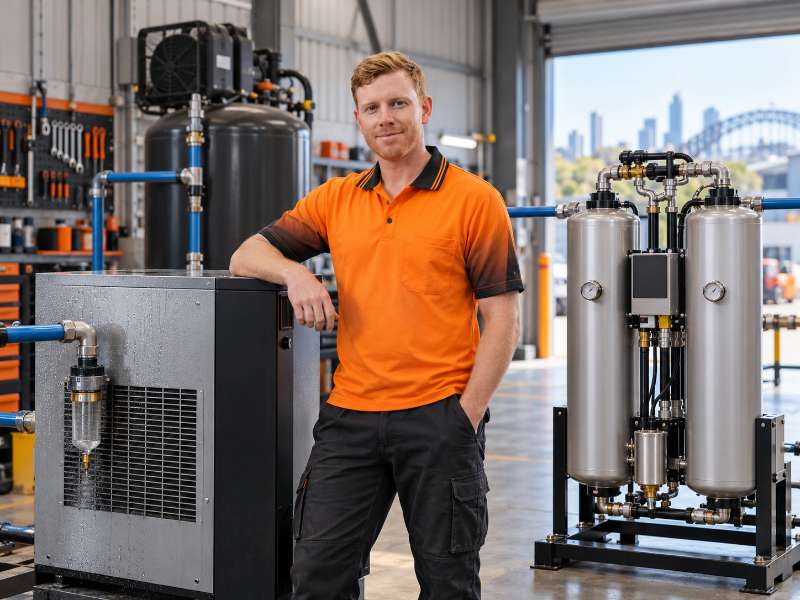
Air Compressor Dryer: Refrigerated or Desiccant and Which One Does Your Sydney Workshop Actually Need?
TL;DR
A refrigerated air compressor dryer suits most Sydney workshops: it removes bulk moisture at a pressure dew point of 3 to 10°C at lower purchase and running cost than a desiccant unit
A desiccant air dryer is required when the pressure dew point needs to go below 3°C: outdoor pipe runs, food processing, medical air, and pharmaceutical packaging all fall into this category
Sizing the dryer to match compressor rated output matters as much as choosing the right type: an undersized dryer in a 35°C Sydney summer bay will not hit its rated dew point
Annual servicing on a refrigerated unit covers refrigerant pressure check, condenser clean, and pre-filter replacement; desiccant units require bed inspection or replacement on a scheduled cycle
All Air Compressors supplies, services, and repairs both refrigerated and desiccant air dryers across Sydney and NSW
Does Your Compressor System Actually Have the Right Dryer?
Most Sydney workshops have some form of dryer fitted, but a lot of those dryers were sized for the compressor as it was originally installed. Add tools, run longer shifts, or move the unit into a hotter bay, and what was adequate before may now be passing wet air straight through to your equipment.
A compressed air dryer removes water vapour from compressed air before it reaches tools, spray lines, pneumatic valves, or production equipment. Moisture corrodes tool internals, causes paint defects in spray booths, destroys pneumatic actuators, and creates compliance failures in food processing lines. Getting the dryer type right, and keeping it serviced, is part of running the compressor correctly.
What Is the Difference Between a Refrigerated and a Desiccant Air Dryer?
A refrigerated air dryer passes compressed air through a heat exchanger cooled by a refrigerant circuit. The air is chilled to around 3°C, water condenses out, and the condensate is drained from the system. The dried air is then reheated before it enters the distribution line. The result is a pressure dew point (PDP) of 3 to 10°C, which is dry enough for most general workshop, fabrication, and automotive applications.
A desiccant air dryer passes compressed air through a bed of hygroscopic material, typically silica gel or activated alumina. The desiccant absorbs water vapour from the air down to a PDP of -40°C or lower. Twin-tower desiccant units regenerate one bed while the other is in service. Single-tower units require periodic downtime for bed regeneration or replacement.
The practical difference is this: a refrigerated dryer handles bulk moisture removal economically. A desiccant dryer is required when moisture must be removed to a level that a refrigerant circuit physically cannot reach.
Which Applications Actually Require a Desiccant Dryer?
The threshold that separates the two types is the pressure dew point your application requires. If your air stays inside a climate-controlled factory, goes to general pneumatic tools, and never contacts food or pharmaceutical product, a refrigerated dryer is the right call at lower cost.
If any of the following apply, you need a desiccant unit:
Compressed air piping runs outdoors or through unheated spaces where ambient temperature drops below the refrigerated dryer's PDP (condensation will form inside the pipe regardless of what the dryer is doing)
Your process contacts food, beverage packaging, or pharmaceutical product directly: AS/NZS ISO 8573-1:2016 Class 1 to 3 compliance typically requires desiccant-grade dryness
Medical or laboratory air lines where moisture contamination affects instrument accuracy or sterility
Moisture-sensitive coating or precision electronics manufacturing
For the majority of Sydney fabrication shops, CNC machining bays, panel shops, and automotive workshops, a properly sized and serviced refrigerated dryer handles the job without the added cost of a desiccant unit.
How Do You Size an Air Dryer for Your Compressor?
Size to your compressor's rated output plus a 20 to 25% margin. A dryer running at maximum rated flow from day one has no headroom for added tools or the performance reduction that comes with a dirty condenser or restricted pre-filter.
For Sydney workshops in western suburbs where summer temperatures regularly reach 35 to 38°C, ask your supplier for performance data at actual inlet conditions, not just standard test ratings. The rule of thumb is a 10 to 15% drop in rated capacity for every 10°C rise in ambient above the test condition. A dryer that was adequate in a 25°C environment may not be hitting its rated PDP on a January afternoon in Wetherill Park.
Check the pre-filter rating as well. Most refrigerated dryers require a 1 micron pre-filter upstream to protect the heat exchanger from oil contamination. A blocked pre-filter raises pressure drop across the whole system. The compressed air piping and line filter guide covers how that pressure drop builds across a distribution system.
What Does Air Dryer Servicing Actually Involve?
Refrigerated dryer annual service:
Refrigerant pressure check: confirms the refrigerant circuit is holding charge and the compressor in the dryer is working correctly
Condenser clean: dust buildup on the condenser fins reduces heat transfer and raises the outlet dew point; in a dusty workshop this can need attention every six months
Pre-filter element replacement: protects the heat exchanger from oil carryover; a saturated pre-filter causes pressure drop and reduces dryer efficiency
Condensate drain check and clean: automatic drain valves are a common failure point; a stuck-closed drain floods the dryer outlet; a stuck-open drain wastes compressed air
Desiccant dryer service:
Desiccant bed inspection: silica gel saturates over time and must be replaced or regenerated; service interval depends on inlet air quality and humidity load
Inlet and outlet filter replacement: particulate and oil filters protecting the desiccant beds
Regeneration cycle check on twin-tower units: confirms the switching valve and timing are working correctly; a failed valve leaves one bed in continuous service and destroys the desiccant faster
The air compressor servicing and repairs team handles both dryer types across Sydney and NSW, including units not originally supplied by All Air Compressors.
What Happens When the Dryer Is Not Maintained?
A neglected dryer passes progressively wetter air.
Moisture in tool air accelerates corrosion in impact wrench internals, angle grinder bearings, and pneumatic hose couplings. In a spray booth, water in the air line causes fish-eye defects and paint runs that require a full re-spray. In food processing lines, wet air creates a compliance risk that can trigger a shutdown. A line filter service is the downstream catch, but the dryer is where moisture removal happens first.
A refrigerated dryer running with a blocked condenser can reach a PDP of 20 to 30°C on a hot day: far above specification and producing air that is nearly saturated at ambient conditions. This failure is usually silent until a downstream problem surfaces. A scheduled annual service catches it before that point.
Frequently Asked Questions
Do I need an air dryer with my compressor?
Yes, for any workshop application beyond basic inflation. Compressed air from a piston or rotary screw is saturated with water vapour. Without a dryer, moisture accumulates in piping low points and gets pushed through to tools and processes. A refrigerated dryer is the standard fit for general Sydney workshop and fabrication applications.
What is the difference between a refrigerated and a desiccant air dryer?
A refrigerated dryer chills the air to condense and drain water, achieving a pressure dew point of 3 to 10°C. A desiccant dryer uses hygroscopic material to absorb moisture to -40°C or lower. Refrigerated dryers suit most general workshop applications. Desiccant dryers are required for food processing, pharmaceutical, medical air, and outdoor piping where the PDP must stay below ambient temperature.
How often does an air dryer need servicing?
A refrigerated dryer should be serviced annually at minimum, covering refrigerant pressure check, condenser clean, and pre-filter replacement. In dusty Sydney workshop environments, a condenser inspection every six months is worthwhile. Desiccant dryers require bed inspection and filter replacement on a 2,000 to 4,000 hour schedule depending on the unit and humidity load.
Can I add an air dryer to an existing compressor?
Yes. A dryer is a standalone component installed in the compressed air line downstream of the compressor and air receiver. It does not need to be the same brand as the compressor. The key is to size it correctly for your compressor's rated output and actual operating conditions. The compressor products and accessories range includes dryer options suited to the compressor models All Air Compressors supplies.
All Air Compressors supplies, installs, and services refrigerated and desiccant air dryers across Sydney and NSW. Call +61 435 166 474 or visit allaircompressors.com.au to discuss your application.