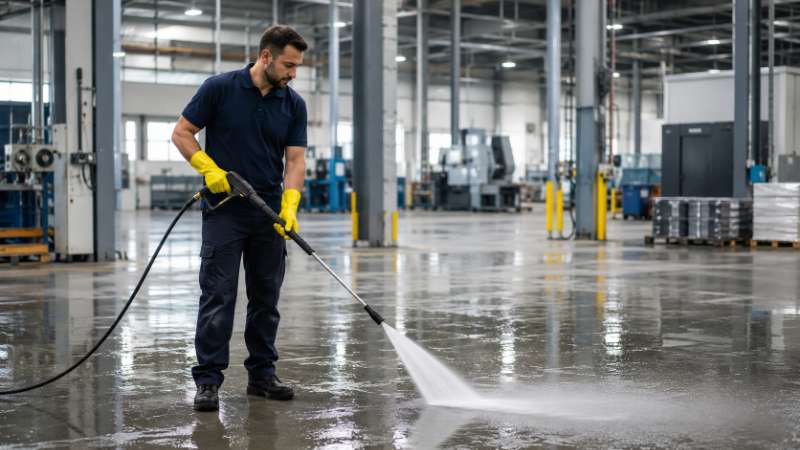
TL;DR: The most reliable signs your factory needs a deep clean are grease and oil pooling near equipment bases, dust settling on overhead beams and machine housings, slippery patches forming near workstations, drains that have started to discolour, and workers quietly steering clear of certain spots. SM&MN Cleaning routinely finds two or more of these overlapping during facility assessments across South East Melbourne. Oil residue and dust that go unmanaged are frequently linked to slip incidents and equipment breakdowns on industrial sites. SM&MN can arrange a facility assessment within the same week for sites in Dandenong, Braeside, Lyndhurst, Clayton South, Pakenham, and nearby suburbs.
Catching the signs your factory needs a deep clean before they escalate is what keeps a maintenance task from turning into a safety event. Daily mopping handles surface-level mess, but it can't touch oil that's worked its way into concrete, dust that's settled inside machine housings, or grime accumulating in drainage points that a quick wipe never reaches. If any of the five indicators below sound familiar, your site's standard cleaning routine has fallen behind what professional factory cleaning is designed to catch.
Below is what each sign looks like on the floor, and what it typically means.
Sign 1: Oil and Grease Pooling Near Equipment
Oil and grease pooling near equipment bases is among the most visible signs your factory needs a deep clean, and it's usually the first one people notice once they're looking for it.
What it looks like: A dark, faintly sticky patch on the concrete beneath a machine, often spreading a little further with every shift. A dry mop won't shift it — it takes degreasing chemicals and pressure to lift.
Oil and grease rarely stay on the surface for long. They work their way into porous concrete over time, which explains why daily sweeping never quite clears it fully. SM&MN's crews rely on pressure washing and commercial-grade degreasers to strip out what a standard mop simply can't reach. Left unattended, that residue turns into an ongoing slip risk — and Victoria's Occupational Health and Safety Act 2004 places a legal obligation on employers to eliminate or minimise slip and fall risks wherever reasonably practicable, with WorkSafe Victoria identifying slippery or uneven floors as a leading cause of workplace falls. Beyond the safety angle, prolonged oil exposure can also degrade floor coatings, turning a routine clean into a costlier repair job down the line.
What to do: If a stain has persisted beyond a week and keeps returning after mopping, it's beyond what mopping alone can fix.
Sign 2: Dust Settling on Machinery and Overhead Surfaces
What it looks like: A grey film coating beams, light fixtures, ductwork, or the tops of machine housings — spots that stay out of sight unless someone's up on a ladder.
Overhead dust often goes unnoticed simply because it's outside normal eye level, but it works its way into machinery intakes and electrical components, potentially affecting equipment performance and, depending on the environment, indoor air quality. This isn't purely a tidiness issue — the Occupational Health and Safety Regulations 2017 (Victoria) cover airborne dust and other hazardous substances under Part 4.1, and WorkSafe Victoria has flagged that neglected housekeeping can turn into a secondary exposure risk when accumulated dust gets disturbed by sweeping or foot traffic. Clearing it properly requires dusting equipment built for height, not the tools used in a typical daily tidy-up. That gap — reaching ceiling level and machine internals rather than just what's visible at ground level — is what separates a mop-and-bucket routine from genuine dust management.
What to do: Look at the top of your tallest piece of equipment or under the nearest overhead beam. A visible layer there means it's been accumulating for well longer than a single shift.
Sign 3: Slippery Patches or Uneven Traction Near Workstations
What it looks like: Scuff trails fanning out from a workstation, a subtle sheen where foot traffic concentrates, or a stretch of floor that just feels different to walk on compared to the rest of the space.
Of the five signs, this is arguably the most pressing, since it ties directly into worker safety rather than just appearance. WorkSafe Victoria's guidance on preventing slips, trips, and falls recommends ongoing inspection and upkeep of floor surfaces as a key control, and specifically advises that spills get cleaned immediately rather than waiting for the next scheduled clean. Foot traffic moving repeatedly across a residue-affected patch tends to press contaminants further into the surface, and mopping often just spreads that film thinner instead of removing it. Pressure washing, by contrast, lifts what's genuinely embedded — the foundation of a proper factory floor cleaning service, as opposed to a surface-level wipe.
What to do: Check the floor at the close of a shift rather than the start. Traction problems tend to show up most clearly after a full day's use, before the next clean covers them up again.
Sign 4: Buildup Around Drains, Loading Docks, and Transition Points
What it looks like: Discoloured or hardened residue where the factory floor meets a drain, loading dock, or external threshold — zones that absorb the combined wear of vehicles, product movement, and foot traffic.
These transition points take the heaviest combined use on-site, yet they're often the last area a routine clean actually reaches, simply because they're awkward to service. WorkSafe Victoria's housekeeping recommendations for industrial workplaces specifically call for regular drain inspection and clearing, since blocked or contaminated drainage adds to both slip risk and overall site cleanliness. Across the South East Melbourne sites SM&MN services, these zones are consistently among the first things flagged during an on-site walkthrough, since buildup here tends to compound fast.
What to do: If drains are draining slowly, look discoloured, or carry a different smell than the rest of the facility, that's a sign the cleaning routine isn't getting to them.
Sign 5: Employees Quietly Avoiding Certain Spots
What it looks like: No formal report, no logged complaint — just a pattern where staff take the long way round, set out a warning cone unprompted, or refer to a section of floor as "the bad spot" in conversation.
This is the least obvious of the signs your factory needs a deep clean, and the one most likely to slip past notice, since it never lands on a maintenance report. Still, informal avoidance is often a dependable early warning that a section of floor has shifted from "needs attention" to "feels unsafe" in the eyes of the people using it daily.
What to do: Ask your floor supervisor directly if there's a spot people tend to avoid. A quick, confident answer usually tells you everything you need to know.
What Happens During an SM&MN Factory Assessment
A facility assessment isn't a sales visit dressed up as a walkthrough — it's a structured check aimed at pinpointing exactly which signs your factory needs a deep clean are showing up on-site, and how advanced each one is, before any cleaning plan gets put forward.
From there, the response is tailored to what's found. Overhead surfaces, walls, and machinery are cleared using industrial vacuums and dusting tools designed to remove buildup that can affect air quality and equipment function. Heavy machinery gets cleaned and sanitised to cut contamination risk without interrupting how it operates. On the floor itself, pressure washing removes embedded grease and grime that daily mopping simply doesn't reach, using eco-conscious products that keep the site safe for staff the whole way through.
Most facilities need this kind of attention on a recurring schedule rather than as a one-time fix — monthly or quarterly is common for general cleaning, with high-traffic zones, machinery, and loading docks often requiring more frequent passes to stay ahead of buildup. SM&MN structures that schedule around what the assessment turns up, rather than defaulting to a fixed package.
FAQ
Q: How do I remove oil stains from a factory floor? A: Surface-level oil can often be lifted with a degreaser and stiff brushing, but oil that's penetrated the concrete needs pressure washing paired with industrial-strength degreasing agents to clear fully. If a stain keeps coming back after mopping, it's sitting below the surface, and mopping won't resolve it.
Q: How often should a factory floor be professionally cleaned? A: It varies by operation, but monthly or quarterly is typical for general cleaning, while high-traffic areas, machinery, and loading docks usually need more frequent attention to stay ahead of buildup and safety risks.
Q: What are WorkSafe Victoria's requirements for factory floor cleaning? A: Under the Occupational Health and Safety Act 2004 and the OHS Regulations 2017, Victorian employers are required to eliminate or minimise slip, trip, and dust exposure risks so far as reasonably practicable — which in practice means regular floor upkeep, prompt spill response, and routine drainage checks.
Q: Is industrial floor cleaning near me available for same-week booking? A: SM&MN offers same-week facility assessments across South East Melbourne, covering Dandenong, Braeside, Lyndhurst, Clayton South, and Pakenham, with scheduling arranged around your operating hours.
Q: Will a factory cleaning service disrupt our production schedule? A: SM&MN works around your operating hours and can stage the cleaning across zones, so sections get cleaned without needing to shut the whole floor down.
Q: What equipment is used for factory floor cleaning? A: Industrial pressure washers, commercial floor scrubbers, industrial-grade vacuums, and dusting tools built for high ceilings and machine housings — a different tier of equipment to mops or consumer-grade gear.
The signs your factory needs a deep clean rarely arrive all at once — they build up gradually until routine mopping simply can't keep pace anymore. If two or more of these signs are showing up on your floor, it's a strong indicator that standard mopping has already fallen behind. A professional assessment lays out exactly what's accumulated, where it is, and what it'll take to resolve — ideally before it turns into a safety incident, a compliance concern, or equipment damage. Reach out to SM&MN's factory cleaning team to arrange a facility assessment and see where your site currently stands.