It usually starts with the bathroom mirror. You catch the sides looking a bit fluffy, the neckline has disappeared and suddenly tomorrow’s 9am meeting feels much closer than it did five minutes ago. The barber is shut. Naturally. This is exactly when having decent hair clippers at home becomes less about becoming your own barber and more about being able to clean yourself up without making things noticeably worse. ConairMan’s head-grooming range includes tools aimed at everything from simple all-over cuts to fades and head shaving, so there’s room to keep things as basic or as ambitious as you like.
First rule: don't suddenly become creative
Sunday night is not the time to discover your artistic side.
If you normally wear a tidy crew cut, do that.
If your hair is short on the sides and a little longer on top, work within that shape.
Do not stare at a photo of some bloke with a perfect skin fade and decide you’ll “have a crack”.
You might pull it off.
You might also spend Monday explaining why you’re wearing a cap indoors.
The safest home haircut is usually a maintenance job, not a reinvention.
That means cleaning up obvious growth, evening out the sides and sorting the back of the neck. Keep the goal modest and things get much easier.
Start longer than you think
There is a universal home haircut experience.
You pick a guard.
You look at it.
You think, “Yeah, that seems about right.”
Then one pass later you realise hair looks considerably shorter when it is no longer attached to your head.
So start longer.
You can always go shorter afterwards. Strangely enough, the reverse process remains unavailable.
Clipper comb guides are designed to hold hair at a set distance from the blade, which makes them much more forgiving than cutting freehand. ConairMan's own clipping instructions recommend choosing the desired guide first, keeping it flat against the scalp and working slowly through the hair rather than forcing the tool.
That last bit matters.
Slowly.
This is not mowing a lawn before it rains.
The back is where confidence goes to die
The sides are easy because you can see them.
Then you reach the back.
Suddenly you're holding one mirror, looking into another mirror and moving your hand in what appears to be the opposite direction to reality.
It's weird.
Actually, scratch that. It's infuriating the first few times.
The easiest approach is to stop trying to make every pass perfect. Work in sections. Start low at the nape and move upwards towards the crown. Go against the direction of hair growth and let the guard stay in contact with the scalp.
ConairMan recommends this upward and outward motion for an even cut, then working around the sides and top once the back is under control.
Use your free hand to feel for patches too.
Your fingers will often find a missed strip before your mirror does.
Don't keep attacking the same spot
This is where people get themselves into trouble.
You notice one slightly darker patch.
So you run over it again.
Still there.
Again.
Still there.
Now the surrounding area is shorter and the original patch looks even darker.
Congratulations. You have created a project.
Sometimes hair lies in a different direction around the crown or sides. Instead of endlessly running the clipper over the same path, approach the area from another angle.
Go across it.
Then diagonally.
Light pressure.
You'll probably find the hair gets picked up properly without having to dig the blade into your scalp.
And if you're using a guard, keep it sitting flat.
Tilting it halfway through a stroke is one of those little movements that can turn a tidy trim into a very specific bald patch.
Around the ears deserves patience
Nobody enjoys this part.
The ear appears to be exactly where the clipper needs to go.
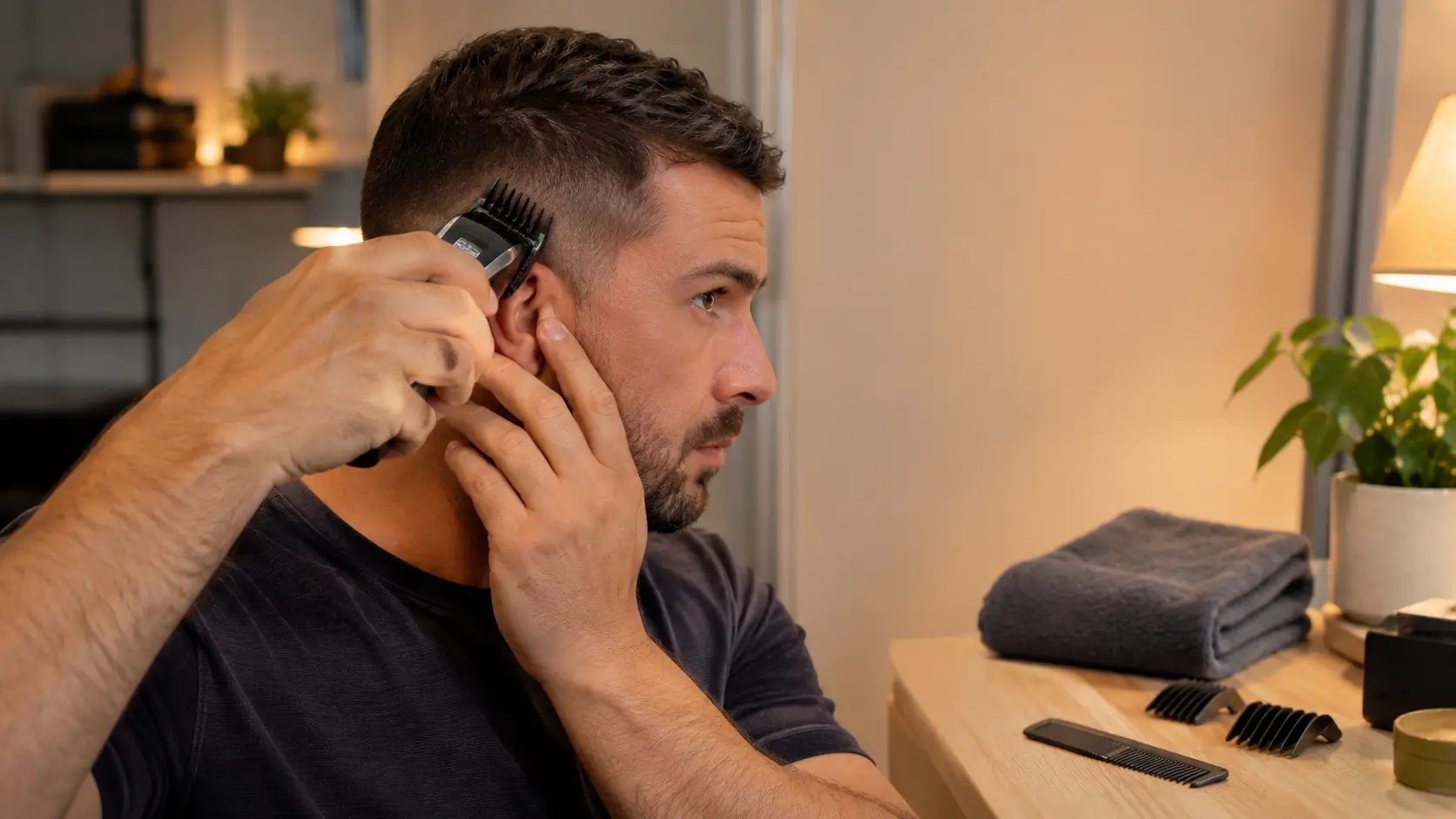
Move it gently out of the way with one hand and use short strokes around the edge. Some clipper systems include taper or ear guides specifically for this job, and ConairMan's instructions recommend working gently around the ear rather than trying to take one heroic sweep through the whole area.
Don't rush.
Five careful extra minutes here beats spending the next fortnight pretending you always intended one sideburn to sit higher than the other.
The neckline doesn't need to be ruler straight
This is another trap.
You're staring at the back of your head thinking the line needs to look absolutely perfect.
It doesn't.
It needs to look tidy.
Natural necklines have slight curves. Chasing an unnaturally straight line can result in trimming it higher and higher while trying to correct tiny differences.
Then you've got half a centimetre of neck hair left and a growing sense of concern.
Clean the loose growth below the natural line.
Stop.
Walk away.
Seriously.
Clean the clipper before putting it in the drawer
By this stage the sink looks like somebody shaved a small dog in it.
You've showered. The haircut looks decent. You're done.
Almost.
Hair collects around clipper blades and inside some cutting heads. ConairMan's instructions for its head-clipping tools specifically note that accumulated hair may need to be removed during use.
Brush the loose hair out before storing the tool. Follow the cleaning directions for the particular model you own, since some grooming tools have different maintenance requirements.
It takes a minute.
Future you will appreciate not opening the drawer three weeks later and finding a small archaeological site of old hair inside.
Know when you've done enough
This is probably the hardest skill in home grooming.
Stopping.
You notice one hair.
Then another.
Then you start inspecting the temples from four centimetres away under bright bathroom lighting.
Nobody else is seeing your head like that.
Step back.
Look at the whole haircut.
If the shape is even, the edges are tidy and nothing looks obviously strange, you're finished.
Home clipping gets much easier once you stop expecting barber-level perfection every time. You're maintaining a haircut, saving yourself an emergency appointment and keeping things presentable between proper cuts.
And if you slowly get better at fades or more detailed work later, great.
Just maybe don't practise the complicated stuff at 10:45pm on a Sunday