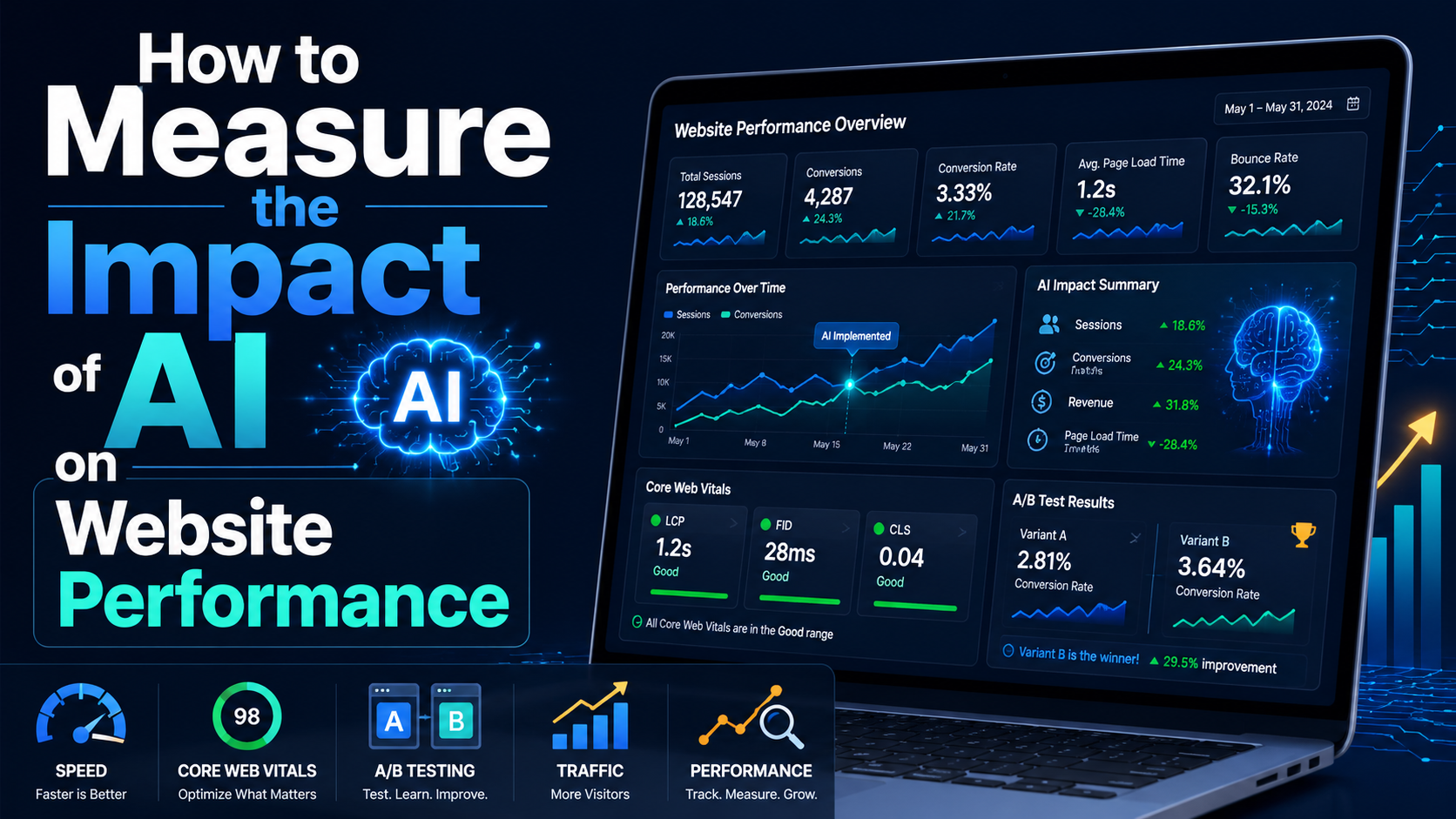
Most teams that add AI to a website can't say what it actually did. They can point to a chatbot sitting on the pricing page or a recommendation block above the footer, and they can point to a quarterly revenue figure. The line connecting those two things is usually guesswork.
The tooling isn't the problem. Measurement gets messy because AI features change several things at once, and a standard analytics setup was never built to pull those threads apart.
Get a baseline nobody can argue with
Before a model ships, record what the site does without it. Four weeks of data at minimum: conversion rate, bounce rate, average session duration, and load times, all segmented by device and traffic source.
Four weeks matters because weekly seasonality is real. B2B traffic falls off a cliff on Saturdays; retail spikes on Sunday evenings. A two-week baseline will flatter or punish an AI feature depending on which day it launched.
Store those raw numbers somewhere outside the analytics platform. Dashboards get reconfigured, attribution windows get edited, and six months later nobody can reproduce the "before" picture.
A dated spreadsheet works fine. For a deeper walkthrough of the tracking side, read about measuring AI website optimization on Uxify.com.
Pick metrics that respond to what changed
Speed comes first, because AI features ship as JavaScript and JavaScript has weight. Google's Core Web Vitals give three usable numbers: Largest Contentful Paint under 2.5 seconds, Interaction to Next Paint under 200 milliseconds, and Cumulative Layout Shift under 0.1.
A personalization script that rewrites the hero section after page load is a classic layout-shift offender. Teams watch engagement climb 4% on desktop while it drops 9% on mid-range Android phones, then blame the model when the real culprit is a 340KB bundle.
Lab scores and field data will disagree, and the field data wins. A synthetic test on a wired connection in Frankfurt says nothing about a shopper on 4G in São Paulo, which is exactly where a chunky AI widget does its damage. Real user monitoring, sampled continuously, is the version worth reporting to anyone.
Behavioral metrics come next: task completion rate, scroll depth on personalized pages, and search refinement counts (how many times someone rephrases a query before giving up). These say far more than session duration, which rises both when people are engaged and when they're lost.
Separate the AI's effect from everything else
Split testing is the only honest answer here. A/B testing has been standard practice in product work for two decades, and AI features deserve the same treatment: half the traffic gets the recommendation engine, half gets the old rules-based version, and the gap between them is the effect.
Keep a permanent holdout group of 5% to 10% who never see the feature at all. A competitor's price cut, a seasonal swing, or a Google core update hits both groups equally, so that gap stays meaningful long after launch week.
And measure across 90 days, not 14. Novelty effects are real: click-through on a new recommendation widget often jumps in week one, then settles 30% below that peak by week six.
Count what it costs
Inference isn't free. Track cost per session next to the revenue lift, including API charges, added latency, and the engineering hours spent tuning prompts or retraining. A recommendation engine that lifts average order value by 3% while adding 400ms to every page load can easily be a net loss.
Quality failures belong in the same ledger. Log the rate at which a chat assistant hands a session to a human, how often shoppers ignore every recommended product, and how many support tickets mention the AI feature by name. Those three numbers usually surface a problem weeks before the conversion rate does.
Organizational friction shows up in the numbers too. Research published in Harvard Business Review found that AI efforts stall when companies run them as ad hoc projects rather than owned systems, and half-owned features tend to drift and quietly stop earning their keep.
Where this goes next
The measurement problem gets harder as AI moves out of visible widgets and into ranking, routing, and generated copy, where there's no obvious button to attribute anything to. Teams that build the discipline now, with clean baselines and permanent holdouts, will still be able to answer the question in two years.
Everyone else will keep pointing at a dashboard and hoping.