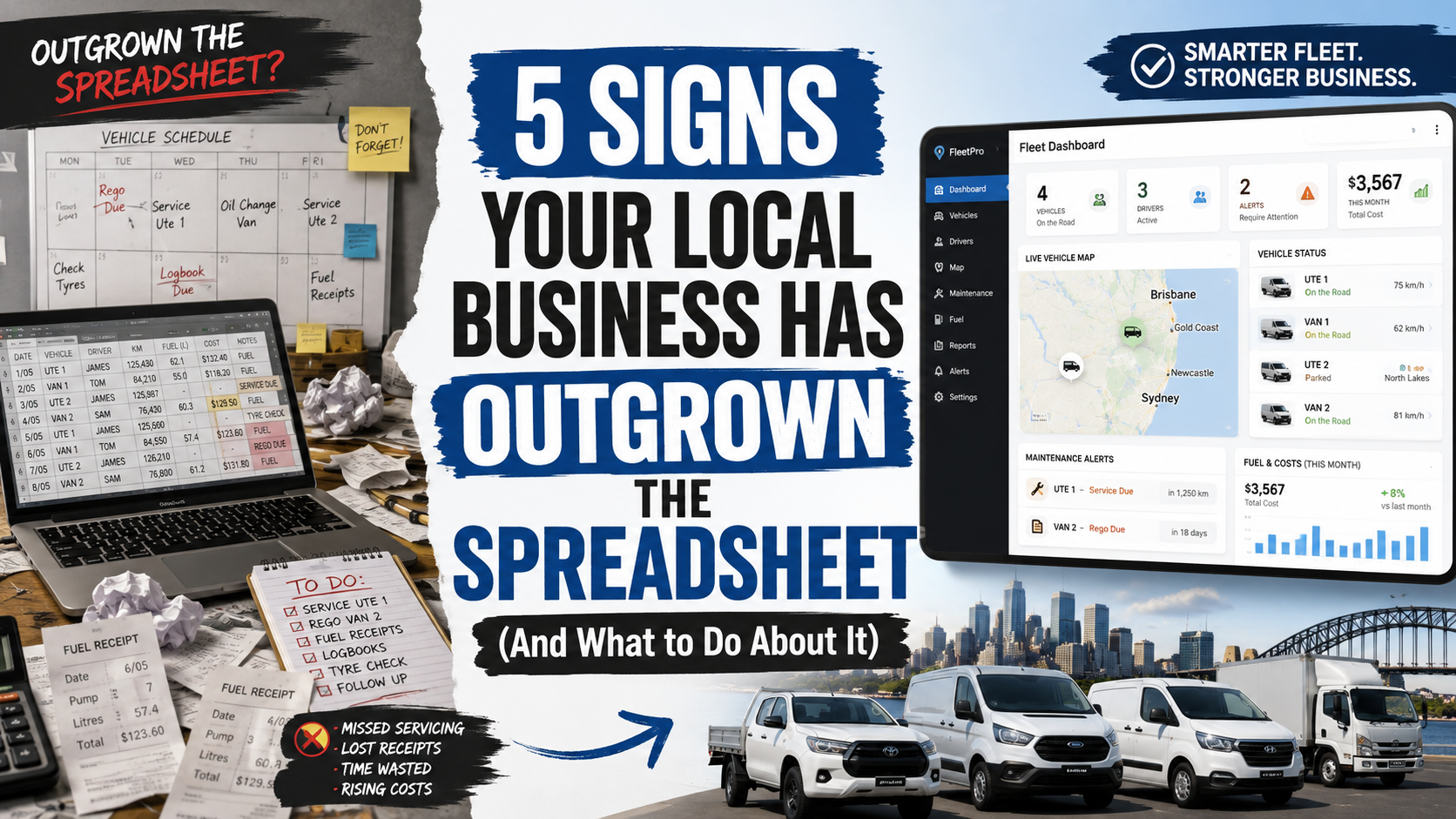
Every local business owner remembers the first van. Maybe it was the first ute, or the first delivery car. One vehicle is easy - you know where it is, you know when it's due for a service, and if something goes wrong, you hear about it within the hour.
Then you buy a second vehicle. And a third. Somewhere around vehicle four or five, most Australian small businesses realise the whiteboard and the shared calendar aren't cutting it anymore. It's rarely a dramatic breaking point - it's a slow leak of time, money and control that's easy to miss until you add it all up.
Here are five signs your business has quietly outgrown the spreadsheet, and what to actually do about it.
You're Finding Out About Problems After They've Already Cost You Money
A service gets missed and a vehicle breaks down mid-job. A rego lapses and someone gets pulled over. A driver's been idling for twenty minutes outside a job site and nobody notices until the fuel card statement arrives.
None of these are huge mistakes on their own. But when a business relies on someone simply remembering to check things, the cost shows up later - as a tow bill, a lost afternoon, or an awkward call explaining why the job's running late. This is usually the point where businesses start looking at proper fleet management solutions instead of another shared spreadsheet - software that flags a problem before it becomes an invoice, not after.
Fuel and Running Costs Keep Creeping Up, and Nobody Can Say Why
Fuel is one of the biggest ongoing costs for any business running vehicles, and one of the easiest to lose track of. Light commercial vehicles - utes, vans and cab-chassis - make up the overwhelming majority of Australia's business vehicle fleet, according to the Australian Bureau of Statistics, and fuel spend across a fleet that size adds up fast when nobody's watching routes, idling time or driving habits.
Without visibility, "the fuel bill went up again" is about as specific as it gets. With it, you can usually point to exactly which vehicle, which route or which habit is costing the business money - and fix it.
You Can't Answer "Where's the Van?" Without Calling the Driver
It sounds like a small thing until a customer calls asking where their tradesperson is, and the honest answer is "let me check." Real-time location isn't about micromanaging staff - it's about being able to answer a simple customer question without a round of phone tag, and being able to send the nearest available vehicle to an urgent job instead of guessing.
Compliance and Paperwork Are Starting to Feel Risky, Not Just Annoying
As a fleet grows, so does the admin - logbooks, service records, registration renewals, vehicle expense claims. The ATO's logbook method alone requires accurate, continuous trip records to substantiate a claim, and reconstructing twelve weeks of data from memory at tax time is a headache most business owners would rather skip. When that record-keeping happens automatically instead of manually, it stops being something you dread every June.
Growth Feels Harder Than It Should
This is the real tell. A business should get easier to run as it grows, not harder. If every new vehicle you add comes with a proportional increase in admin, phone calls and stress rather than just capacity, that's a sign the systems underneath the business haven't kept pace with it. Trades and service businesses in particular - where a growing number of local operators run multiple vehicles across multiple jobs a day - tend to hit this wall earlier than most.
What Good Fleet Management Actually Looks Like
Strip away the sales pitch, and effective fleet management comes down to a handful of practical things: knowing where every vehicle is in real time, getting alerted to maintenance needs before they cause a breakdown, seeing fuel and running costs broken down by vehicle rather than guessed at, and having compliance records that build themselves in the background instead of piling up for tax time.
None of this requires a large business or a dedicated fleet manager. It just requires the right system doing the watching, so people don't have to.
The Bottom Line
If more than one of these signs sounds familiar, it's not a failure of management - it's just what happens when a business grows past the point a whiteboard can handle. The good news is that fixing it isn't a huge undertaking. It's usually a matter of swapping informal tracking for a proper system, and letting the data do the work that used to rely on memory and good luck.